See All Locations



Microsoft believes in what people make possible. Microsoft’s mission is to empower every person and every organization on the planet to achieve more. Did you know Microsoft spends over $1B in R&D on Security every year? With Enterprise Mobility + Security solutions, Microsoft has leveraged it’s investments to quickly become the market leader in protecting companies from the latest security challenges while enabling employees to remain productive on their favorite devices and applications. Over 56,000 companies have already partnered with Microsoft to implement an identity-driven security solution that offers protection without compromising productivity.
Most businesses are adopting cloud services from multiple providers to remain flexible, agile, efficient, and competitive, but many do not have enterprise-wide control over and visibility of tens of thousands of cloud access permissions, exposing the enterprise to risk of security breaches.

Establishing a verified digital identity is crucial to successful business collaboration and customer engagement in the digital economy. Verifiable Credentials provide a highly secure way of establishing digital identity. However, knowing exactly how to begin using this approach can be challenging.
Join us to understand how Zero Trust transforms your security strategy and makes you more resilient to a range of attacks. We will share a roadmap for leaders, architects, and practitioners, as well as talk about some quick wins and incremental progress on this journey.

Even though companies need to implement Identity Governance & Administration (IGA) solutions in order to stay compliant and support their security, the deployment of IGA solutions still poses a challenge to many of them. Delivering a frictionless experience for users and employees while efficiently managing identities and access entitlements are key to a successful deployment.
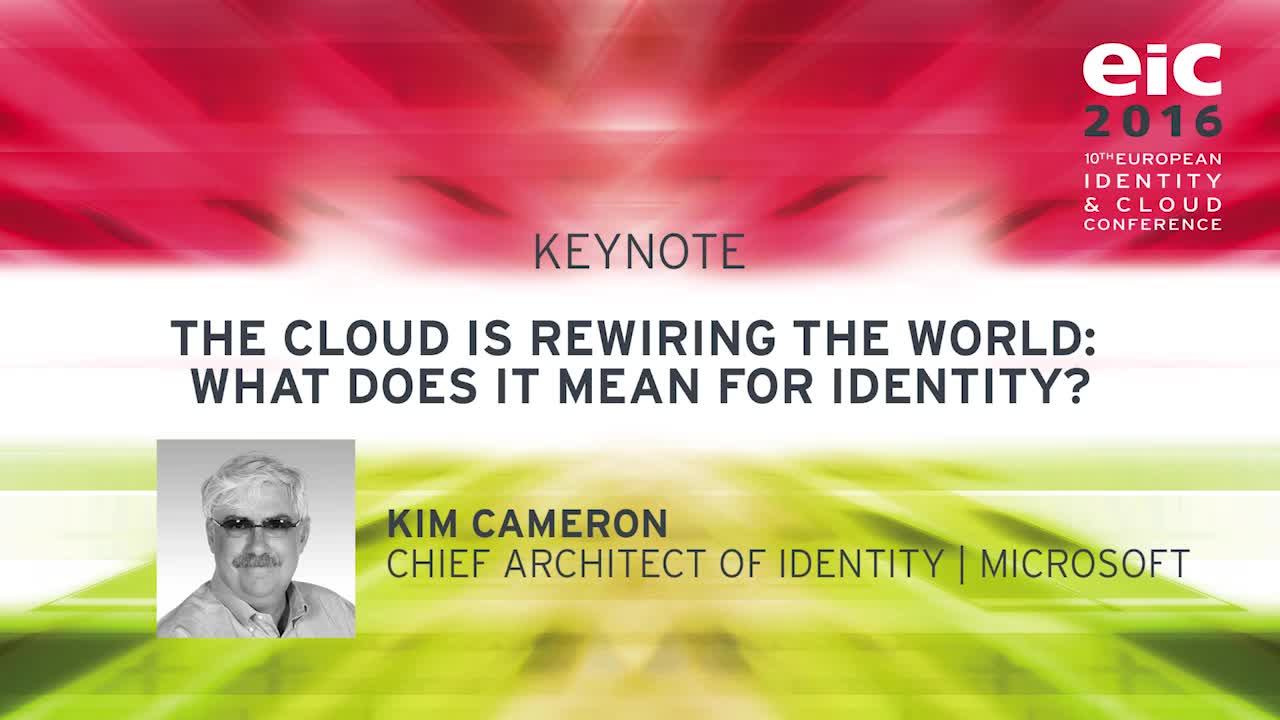
The Cloud is turning out to have important “emergent properties” – features not previously observed in computing systems, never imagined by cloud architects, and not yet widely discussed or understood. They will be key to determining which strategies prevail in meeting cloud era challenges. Kim Cameron discusses how this impacts the world of identity – leading to better applications and simpler identity solutions for people and things.
Keynote at the European Identity & Cloud Conference 2015

Connecting with external users and other businesses, being agile, delivering to the business. However, when thinking about using Microsoft Active Directory as pure foundation, security and segregation issues, scalability in the heavily replicated environments, or schema changes are common challenges. But not only that: How to manage access to Cloud services based on that? On the other hand, Active Directory is here to stay, as foundation for the on premise part of IT. Organizations thus must find their way for extending and leveraging their investments.
Martin Kuppinger, Principal Analyst at KuppingerCole, will describe the evolving market segment for Cloud IAM, integrated solutions that support user and access management in the Cloud. He will describe the requirements of such services. He also will explain how to extend the existing Active Directory to the Cloud by relying on Cloud IAM. And he will look at other options to achieve this target.
In the second part of the sessions, Kim Cameron of Microsoft will talk about the Microsoft strategy for extending Microsoft Active Directory (AD) with Microsoft Windows Azure Active Directory (WAAD). They will talk about the strategy, added services, integration options, and explain the differences and similarities between classical on premise AD and WAAD.
This is a must-attend webinar for everyone being responsible for Microsoft Active Directory infrastructures today, explaining the evolutionary path for these environments towards the new ABC.

Secure Information Sharing with business partners is a long-lasting challenge for organizations. There have been some solutions out for a longer term, including on-premise Information Rights Management (IRM) solutions. Unfortunately, until now these solutions struggled with support for heterogeneous environments, document formats, and onboarding of external users. This is changing now.
Martin Kuppinger, Principal Analyst at KuppingerCole, will give an overview of the requirements and current solutions for Secure Information Sharing, from various types of IRM approaches to secure data rooms, indicating the strengths and weaknesses of such approaches. He then will look at more detail into requirements of Secure Information Sharing on enterprise-scale, to cover all various requirements.
In the second part of the session, Dan Plastina of Microsoft will explain the Microsoft strategy on their IRM and look at their partner ecosystem. This will give more detailed information on how to do that. He will also have a look at specific requirements and security concerns especially Non-US customers are raising in this “post snowden era”.