



In the first two blog posts of this series on deepfakes, I focused on the threat itself. I discussed what deepfake attacks look like today and how cybercriminals build campaigns around them. The next practical question is how organizations can procure deepfake protection.
Deepfake detection is no longer arriving as one clearly defined product type. Recent UK government market research indicates that, although the sector is still in its early stages, it is already spreading across 7 operational use cases. These include fraud prevention, identity and age verification, content moderation, misinformation and manipulation detection, secure real-time communications, brand protection, and law enforcement. This tells us something important. The market is not converging on one delivery model or use cases. Rather, it is fragmented into several delivery models and use cases.
Standalone Deepake Detection Platforms vs. FRIP vs. IDV
According to my initial research, deepfake detection is offered in three ways. First, there are standalone Deepfake Detection platforms that primarily analyze suspicious media. Second, broader Fraud Reduction Intelligence Platforms (FRIP) embed deepfake detection into their workflows. Third, Identity Verification (IDV) platforms use deepfake aware liveness, selfie matching, and document checks during onboarding and authentication. Also, a wider set of adjacent solutions, such as content moderation, brand protection, and investigative workflows, now include deepfake detection capabilities. However, these adjacent solutions are not investigated in this blog.
The distinction among Deepfake Detection tools matters since buyers are choosing not just a feature, but also an operating context. Standalone deepfake detection platforms are the most direct expression of this market. These tools are designed to examine suspicious audio, video, and image content. They are also moving toward analyzing live and recorded communications. The UK government’s research defines this use case as ensuring the authenticity of video and audio to prevent deepfake enabled impersonation in corporate and government communications. This indicates that the market is shifting from analyzing static files and media. This is one of the more innovative shifts in the market. Detection is moving from offline forensics toward real-time decision support. The same UK study notes that providers are investing not only in FRIP and IDV, but more recently in video conferencing security. Most incidents do not begin with a viral fake video on a public platform. They begin with a call, a hiring interview, or a trusted internal communication. A detector that only works after the incident is already late for many of those use cases.
The market is also moving toward layered detection approaches that combine machine learning (ML), multimodal analysis, and real-time processing instead of relying on a single signal. NIST’s 2026 deepfake evaluation program makes a similar point from a different angle. It is developing challenging, operationally relevant benchmarks as current detectors perform poorly when transitioning from academic testing to real-world use cases. In other words, innovation is not only about detecting more fakes. It is also about detecting them under pressure, against more realistic manipulations, in a timely manner, and in workflows where the cost of delay is high.
FRIPs approach the issue differently. Rather than asking, "Is this media fake?" they ask, "Should this transaction, session, claim, call, or account activity be trusted?" In this model, deepfake detection is just one part of a broader fraud decision-making process. According to UK government research, fraud prevention is one of the most common focuses among vendors, and there is strong demand for it from the banking, financial services, and insurance sectors. These platforms already operate at the intersection of attack vectors, including impersonation, account takeover (ATO), synthetic identity abuse, and financial deception. This is also why I think broader FRIPs may be a good alternative for large enterprises, as long as the solutions can match the quality of detection with that of the specialist vendors. For a large bank, fraud and deepfake abuse are not two separate operational problems. Rather, they are often different expressions of the same trust problem. If one platform can address voice fraud, ATO, identity risks, and deepfake impersonation, the value of integration is clear. However, that "if" is an important nuance. Buyers should determine whether deepfake detection performs at the required level in the channels where fraud occurs.
IDV services offer a narrower functionality when it comes to deepfake detection. Their main concern is determining whether the person presenting themselves is genuine and whether the document is authentic. FIDO’s face-verification certification clearly defines this operational boundary. It focuses on selfie matching systems and tests for threats such as deepfakes, liveness, and biometric matching. This is why IDV services are highly relevant to deepfake defense but usually in a more limited way than standalone deepfake detectors. In my opinion, IDV services are most effective during onboarding, account recovery, authentication and periodic Know Your Customer (KYC) verification processes, rather than in broader media analysis or communication monitoring scenarios.
Standalone Deepfake Detection Market Overview
The standalone segment appears to be heavily dominated by startups rather than established companies. The strongest evidence of this is the UK government’s market mapping. The mapping identified 59 third-party providers globally and found that 83% of them were micro or small enterprises. It also noted that many dedicated providers remain in the pre-seed or seed stages and that only one dedicated provider was at the Series A stage as of March 2026. This does not mean that larger platform vendors are absent. It does mean, however, that the dedicated specialist end of the market is still mainly led by younger firms rather than large vendors.
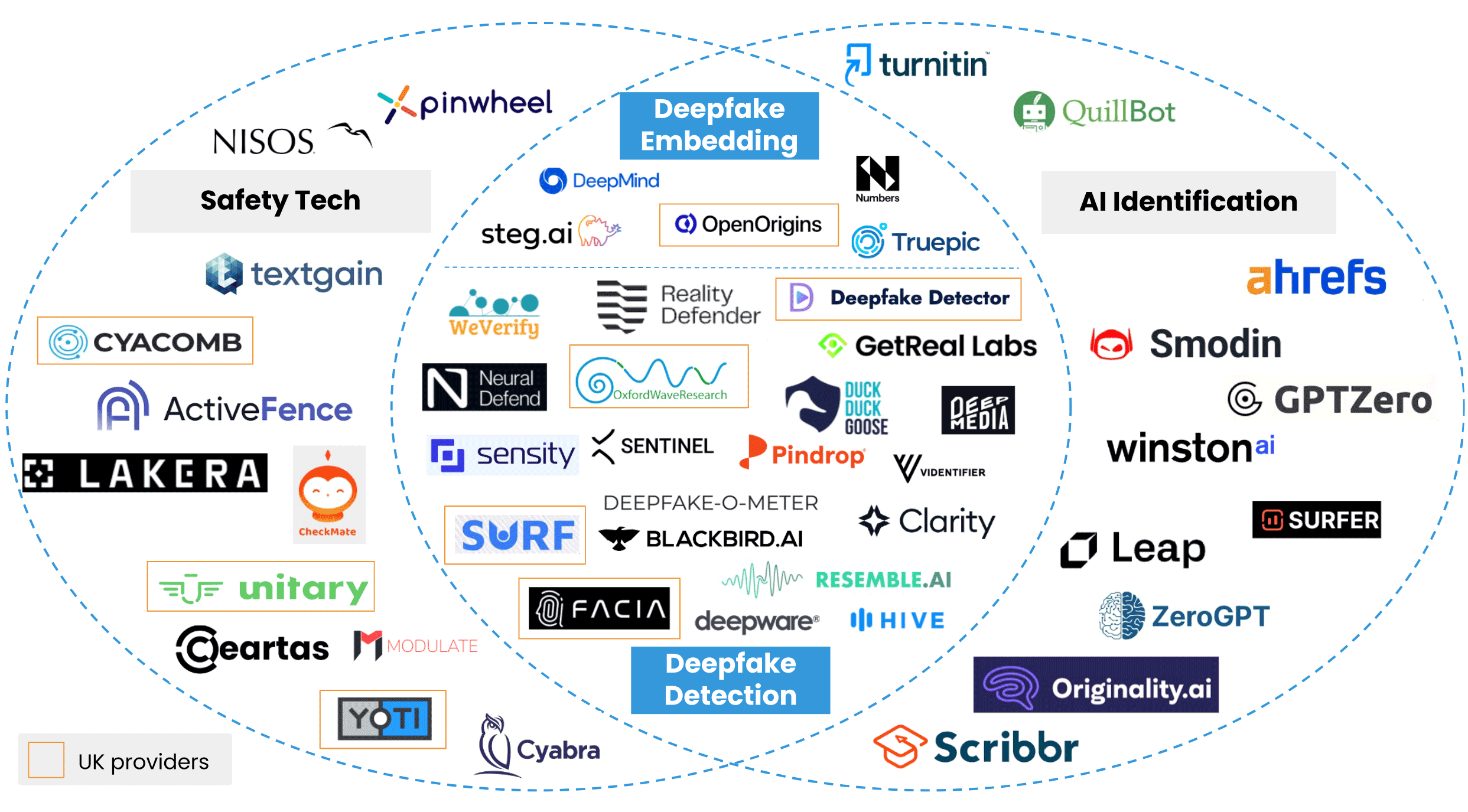
Deepfake Detection Providers Mapped by UK Department for Science, Innovation & Technology
Personally, I believe there is still significant opportunity for investment in this area as a vendor. The UK government research highlights technical costs, limited representative training data, and variability in testing datasets and accuracy metrics as barriers to maturity and buyer confidence. NIST’s work points in the same direction. The deepfake detection market is not mature. It is a market in which better technology, benchmarks, and product engineering can create significant differentiation.
Conclusion
For me, the takeaway is simple. Standalone deepfake detection platforms are ideal for organizations that require specific capabilities, such as suspicious media verification or executive communication protection. However, FRIPs may be better suited to larger enterprises if they can provide specialist level detection and integrate it into broader fraud workflows. IDV services are most relevant for onboarding, authentication, KYC, and document or biometric trust. The right choice depends less on the tool category and more on where deception enters the organization. Therefore, the deepfake detection market is not moving in one straight line. Today, deepfake detection is less of a single product category and more of a control layer that spreads across the broader cybersecurity and digital trust stack. Some organizations might want to procure this layer as a standalone solution. Others might want to procure it as part of larger platforms. However, ignoring it is no longer a serious option.
Finally, if you have the time, I highly recommend reading the UK study and reviewing the links to our FRIP for eCommerce, FRIP for Finance, and IDV research for a more in-depth understanding of the market dynamics.









