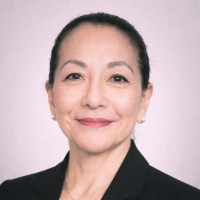
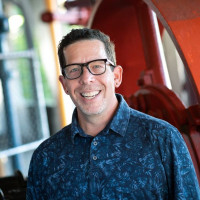
Yeah, I just wanted to do the shtick. Instead of any singing, Dean is the founding co-chair and I am a co-chair of the Death in the Digital Estate Community Group. We were going to have Mike Kaiser with us.
Sadly, he is no longer with us because he headed out of town. It's not as dark as you think. But we do have Miki Brotzler with us who is a very active member.
Miki, I want you to just say a word of introduction because I think people have seen us probably talk all week. I am very honored to be here among these giants. I am Miki Brotzler. I am on the board of the IDPro, but I also work for a financial institution in Australia. I am very interested in this same topic for various reasons. We are so happy to have you here today, Miki. I am Dean Sachs. As Eve said, I helped found the Death in Digital Estate Community Group at the OpenID Foundation about a year and a half ago now, I guess it was.
Some of you have probably heard me talk a bit about the history and kind of how I got here, but I wanted to recap a bit of that for those who haven't. I was just having this conversation with Guy sitting up here a little while ago. But about 15, 16 years ago, a friend of mine, he was a peer. We both worked at Foundstone Professional Services as White Hats, and he passed away at 39. He had two young kids, wife, and as a security-oriented person, all of his data was very tightly locked down.
And that made me start thinking about how do we actually ensure that our friends, our families, our loved ones can pass on those digital assets after they pass away. And the initial thought was, well, a dead man switch, terrible name, but great idea, is the right mechanism.
Because a dead man switch, if you are familiar with the term, or not familiar with the term, in a train, for instance, there might be a button that has to be pushed every so often, or you have to keep your foot on a pedal on the floor, and if you don't push the button or you don't keep your foot on the pedal, the train comes to a stop because it's assuming the conductor is no longer in charge of that train anymore, that the person running the train is no longer in control. And so that was my initial thought 15, 16 years ago now, but we didn't have the right tooling.
We didn't have credential managers. We didn't have a 1Password or a Bitwarden or a Dashlane.
Well, we did, but they weren't in popular use. Fast forward right here, Berlin, four years ago. I shared this thought with Vittorio Bertocci, Andrew Schickiar of the Fido Alliance, Tim Capali, and we had drinks and talked about it, and Tim joked that it was now Dean's Death Service that we were building, which, again, another terrible name, but we all walked away from Berlin agreeing something needed to be done, and we did nothing. Because nobody likes to think about this, but the reality is 100% of us are going to die, and 100% of us need some sort of a mechanism.
When Vittorio later became sick in 23, I believe it was, and passed away, that prompted action. We talked about it at IIW. We talked about it at Authenticate late that year, and I started spending time with Gail Hodges of the OpenID Foundation, really working toward building a charter along with Eve and Mike and others, and then we launched the Death in Digital State Community Group. And so that brings us to where we are today.
And so in the past year and a half, what we've done is we've been meeting very regularly, talking about the problems, talking about the use cases, talking about the challenges we have, and with the rise of AI, things have gotten really interesting, because now we have questions about, well, how do we want to be represented when we pass away? Do we want AI to change that representation? Do we want deep fakes to make us say things that we would never say?
And so the conversation has been interesting and led to a white paper that we released on March 3rd this year that was written by myself, Mike Kaiser, and Heather Flanagan. The white paper covers technology, culture, law, and religion, and the intersection of all four when it comes to dealing with digital estates. It's available at the OpenID Foundation website. We also released a planning guide so you could plan your own digital estate. And this is a manual planning guide.
It talks about how you go about planning for this and how you put this estate together, not in the sense of a legal will or anything. That obviously requires legal support, and I am not a lawyer. But that was also released, and people can use that now. And it also contains information on how do you recover if somebody passes away without a digital estate. So how do you then approach that problem from the someone has now passed away. How do I now start to deal with that problem?
And that leads us to where we are today, which is we would like to move forward into a working group, a working group that has the ability to author standards about digital estate management.
But as we talked about this at IAW a couple of weeks ago, we are pushing rope to the community, and now we are looking for partners to sit on the other side and pull that rope and give us concrete use cases and concrete problems that they are experiencing so that we can collaborate, build this working group, and move on to the next phase of this work, which is really to start thinking about the strategies that will allow us to move forward. And so that brings us here today and to this conversation with you all.
And these are actual real stickers that we have brought with us if anybody is interested. Maybe I'll make a comment. Looking back at the last year and a half, two years, more years of this conversation and the moment that we're in, an observation that I'll make was you started with a kind of dead man's switch, kind of proof of life, if you will, for a service. We quickly moved on to the authentication problem when you have strong authentication in any form. There are members of the community who are security minded and turn on all that stuff, and we've been experiencing problems first.
And then there's this challenge of what used to be the exclusive province of celebrities and sports figures and whatnot, which is probably a lot of people here know the phrase name, image, and likeness, NIL, which is becoming a thing in the era of deep fakes and content authenticity, and it's all sort of coming together. So the same way we talk about AI for identity versus identity for AI, we now have kind of like digital estate matters for the technology, and technology matters for digital estate.
They're all sort of blending together, and we found ourselves at the nexus of working within an organization and within a community that has the prospect of really having some neat solutions and not having to deal with so much mess. Maybe you have more comment on that.
Well, I think for me, there's two areas of real interest for me. One is that there's what we came across when we were trying to do the guide is that