

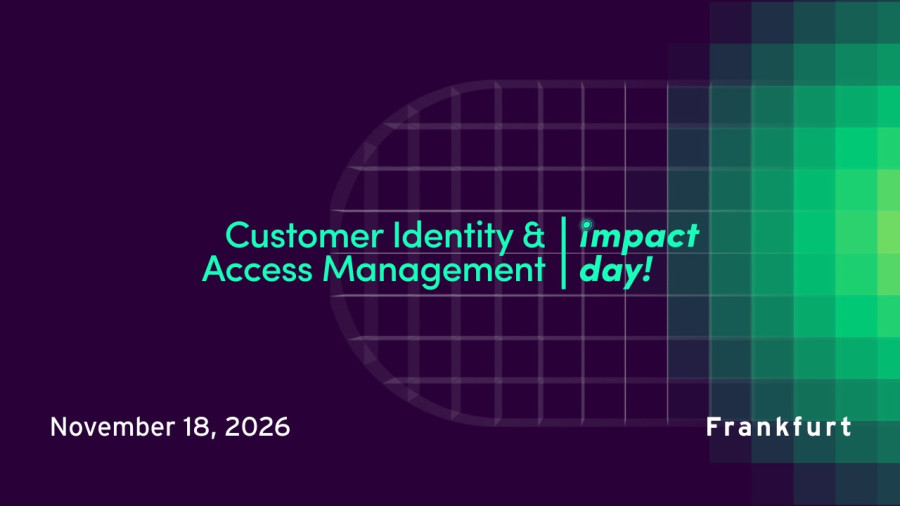
4:00 PM CET, 10:00 AM EST, 7:00 AM PST

Can You Trust Your Customer? Securing Identity in the Age of Deepfakes and Passkeys



- Understand how AI, deepfakes, synthetic identities, and automated attacks are reshaping customer identity risk.
- Learn how identity verification and human identity assurance build trust beyond basic authentication.
- See how risk signals and adaptive controls can flag suspicious behavior without penalizing genuine users.
- Explore how digital wallets, reusable credentials, and passkeys are changing the balance between security and user experience.
- Rethink your CIAM strategy so that identity assurance, fraud prevention, and authentication work as one.
Customers expect digital experiences that are fast, simple, and ideally password-free. At the same time, deepfakes, synthetic identities, bots, and increasingly sophisticated fraud are making it harder to be confident about who is really behind a login or transaction. Modern Customer Identity and Access Management (CIAM) therefore has to do more than let people in: it has to establish and maintain trust throughout the customer journey, without adding friction that drives genuine users away.
In this session, Alejandro Leal, Lead Analyst at KuppingerCole Analysts, explores how CIAM is evolving through identity verification, fraud detection, digital wallets, passkeys, and human identity assurance to build trust across the customer lifecycle.
Erik John Setsaas, Principal Advisor and Founder at Setsaas Trust Advisory, shares practical insights on strengthening identity assurance, addressing emerging fraud threats, and delivering trusted customer experiences at scale.
Jaye Hackett, CTO and Co-founder at Vouchsafe, brings expertise in inclusive identity verification, digital trust, and designing secure, accessible experiences that balance security, privacy, and usability.
Who Should Attend
This webinar is intended for CIAM and IAM leaders, CISOs, identity architects, fraud and risk teams, digital product owners, and IT decision-makers responsible for customer identity, authentication, identity verification, fraud prevention, and digital trust.







Hello everyone and welcome. My name is Alejandro Leal, I'm a Lead Analyst at KuppingerCole and today's webinar is titled Can You Trust Your Customer? So the topic of this webinar is to understand how CIAM is evolving, how it's building trust, and before I introduce the speakers today, just a few quick things to remember. This is going to be a conversation, not a lecture, so we'll be talking together rather than running through slides, so please use the chat to enter any questions at any time.
Don't wait until the end, although we will have, in the last 10 to 15 minutes, we'll have time for questions, but feel free to enter any question anytime. The session is being recorded and the recording will be shared on our website in the coming days. And just to set the stage before introducing the speakers, let me just start with attention that I think everyone here will recognize. So our customers today, they want digital experiences that are fast, simple, and ideally password-free.
They don't want to be interrogated every time they log in, and at the same time, the people on the other side of the screen are getting harder to trust. We see deepfakes, we see synthetic identities, we see bots, and now AI agents are starting to act on behalf of real customers with real credentials. So a successful login tells us less than it used to. It tells us that something passed the check, but it doesn't necessarily tell us who is there, whether they are who they were at onboarding, and whether we can trust these identities.
So that is why customer identity and access management can no longer be just the front door. It has to establish trust and then keep earning it across the whole customer journey, from onboarding to everyday use to the moment something looks off, right? So today we're going to look at this topic. We're going to understand what trust means today. We're going to look at it from different angles, and I'm joined by two people who look at this problem from complementary angles, but perhaps they will disagree on some points, and that's why I think that today's conversation is going to be exciting.
I will let them introduce themselves. Maybe we can start first with Jay.
Yeah, hello. I'm Jay. I'm one of the co-founders of and the CTO of a company called Vouchsafe. We're going to change the name soon. And I guess my main claim to fame, I'm a technologist, but my main claim to fame is probably working on the NHS coronavirus contact tracing app, one of those Bluetooth contact tracing things that I'm sure that we all remember from the pandemic, which was a very different kind of like large distributed trust system to what I work on today. Awesome. John-Erik.
Yes, thank you. Thanks for having me on the webinar. I've been doing digital identities for almost 30 years now through several companies. I was the lead architect of identity management at SAP. I was the face of SigniCat when going out into Europe from 40 to 500 employees, and I've been in T2E working with financial crime prevention, also including AI. So that's what I've been doing the last few years. Now I'm running my own advisory company. So if somebody wants some advice, please reach out.
Well, Jay, John-Erik, welcome and thank you for joining me today. I know that you two will meet next week in Frankfurt during the Impact Days event. So just to warm up and set the stage, let's start first with the threat itself. So we see AI power fraud gets a lot of headlines these days. From your perspective, which threats are you actually seeing hit organizations today, whether that's deep fakes, synthetic identities, or automated attacks, and which are still more hype than reality? Maybe we can start first with Jay.
Sure, yeah. Well, I guess I'd probably have to start with the one that everyone jumps to to begin with.
Though, I mean, from our point of view, we see these used to support entirely fake identities or impersonate one that might exist in official records. So essentially laundering an attachment between yourself and what might be a genuine identity. And frankly, I think we're at the point where we need to just sort of quit this habit now. We need to quit this addiction, stone dead. I think the time has come. I'm sure we'll talk more about that one.
But on some slightly more interesting threats that we maybe don't hear so much about, one that I give a lot of thought to at the moment is first party fraud, especially as the cost of living is bitten. So the Online Safety Act in the UK, for example, and equivalent acts around the world regulating age-restricted content on the web, have triggered a very significant change in user behavior. So surveys here in the UK, for example, they say that about half of all adults now comfy with the idea of doing fraud in their own name.
And hilariously, only about 8% on the same survey will admit to actually having done this. But in practice, this looks like things like juicing affordability for a loan or tenancy or all sorts of other things. And this is a really difficult problem with a lot of facets, because sure, there are hardened criminals that do this for human trafficking and money laundering and so on. But often it is just people trying to get stuff. And sometimes the stuff is one of life's essentials. But that's a really tricky multifaceted threat to deal with.
And then, of course, a lot of this fraud is AI powered. We know this AI has created a lot more fraud, but it's also changed the patterns. It's kicked things up a gear. But I think I would contend that the actual fundamentals of fraud haven't really changed that much. Though the same kind of mismatches in the data, the same kinds of weird velocities will still apply. Velocities will still apply. But maybe it will look different because the actual mechanism of that fraud will be different.
Crucially, fraud reports about a particular identity, a particular set of details are still just as useful as they've ever been. But I think I would contend that moving to things like digital IDs and wallets, which I'm sure we're going to talk a lot about, will most likely cause a kind of channel shift rather than suppress, like, synthetic identity or impersonation fraud altogether. They'll transform what we see today as fake document attacks, though generated pictures of passports, for example, and turn them more into social engineering attacks that act on the person rather than a document.
I'm sure it's going to be a net positive overall, but I think that we need to acknowledge that going from, say, a passport that normally sits in a drawer to a digital credential that's in bands dozens of times a day for all sorts of things that a person might be doing will inevitably broaden the attack surface. So it might not be as much of a slam-dunk win as it currently feels like it's going to be when we finally go digital ID for all these things.
Yeah, that's about what we see today. Thank you, Jay.
Jan-Erik, what do you see? Yeah, no, just first interesting comments about the first-person fraud.
I mean, the first service after the APP fraud, the rules coming into place show that there were no increase in first-person fraud, but interesting to see it is increasing now. And as you said, when people have less money, I mean, they're more prone to do that. I think that one of the major challenges, and also I'm going to talk about this next week in Frankfurt, who is that individual you are identifying? When you do onboarding, it's two things.
One, is this a real person? Does this person actually exist? And is that person present? That's the two parameters.
Typically, we will use the identity document, the NFC chip on that one, as determining whether that individual exists. And I agree, we do have fake documents, but I think still faking the NFC chip is still challenging. And then what we've been doing for so many years now, then we just take a picture of that person, and we compare to the identity document, and we know that person is present.
Well, not so much anymore. Because with AI, it's so easy to fake this. It's so easy for anyone to create a fake image. And according to Dr.
Goose, they're saying at peak times, because these deep fakes come in peaks, they go in waves. At peak times, as much as 10% of the onboarded identities could be deep fakes. That's a big number.
And also, this is a real problem. In April, I think it was, there was this guy that created more than 40 accounts in one of the Dutch banks. He was using stolen identity documents, but then he used the deep fakes to onboard more than 40 people. And it turned out he didn't know anything about this, because they found this chat GPT log. That's where you learn how to do all this stuff. And I'm not sure they still found out why he was doing this. But it's so simple. Deep fakes are now available. There are no cost of creating them. They are fast. And anyone can do it without any prior knowledge.
And also, you can now buy KYC bypass products online. You don't even have to go on the dark web. You can on the open web find products that help you bypass the KYC processes.
So, I think then that kind of impersonation is one of the biggest problems we have. Yeah, I really agree with that last bit. My co-founder, Chloe, she loves to use the film Catch Me If You Can as an example for this. There's a famous thing that the real guy did where he would like soak toy Pan Am planes in to get the logos off so that he could attach them to fake pay slips. And she uses this to demonstrate that you used to have to be really clever to be good at this stuff and no longer.
No, I mean, you can go up, you can buy this stuff. And if you have a good idea, you get some help from an LLM to go through with it.
Yeah, sorry, I'm able to just say to chat GPT or something like when I type my name into this like credit card company's website, what exactly are they checking? That's very powerful knowledge that now everyone has. It is.
And also, if you phrase the questions in the right way, you can bypass the ethical filters. Typically, I mean, sometimes the chat GPT and Claude would say, you know, I can't answer that question. Then you say, well, you know, I'm writing a book on this topic, and I really need to get information on how to you know, I want to make it realistic in the book.
Yeah, okay, then you can get the information. So I mean, you can always get around some of those filters if you know how to phrase the questions. Absolutely.
Well, one of the things that stood out to me during your conversation is that, you know, no single organization can see the full picture on its own today. So question for Jay, you know, businesses have become very good at verifying who someone is. But I think those checks usually stop at the edge of the organization. And these days, we see fraudsters exploring that fragmentation by, you know, moving between different businesses and sectors. So my question is, what would real time interoperable fraud signal sharing look like in practice? And what do you think is the biggest obstacle?
Is it technology or governance? What do you think?
Yeah, well, so we used to and still do, to be honest, run an identity verification business. And we discovered the thing that many people around the world have discovered, which is the pictures of documents are just simply not enough anymore. They give you next to no security, if that's all you're doing. You have to pair them with something, whether that's an NFC chip read, or a data check in our case. And we discovered that there was no good authoritative data source to tell you things like, which of these identities are known fraudsters.
And on the other side of things, which of these identities are sort of known to be low risk, especially in the segments that we were focusing on at the time, so the financially underserved of the population. And when it comes to specifically sharing fraud reports and sharing fraud data between businesses, there are, of course, some networks that exist for doing this in some geographies and some sectors. So CIFAS in the UK, where we are, is a member organisation and a non-profit. And they do this mainly for consumer credit and lending.
And the legal basis for doing it is very well-established in law. So regulators are also begging for more of it to happen every day because they see what we all see. They see that the industry, the economy in general, has to get better at doing this. But the main problems that you see with the incumbents today are the operating model. So it tends to be a kind of 1990s way of looking at where the work sits and only dealing in a very high reporting bar for confirmed fraud, people say. And a problem that kind of springs from that is the speed that it all happens at.
So to share data today on one of these fraud networks, these sort of databases of known fraudsters, it might look like off a day writing up a fraud investigation and maybe, in some cases, weeks for the network that you're reporting it to, to uphold that report and actually add it to their database. And maybe even longer for other people to come back around to checking that database to discover something that perhaps happened months or even years ago. This is very similar to how credit files worked and, in many cases, still work until quite recently.
So it can be really, really hard and slow and so, so expensive to clear that reporting bar, but most fraud will just go unreported. And what does get reported, it might not be reported fast enough to make a difference. So that's necessary, ethically speaking, let's say, in a world where that data sharing is essentially just like a shared Excel sheet, if we strip away all of the trappings and all of the branding, where you get a report against your details and you're essentially blacklisted from applying for credit or what have you.
But I think I would argue that the tech is more than good enough now to solve that problem and automate a great, great swathe of that process, if not all of it. So those explicit fraud reports, they can be one signal among many and you can weigh them against, for example, the actual behavior of that identity on the network, if you're plugged into the businesses in the right way, and other fraud signals as well. And that can essentially get you to a world where the actual fraud report, if it's necessary at all, it turns into a one-click process or a single API call.
And I think that unlocks a heck of a lot of other obstacles. That unlocks so much of the mountain that you have to climb to get to doing this in the first place, that I think it's going to be a really exciting few years, us and other people doing things like us around the world.
Yeah, and thank you for sharing that, Jay. You know, last week, maybe it's a little off topic, but last week I was in London for a work event and I tried to take the metro at London Bridge Station, and when I tried to pay for my £7 ticket, the machine was skimmed. So I actually placed two of my cards there, and I ended up losing around £1,000. And it was a little bit complicated to call the file, I complained to the police. It took me like three to four hours, and then I had to go to work for the event.
So I was, you know, pretty stressed the whole day. And it took until yesterday morning to finally solve it. So I think it's just a silly example, but I think that we really need to work on that.
Yeah, no, that's not a silly example at all. I'm sorry that happened to you, that really sucks. Did you get the money back?
I did, finally. Okay, good. I thought skimming was something of the past, but it still exists then, obviously.
Yeah, yeah. And still somebody trusts the Magstripe.
I thought, again, all cards were cheap nowadays to transact. But I mean, I guess the Magstripe is the pullback. But to your point there on, you know, having a registry of fraudsters, I mean, I agree that would be great.
I mean, we had that with credit card numbers, right? In the old days, they had printed lists. I still remember the printed list of blacklisted credit card numbers. So when I paid somewhere, they took out this list and checked my number against it. And that wasn't always simple because it was a unique 16-digit number. But we don't in most countries have unique identification of people.
I mean, I live in Norway, so we have a national identification number. And I know both of you now are going to look at me, wow, you know, we don't number our people, as they say in Germany and UK don't either.
So I mean, that's going to be one challenge with something like that. And also, if somebody has impersonated me and used that account for fraud, that's, you know, another challenge in that picture. Then you talk about sharing of data, which is, you know, whenever we talk about catching financial crime, we're coming back to sharing of data. It's always the topic. And the challenge is then often, why are we not sharing more? And part of it is GDPR, or not necessarily GDPR, but the interpretation of GDPR, which is interpreted too strictly.
And the data privacy officer is not going to take any risk. So he's going to say no as a default answer to sharing. One interesting technology, and I mean, that would warrant a separate webinar, I think, is looking at MPC, multipart computation, as part of this where you split an encrypted data, and then you can do operations on that encrypted data. So then you can, you know, share intelligence without sharing the data. Just mentioning that as, you know, part of technology that could be interesting to look at in a more degree than we're doing today.
Yeah, that's very similar to the principles that we employ. And you're right to draw a distinction, I think, between what the law actually says and how people interpret it, or what people imagine it says. Because if you actually look at the way that the law is drafted in the UK and the EU, there are some like legitimate interests. This is a classic case of the legitimate interest, right? Preventing fraud in your services and on your platform. And the example of the London Underground, I think, is actually a really prudent one, because this is exactly what they do when you pay by contactless.
They use that old system where you tap a card on a machine, and there's not enough time for that to go all the way to your bank and back in the instant that you want that gate to open in. So what they do is just assume your card is good, unless it hits their own locally held database of known bad card numbers. And you'll find that any card will work, whether or not it's got money on it the first time. But the second time, if the payment bounces, then that card will be blacklisted and it won't work anymore.
So that's actually quite a good example that still exists in the world today of the old model, which I think is going to have to upgrade as many, many different ways of paying comes to fore. I'm in London right now, and I saw that.
I mean, I did several trips with YouTube before Revolute told me, now your card is authorized for paying on the Underground. And I was charged, of course, for the trip.
So yes, there is a delay. As you said, there's no time for direct lookup in that case.
Now, shifting gears a little bit, I want to do a follow-up with John-Erik. You're going to talk about EID next week. So we know that EID onboarding is strong. But in daily use, the service provider often has no real way of knowing who is actually using the EID. Someone may have shared it or someone may have taken it over without the owner knowing. And as the EU Digital Identity Wallet enables selective disclosure, how can a relying party trust that I claim like I'm over 18 years old come from the rightful holder? Where should that binding happen?
The device, the biometrics, the pass keys or somewhere else? Yeah, and I mean, that's a real problem.
I mean, as you said, onboarding, and as I mentioned initially, the onboarding is normally pretty strong. You check the identity document, you do biometrics of the person and, you know, the best solution today, obviously, also do deep fake detection to ensure that, you know, it's really me here. But very few EID systems are checking who's using it right now. Who is the user of?
I mean, I use BankID almost every day. But there's no check that I'm using it. It assumes that I have access to my phone, and then I must be me. Last time I refinanced my loan, there were no checks on my real identity. It was just assumed I was using my own BankID and nobody else was using it. And we see one in four people in Norway have shared their BankID with others for various reasons.
I mean, typically, people help each other, right? You have problems, accessing service and, you know, yeah, I'm just gonna hand over my EID and you're gonna pay my bills and stuff. And there's a lot of fraud connected to that. Because when I have somebody else's EID, it's not that I can act on behalf of them, but I really am them from a legal sense. Because when my BankID is being used to sign something or do a transaction, that's considered proof that it's really me doing it. Although that is changing now. There that for a financial institution, the only proof you have is the use of a BankID.
You must consider that somebody else could be using it, which I think is interesting. And then over to the wallet, it's gonna be a much more attractive target. The fraudsters are already, I guess, having conferences and discussing these topics, how they're gonna, you know, exploit the identity wallet for their benefit by impersonating others. And one of the problems with sharing is the lack of authorizations. That's why people are sharing with others.
So, there's no way for me to say, okay, Alessandro, can you pay my bills? And if there is something like that, it's all or nothing. You can do anything on behalf of me. I would like to have granular authorization saying, well, I'll let you pay my bills up to 1000 euros.
But no, if there's above that, I mean, you're not allowed to do it. You cannot take up a loan, you can't buy a car, you can't get a divorce and stuff like that using the EID. You can only do limited things.
So, that's a problem that we have. We don't have the authorizations. But in the cases where people are sharing, but then also the lack of checking that it's really me using my identity, me using my wallet. And I see that as a big problem. And this will be the topic of my talk next week.
Jay, maybe a question for you. From your perspective, does stronger binding risk excluding people, for example, whose biometrics don't work well with current systems or who share a device? I actually had a slightly different thought pop into my head on this question.
So, the UK has recently made it legal to use digital ID to purchase alcohol. At the moment, this is only really practical to do in person rather than on the web.
And so, we're now in a world where people used to just someone presenting a plastic card and being like, oh, yeah, that's you or that isn't you and just making a kind of snap judgment now might be faced with a digital thing in an app that they've never heard of before. Because remember, the UK has no national ID.
So, this is like private companies apps that are being used to do this. And then there's a QR code that the retailer is supposed to scan with an app that they have on their own phone or some device provided by their employer. And then confirm that it is the person that's presented. People just aren't going to do this.
I'm sorry, but they're not. They're just going to look at that thing and either just not accept it at all or make a snap judgment about whether the thing that they're being shown is similar enough to the others that they've seen that it will count as the same person. You can't ask a bartender or someone who might be in the middle of a busy shift to stop and get an app and scan like it's just not going to happen.
So, I think that the in-person side of this is also quite interesting, especially as more and more of the situations where we might even use our plastic cards disappear and they become digital. Just something that popped into my head. And on the inclusion side, I guess it's probably worth saying that my company used to and still does, to a large extent, specialize in solving the inclusion problem. We started out offering a feature, a product capability that we called biometric vouching.
So, essentially, it's like trusted referees as a service, as a way to onboard people who don't have the classic good quality photo ID or other identity evidence. And we learned a heck of a lot doing that in production for a few years, not least that that's not a great way to solve that problem because it's really complicated and it puts so much of the burden on the person who is least able to bear it, right?
So, like the person who may have poor digital skills. Because if you've got poor identity documentation, you don't just pop up randomly with that status. Other things have happened to you to get you to that point. You might have poor digital skills, you might have access needs, you might not have birth registration, for example. All sorts of overlapping problems might be afflicting you.
And so, I think that I've become convinced that what is needed to solve this is a data-driven solution, ultimately. Like the thin file problem that the credit bureaus describe, I think that holding that data hole is what will ultimately solve the downstream subits. And what we had initially with our vouching app was essentially a stopgap. Because I'm not sure that I buy into the argument that biometrics are still... It depends on the algorithms, but by and large, the biometric vendors have improved quite a lot in the last few years.
And I think that these kinds of technologies are getting pretty good from an inclusion point of view. But I think when you're asking someone to do something in the and you're not giving them the same, thanks, loading spinner, you're done experience, that's always going to be a second-class experience.
So, solving the data problem and fixing it more at source is really where I think we should be focusing for what it's worth. Yeah.
And also, interesting, you talked about vouching. I also heard about doing that.
But, I mean, we did try that before. And I'm old enough to remember PGP Web of Trust. And that was exactly the same thing.
I mean, I have a private key and then I can, you know, sign you and then because I know you, etc. So, it's the same kind of thing, you know, vote for someone else.
So, that was tried back in the 90s or something, I think, to do that. But I see the challenges with it. And it all becomes very abstract. Same with it, as you said, bar counter, scanning the QR code for determining.
And it's, you know, so abstract. And then you get the screen saying something, something. And I was just, again, if you think like a fraudster, hey, could I create the QR code with an injection code that I show to the bar contender? Yes. What would happen in that case?
Yes, you could. Yes. I think it's often received wisdom that vouching is the solution to these inclusion problems, especially in policy work circles. And I think, like, I received that wisdom. I built a product, built a company off doing that. And now here we are having experimented with it, our product still does this. But will it do it forever? Probably not.
So, I think there's better ways to solve it. Right. Yeah.
Now, we definitely need to look at inclusion issue there. And then, you know, over to the biometrics.
I've been, you know, trying to pick my brain on what alternatives to be had to using biometrics to determine if it's really me. The problem is that lack of trusted samples, because you need to compare my biometrics to a trusted sample of my biometric, which is what the police is doing when issuing a passport. Then you collect the trusted sample and you add to the identity. And I haven't found any other sort of human characteristics that you have a trusted sample.
Yeah, I think, I guess it's probably worth saying as a point of context, like the size of the population that we're talking about here on the inclusion point. The FCA in the UK and Fair For All Finance, which is quite a big sort of non-profit funder that receives, I think this is so interesting, that they get their money that they then disperse as grants for various financial inclusion projects from dormant bank accounts that they can't trace the beneficial recipients of those funds.
So, they turn that money towards something good. Isn't that lovely?
Anyway, they both separately, with separate mechanisms, define populations that they call financially underserved or financially vulnerable. And no matter how you calculate it, this ends up being near enough half the population.
So, when we're talking about inclusion, this is not like a one in five or a one in ten kind of problem. We're talking about like people in a lot of ways. If you look at some countries around the world, it's the vast majority of the population.
So, I think that we absolutely can't be thinking about it as a separate problem. It is simply like the next problem to solve, you know?
Yeah, we definitely have to. And I mean, see it coming from where I am.
In Norway, we've been bragging about the bank ID. So, successful and everybody's using it.
And wow, we're best in class. But I mean, the dark side of that is inclusion because the people that don't, for whatever reason, if you can't get a bank ID. And organizations are now turning off the alternative mechanisms because they're so little used. Which means if you don't have a bank ID, well, you have really big problems existing in society. And that's where we've gotten to now. That it's become, you know, not like it's a challenge doing stuff. It's like almost impossible doing stuff.
Hello, yeah. We've had a similar, I'll have to be quite vague in how I describe this. But we've had a similar challenge with a government department in the UK.
So, we have a new power as a certified business under the UK's trust framework where we can request, with the right legal basis in place, we can request authoritative government information about people in order to fulfill a legitimate purpose, like proving who they are. And we have been in talks with a department to receive some of this information. And it would be very, very valuable to a whole section of the economy to get this stuff. And this is the first time in history it's been worth talking about.
And we were talking to the people who run this department and they were like, well, yeah, but like, I think to prove that it's not just some random person, like we want to be able to like know that the person's given their consent to have this data. I think you'd have to have their passport on file or something. And we're sitting there like, well, that would kind of defeat the purpose because the whole reason of trying to access this data is to help prove things about these people where they probably don't have a passport, right? As many millions in the UK do not.
And rusted sources of government data, I think, are one of the few remaining places that we could get that confidence. Still back to the problem needing, you need to know, it's really me sitting on the other side of that internet connection and somebody impersonating me. It's not going to solve that kind of problem. It's going to solve the owner of the ID problem or the owner of the identity, not the user of the identity right now.
Yeah, completely. I think impersonation is its very own, not separate, but like its very own, very deep problem to solve. Absolutely. Speaking of problems, so far, we've mostly talked about a human and their own credential. But increasingly, the one showing up at the door is not the customer at all. So we think about reusable identity, delegated access and agents acting on a customer's behalf. And they all rely on someone else's trust decision. So from your perspective, this question for both of you, when an agent arrives with valid credentials, what does a successful login really tell you?
And who should really carry the liability when it goes wrong? Maybe we can start with John-Erik.
Yeah, no, that's a good one. And I mean, it's back to authorizations.
I mean, what's happening a lot these days when with agent is that the human just gives the agents their credential. So on the service provider side, you don't know that it's an agent operating on behalf of a human. And that's very similar to if I hand my credentials over to one of you guys, the service provider is not going to know that somebody else and I mean, I've seen that some fraud on somebody I knew on that exact thing where somebody was, you know, supposedly going to help someone and then use that credentials to fraud. So does an AI agent need an identity?
Yes, for sure. We need to issue identities for AI agents. We need to have good authorizations. So I give that AI agents, you know, specific authorization. This is what you're allowed to do. This is what you're not allowed to do. And probably set a limit on how many talks you can spend and, you know, what you can do, etc. to limit that.
Of course, that's not going to stop that agent talking to another agent and getting help to do stuff like we saw in the hugging face case. But I think that's a really important part that we need to do that one. So what if the agent hallucinates?
Or, you know, does something wrong? I heard a very interesting story. A guy told me he was setting an agent. I want their agent, I want you to buy airline tickets from A to B. This is the time frame and get the cheapest tickets, but I need to confirm before you buy them. Right? Easy instructions. Then suddenly you got an email, tickets were booked. And then he confronted, you know, the agent.
Well, I told you not to check with it. Well, you know, but I found these really, really cheap tickets. And if I was going to check with you, the time would have passed, I wouldn't have time. So I just decided to buy them anyway.
And, you know, that's how we sort of give the rules to the agents. I mean, we don't really have a structured language. As a human, we would understand that that part, check with me first, has higher priority. Right? So that's one part, you know, how do we know we ask the right questions or give the right instruction? And what if it hallucinates and, you know, does something completely off the board here? So the liability problem is, you know, who's responsible in that case? Absolutely. Thank you for sharing that, John-Erik. Maybe just a follow up question for Jay.
In your opinion, if you don't block agents, what do you think is the minimum you'd want? Yeah. So would the agent works for or what's been authorized to do something else? I think this is such a good question.
I mean, first of all, like blocking it is just unrealistic, right? Let's be honest, the way the world is going, we'll maybe be able to get by doing that for a year, maybe two at the max, but it's not going to be a long term strategy. I think a lot of our tools kind of make assumptions on, especially the ones that make assumptions on things like the way a cursor moves and stuff, device signals, they're going to have to do and hopefully already are doing some really deep rethinking because those assumptions are just not valid anymore.
A lot of the stuff that even a year or so ago, we would have said, well, this is a clear indicator of spam or fraud or what have you. Those assumptions just aren't valid.
So, I mean, if I give you an example, so up until recently, all of the sales inbound for our company, I replied to as a person. And about six months ago, I started getting a lot more clearly AI generated emails. These bear the hallmarks of spam, like it's that they're this thing where they'll give you a numbered set of questions that they want to answer. And then often they'll be like several questions on a line. And I eventually got so tired of responding to these that I thought, right, I'm just going to let an AI respond. But the customers convert. It's the weird thing.
Like if you reply to these, the customers will sign up and they'll start paying you. So my assumption that, well, this is spam is not accurate anymore. That's an out-of-date assumption.
Luckily, our network, our business, we deal in predominantly the underlying claims about an identity. And we're kind of agnostic at the moment about whether it's a human or an agent using them. Because from our vantage point, fraud kind of looks like fraud, no matter who's holding the credentials. And I do think that the only viable answer to this is really to add a sort of second dimension, a second axis to all of our trust and risk calculations. So how much do we trust the human on one axis?
And then on the other axis, something like how much do we trust, not even the agent, but the software on them to us as a unit? And how do we deal with those weird spaces in the middle where you might have high trust in one, but not the other? And I think that it's possibly not a solution for my company, but I think it's a good use case and one to start maintaining a rogues gallery of these things and to start making a good database of what these agent trust signals are completely in isolation of the humans that are behind them.
And I guess on the liability point, I don't think we're going to see any massive changes in liability, of course, because of the law moves relative to everything else. But it's probably worth noting that here in the UK, we have the DVS trust framework, our version is called. And it has made it clear now in law that to get a statutory excuse for certain things like a right to work check, a right to rent check, alcohol purchases that I mentioned before, be legally compliant, you have to follow the rules of this framework now.
And that transfers liability from you to the company that has that check legally. And they have designs on doing the same thing for financial services. So there is a world in which that liability does transfer over time to essentially a technology vendor rather than the regulated firm, say, is likely to say. And just going to what you mentioned, I mean, we cannot keep them up.
I mean, we spend a lot of time trying to keep robots out of systems by having, as you mentioned, CAPTCHAs and mass movements and click on old pictures of bicycles. And we all hate that crap, I mean, to prove you're human. There was an interesting story about that where somebody set up an agent to do something. And this agent hits a CAPTCHA. And then it goes online, where you can find online services where you can buy human resources to do stuff, where people would do small stuff online for a fee. So he got a human and say, hey, I just need some help for you to click on this CAPTCHA.
And this human user had, you know, some ethical say, well, you know, isn't that cheating? Maybe you're a bot or something.
No, no, no, I'm blind. I can't see it. So please help me with this. And this was all invented by the AI agent just to bypass the CAPTCHA. Wow.
Well, we're almost out of time. We covered a lot of ground. So from what is trust to biometrics, credentials, inclusion, AI agents, fraud, you name it. But before we turn it to the audience questions, I would like to maybe make it more practical with my last question. So if a SIAM leader in the audience could change one thing in the next 12 months to make identity assurance, fraud prevention and authentication work better, what should it be? Maybe we can start with Jay first and then with John and Eric. Sure. Are either of you professional wrestling fans? I don't know.
I think this is such a useful, right? Okay. Hopefully I'm not surprising anyone by saying that wrestling isn't real. Yeah. This is a story that's being told to us. And I think wrestling is kind of unique in that the wrestlers are characters. They're playing characters and they're enacting a story, but they continue to be the characters even when they're out of the ring in a lot of cases. And wrestling has a word for this. It's called kayfabe.
And I think kayfabe, this idea of like keeping up appearances, purity theatre, we sometimes call it in our industry, is such a useful concept right now with everything that's happening. But I think if I was going to do one thing, it would be to kind of look inward rather than outward and have a really sort of deep personal reckoning and start to let go of these old assumptions, whether it's things like trusting in a picture of a passport or a utility bill that you file, or like taking the vendor's word that device signals are actually predictive of fraud in an AI first world.
I think all of these assumptions we need to be now taking a really hard look at because the world is in the middle of changing very, very rapidly in a very significant way. And we've got to be ready. And treating any of this stuff as compliance checkboxes is just not going to cut it anymore. I think that's what I'd say.
Thank you, Jude. Yeah, very good.
I mean, and sort of follow up on that, don't trust what you see, right? I mean, make sure you know who the customers are when onboarding. Make sure you know who they are when doing stuff, especially when you consider it high risk. And make sure you then have deepfake detection everywhere on this because I mean, you have presentation attack detection, you have injection attack detection, all that is fine. You need that. But the deepfakes can go through those. So you need to have a good deepfake detection. And also you need expert companies to do this. Don't try to invent this yourself.
This is like virus checking in the early days. There were new waves of viruses coming, you need to be continuously monitoring what's going on. And add new prevention mechanisms when you see new waves of deepfakes coming. So that would be my advice. Make sure you have everywhere you have photos, even identity documents as well.
Check, do deepfake check everywhere. Thank you, John-Erik. While people are typing, one of the questions that comes up a lot around deepfakes is, maybe it's a question for you, John-Erik, if an organization relies on selfie or video verification today, how worried should they be about deepfakes and what should they add or change?
Oh, they should be very worried because I mean, it's coming in waves, as I said, 10% of your onboarded identities may be fakes. And that is concerning that it's so many. So you should definitely be concerned. You should definitely then implement, go talk to one of the expert companies in this area.
I mean, I know very well Dr. Goose in the Netherlands, which is a good company doing this and others as well, and get help in doing fake detection. Thank you.
And Jay, one question for you. You already sort of hinted at this, but for an organization that wants to start sharing fraud signals, but has never done it, what's the realistic first step that, let's say, doesn't create new compliance risks?
I, most of our customers are people who've never do, let's say, strong identity checks or strong fraud checks before. And we are, I think, in a place now where great big chunks of the economy are taking on this identity and fraud risk for the first time. But unlike, say, big banks, they don't have the institutional knowledge or institutional culture even to know how to deal with it, or even necessarily know that they're carrying it right in the first place.
So a lot of our work, like a lot of our sales process is essentially handholding, like helping people understand, like, here's how to think about this problem that you may have only recently realized that you have. And we find that a lot of it is kind of like GDPR consulting as a service, you know, so like helping people say, like, here's the legal basis that probably applies to you.
Like, here's an exemplar sort of data protection impact assessment that you should think about whether these bits apply to that. Like, that's normally the first place I'd suggest that you start. Think about the kind of risk that you're exposed to and think about what you're allowed to do under the law. And like I say, there's a very well-established basis for most people, and it's either it's legitimate interests, or if you're a regulated business, probably a legal obligation because you have to prevent money laundering.
And from that point, what we try to do is find, like, show the return on investment quite simply. So something that we really love doing is like taking these data samples and like finding the extra fraud rings that were missed the first time around. And we've never failed to find, like, a really impressive visual of, like, here's the one or two that you found, and here's the ones in your own data this is, not even like people we've seen that they haven't, but people in their own data sample that were associated with them that they missed.
So I think that once you're armed with something like that, whether you get a vendor to do it or spend a bit of time doing it internally, it can be really, really difficult to argue against for your business. And that's normally the route that we see most people taking. Quickly on that, I mean, back to combining what you said about the defect detection, you can also, of course, also get help with checking all the photos you already collected, all the data you collected, and check them for defects to see how bad is it. So that's one comment.
The other comment is, if you want to learn more about MPC, multi-party computation, I mean, reach out and we can have a talk around that as well, because that's also a very interesting road to go down. Yes.
Well, I believe it's time to wrap it up. I want to thank you both for your presence today. Let me try to pull together what I heard today.
So one is, you know, trust can stop at the front door as successful login says less than it used to. So trust has to be established at onboarding and maintained across the whole customer journey. We cannot fight this alone. As Jay put it, fraudsters exploit the gaps between organizations. So sharing signals faster and more easily is essential. Strong onboarding is not enough, as John and Eric reminded us, if we cannot bind a credential to the person using it, even the best wallet or EID cannot tell us who is really here.
Another thing that we learned today is that security and inclusion are not opposites. The best adaptive controls protect customers without shutting out the ones who don't fit the standard profile. And the last thing, agents are coming either way. Blocking them is not a particularly possible solution, but we'll need clear answers on authorization and liability. So once again, thank you, Jay Hackett and John and Eric Setsos for a thoughtful and honest conversation.
For those in the audience that will be attending the impact days in Frankfurt next week, make sure to reach out to them if you have any questions. And any last words before we let you go?
Oh, goodness. Hey, Fab, there's a last word. My camera dropped out, sorry.
But yeah, no, it's a good conversation and I hope to meet and have some discussions around these topics in Frankfurt next week. So it's been a pleasure being here, a really nice discussion we've had, and I think we've gotten a highlight on many very different important points.
Oh, yeah. Thanks a lot, folks. Lovely chat. Thank you so much and have a wonderful rest of your day. Thank you. Bye-bye. Take care. Bye-bye.