Why don't you like this?



Description
Short Summary
Interesting Facts
Notable Quotes
Recommendations
Takeaways


Executive Summary
Identity is no longer just an IT issue. It is now a critical component of cybersecurity and business operations. There is growing consensus that identity misuse has overtaken other methods as the preferred mode of intrusion. For example, according to the 2025 Data Breach Investigations report, more than 80 percent of data breaches involve compromised identities, as adversaries exploit techniques such as Kerberoasting, brute force attacks, password spraying, and the abuse of misconfigured identity systems.
In addition to identity-based threats, the increasing reliance on Non-Human Identities (NHIs) introduces significant security and compliance risks. This is especially true when these identities are not properly managed. KuppingerCole’s research suggests that the majority of identity-related breaches stem from compromised NHIs, particularly service accounts and API keys. While identity threat detection and response (ITDR) is often discussed in the context of human users, its application to NHIs is increasingly crucial. And as AI agents begin to act on behalf of humans, organizations face a critical governance challenge: how to establish trust in these systems, monitor their behavior, and enforce guardrails when automated actions deviate from expected norms.
To make matters more complicated, organizations typically operate a combination of different systems and applications, including those dedicated to privileged access management (PAM), Identity Governance and Administration (IGA), and those serving as identity providers, such as single sign-on (SSO) platforms. They also use cloud-based services, on-premises servers, and integrations into Security Information and Event Management (SIEM) and Security Orchestration, Automation, and Response (SOAR) tools. This creates a dispersed "identity fabric" in which many components are managed separately. As a result, organizations face challenges in maintaining visibility and control across the entire landscape.

Figure 1: ITDR adds the identity analytics capabilities and insights to SIEM, SOAR, and XDR
Point solutions may cover individual segments of the identity stack, but they often fail to provide a holistic view or real-time awareness. To properly secure the identity environment, organizations must adopt an integrated approach that can monitor all components collectively. This highlights the need for continuous ITDR that spans the full identity fabric. Such capabilities must unify fragmented tools, bridge siloed data, correlate activity across systems to assess risk dynamically, detect threats as they emerge, and support proactive remediation strategies. Visibility and compliance alone are not enough; a resilient defense against identity-based attacks demands integrated detection, response, and recovery capabilities.
ITDR solutions should both protect and defend. However, identity-related threats now span multiple domains, creating a problem that no longer fits neatly within the scope of a single team. IT administrators may have visibility into identity systems but often lack the threat context. On the other hand, SOC analysts are trained to hunt threats across the network and endpoint layers, yet they usually have limited familiarity with IAM systems and governance structures. In response, ITDR vendors are positioning their tools as the connective tissue between these teams, introducing real-time monitoring, contextual analytics, and adaptive controls to identify abnormal activity, assess risk, and support automated or guided response actions.
The vendors included in this Leadership Compass hail from various backgrounds and offer diverse approaches. This is not a sign of market immaturity, but rather a reflection of how cross-functional and strategic identity has become. Some are pure-play ITDR vendors, having built their platforms specifically to address identity-based threats through detection, correlation, and response. Others are more established identity or security players that have added ITDR capabilities to existing platforms not originally designed for this purpose. As a result, some vendors excel at real-time detection and signal correlation, while others stand out for their strengths in visibility, recovery, or posture management.
The smart bet is on vendors that can help organizations converge around identity as both a control plane and a detection surface. When evaluating identity threat detection capabilities, organizations should avoid limiting their questions to whether a solution can detect specific techniques like credential stuffing or Golden Ticket attacks. Instead, the right questions center on whether the platform can establish and adapt behavioral baselines over time, correlate weak signals across identity silos, and automate the investigation process. Buyers should assess how well a solution can surface identity anomalies and suspicious behaviors, not just match known techniques. Nevertheless, the business value is clear: reduce false positives in the SOC, enable real-time enforcement actions, and build a defensible security posture around identity. What unites all of the vendors in this report is the assumption that prevention is no longer enough. Organizations must assume compromise and invest in detection and response mechanisms. This includes integration with as many relevant systems as possible, including identity providers, directories, SaaS applications, ticketing systems, EDR platforms, SOAR, and other security tools.
This Leadership Compass covers the dynamics of this emerging market, provides a framework for evaluating ITDR solutions, and offers guidance on how enterprises can select the appropriate technologies for their organizations. To better understand the fundamental principles this report is based on, please refer to KuppingerCole’s Research Methodology.
Key Findings
- The ITDR market spans the space between identity IT administration and security operations center (SOC) threat detection and response. This dynamic is creating a new type of solution, because protecting identity requires both departments to cooperate in converged products.
- Not all vendors offer the same level of operational readiness. Buyers should consider the maturity of the platform, customization of dashboards and playbooks, availability of APIs, and the vendor's track record in supporting enterprise-scale deployments.
- While not universally available, deception technologies, such as honeytokens and identity decoys, can provide early warning signals and help slow down or divert attackers. Consider whether these techniques align with your SOC capabilities and threat model.
- ITDR platforms should integrate natively with IAM tools (IGA, PAM, Access Management), security tools (SIEM, SOAR, XDR), and ITSM systems. Gaps in integrations can lead to fragmented investigations or require custom workarounds, limiting response effectiveness and increasing operational overhead.
- All vendors we cover in this report have experienced strong product-market fit, but they are also fairly diverse in their architecture and approaches. As such, selecting a vendor relies primarily on enterprise organizations understanding internal requirements for ITDR.
Market Analysis
The ITDR market is experiencing substantial growth. Several key drivers underpin this growth. Most notably, identity-based attacks account for a substantial and growing share of breach activity. Meanwhile, rising regulatory and compliance demands, such as GDPR, CCPA, and other data protection standards, are compelling organizations to adopt proactive identity threat detection as part of their security frameworks. Additionally, the Zero Trust paradigm, with its core principle that breaches are inevitable, further emphasizes the need for continuous authentication, identity validation, and responsive mitigation, areas where ITDR excels.
As described above, the market landscape includes specialist vendors born in the ITDR space, who offer focused capabilities in threat detection, identity behavior analytics, and contextual correlation. At the same time, larger identity and security platforms are evolving by incorporating ITDR capabilities into their existing IAM, IGA, or XDR stacks. This is sometimes achieved through native development and other times via acquisition. This has resulted in solutions that vary significantly in scope, architecture, and depth of capabilities. Nevertheless, adoption still faces setbacks. For many organizations, aligning ITDR with existing workflows and governance is a significant challenge. High implementation costs, talent shortages, and organizational inertia further impede adoption.
The total market size for ITDR is difficult to establish compared to other tech industry markets for several reasons. First, as mentioned above, few products are currently sold purely as ITDR solutions, so determining the amount of economic activity generated by ITDR requires some triangulation of the money spent on the various products used to create ITDR solutions. However, based on our analysis, we project compound annual growth rates (CAGR) between 19% and 23% over the next five years, reflecting strong and sustained demand for ITDR solutions as identity continues to solidify its role at the core of enterprise security strategies.
Large enterprises, particularly those in the financial services, healthcare, government, and critical infrastructure sectors, currently dominate ITDR adoption due to strict compliance mandates and valuable assets at risk. Yet Small and Medium-sized Enterprises (SMEs) are projected to exhibit strong growth, especially when cloud platforms and managed services lower adoption barriers. Regionally, North America and the EMEA hold the largest share, supported by mature cybersecurity infrastructure and regulatory frameworks. Meanwhile, Asia-Pacific is seen as a high-growth frontier due to rapid digital transformation across emerging economies.
Delivery Models
ITDR solutions are delivered through a variety of models to meet different organizational needs and integration preferences:
- Cloud-Native/SaaS: Many modern ITDR offerings are cloud-native, delivered as Software-as-a-Service (SaaS). This model supports rapid deployment, continuous updates, and integration with cloud IAM providers and SaaS applications.
- Hybrid Deployment: Some vendors offer hybrid approaches, combining cloud-based analytics with on-premises connectors or sensors to monitor legacy infrastructure such as Active Directory (AD) or on-prem identity stores. This model is common in enterprises with mixed IT environments.
- On-Premises: Though less common, certain ITDR capabilities are available in fully on-prem deployments, typically required by highly regulated industries or organizations with strict data residency requirements.
- Modular/Embedded: ITDR capabilities may also be embedded into broader identity platforms (e.g., IAM, IGA, PAM) or XDR/SIEM tools, delivered as feature modules rather than standalone products. This model suits organizations seeking tighter integration with existing security operations.
Additionally, some ITDR solutions are delivered through managed service partners. This enables organizations to offload deployment and operations while gaining access to specialized expertise and continuous monitoring. Although all delivery models are looked at in this Leadership Compass, it is worth considering each delivery model's pros and cons against the use cases for ITDR solutions.
Required Capabilities
Although ITDR solutions come in many forms, key aspects of any solution include:
- Discovery and Visibility: Discovery refers to the automated identification and classification of identities, credentials, service accounts, roles, and entitlements across systems and applications. Visibility, in turn, enables organizations to understand how those identities interact, what access they have, and how they are being used in real time.
- Monitoring: This refers to the continuous observation of identity-related signals, sessions, and events across an organization’s IT environment. It includes collecting telemetry from identity providers, directories, endpoints, cloud services, and applications to detect anomalies, suspicious behaviors, and indicators of compromise.
- Prevention and Posture Management: Posture management also involves evaluating an organization’s identity hygiene, setting baselines for normal behavior, and ensuring identity systems follow policy and compliance standards. Some ITDR solutions also deploy decoy accounts or honeytokens to detect unauthorized activity early. The goal is to expose misconfigurations before attackers do.
- Detection: The ability to identify abnormal behavior or suspicious activities that could indicate a threat to an identity, such as unauthorized access attempts, anomalous login patterns, or exploitation of vulnerabilities related to identity services and protocols. This enables teams to distinguish between legitimate and malicious use of credentials across hybrid environments.
- Correlation: Linking identity events with entitlements, user context, and signals from security tools like SIEM, SOAR, or XDR, thereby distinguishing between legitimate usage and credential abuse. Rather than analyzing events in isolation, correlation engines identify patterns across multiple domains.
- Investigation: The goal is to give SOC analysts and identity teams the tools to quickly validate incidents, understand their scope and impact, and determine the appropriate response. This involves correlating data from various sources to gain insights into the nature of the threat and identifying the affected systems or data.
- Response: Appropriate actions to mitigate attacks include executing predefined or dynamic playbooks, adjusting security policies, implementing stronger authentication measures, revoking compromised credentials, and deploying patches to address vulnerabilities. These actions are often automated or orchestrated through integrations with SIEM and SOAR platforms.
- Recovery: This capability is critical for organizations recovering from ransomware, Golden Ticket attacks, or deep compromise of the identity infrastructure. It includes directory integrity validation, automated rollback of malicious changes, and forest-level restoration of Active Directory environments.
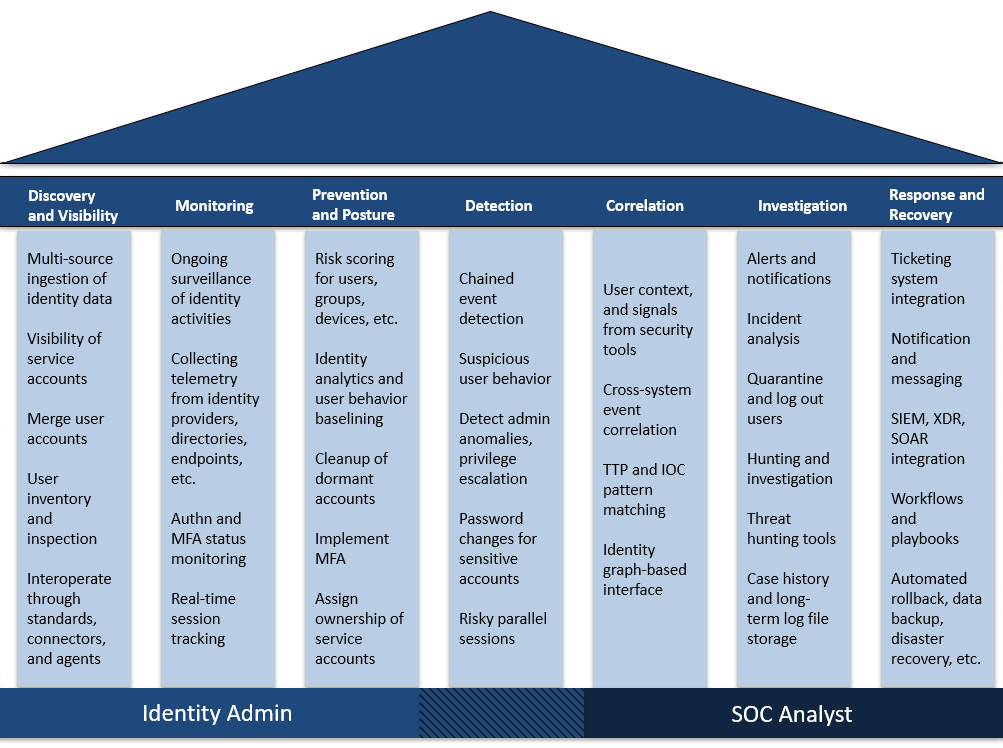
Figure 2: The Seven Pillars of ITDR
These pillars support activities that range from administration of identity systems (on the left) to SOC-related responsibilities (on the right). However, several functions depicted sit at the intersection of both domains. These overlapping areas underscore the necessity of shared responsibility between identity administrators and SOC teams. Tools that offer integrated visibility and shared workflows significantly enhance the effectiveness of ITDR initiatives, helping teams respond faster and with greater confidence to identity-based threats.
Other capabilities include, amongst others:
- Standards support
- Data Access Governance
- Developer support
- Connectors to target systems
- Toolkits for customizing connectors
- Integration and/or synchronization to directory services
- Compromised credential intelligence
- Identity and access analytics
- Service account and NHI protection
- Auditing, reporting, and dashboarding
- Comprehensive set of APIs
- Flexible, modern software architecture & deployment
- Configurable and explainable AI capabilities
- Fraud Reduction Intelligence Platform Integration
- ITSM integration (i.e., ServiceNow)
- NDR and EPDR integration
- SIEM, SOAR, and XDR integration
- Integration into Incident Management / Response Systems
- Applied AI/ML for identity and access analytics
- Applied AI/ML for adaptive authentication and authorization
- Support for strong risk- and context-based authentication to the ITDR system
- Ability to create and manage deceptive assets like accounts, token, certificates, etc.
Leadership
In the full chapter: Overall Leadership, Product Leadership, Innovation Leadership, and Market LeadershipCreate a free account
Product/Vendor evaluation
In the full chapter: Spider graphs, Acalvio – Acalvio ShadowPlex, Andromeda Security – Andromeda Identity Security Platform, AuthMind – AuthMind Identity Protection Platform, Axonius – Axonius Platform, BeyondTrust – BeyondTrust Pathfinder Platform, Cayosoft – Cayosoft Guardian and Cayosoft Administrator, CrowdStrike – Falcon Next-Gen Identity Security, CyberArk – CyberArk Identity Security Platform, Delinea – Delinea Identity Threat Protection, ManageEngine – ManageEngine AD360, PAM360, and Log360, Microsoft – Entra ID and Defender for Identity, Netwrix – Netwrix ITDR, Okta – Okta and the Auth0 Platform, Quest – Quest Security Guardian, Saviynt – Saviynt Identity Cloud, Segura – Segura 360° Privilege Platform, Semperis – Active Directory Threat Detection and Response, SentinelOne – Singularity Identity, Sharelock – Sharelock Identity Security Platform, Silverfort – Silverfort ITDR, SlashID – SlashID Identity Protection, and Whiteswan Identity Security – Whiteswan ITDRCreate a free account
Vendors to Watch
In the full chapter: Astrix Security, Gurucul, Oasis Security, Securonix, and ZscalerCreate a free account
Related Research
Leadership Compass: Identity Threat Detection and Response (ITDR) 2024
Leadership Compass: Cloud Security Posture Management 2024
Webinar: Cloud Security in the Age of Generative AI
Leadership Compass: Container Security
Leadership Compass: SASE Integration Suites
Advisory Note: Security Organization Governance and the Cloud
Advisory Note: Cloud Services and Security
Blog: Cloud Security Alphabet Soup
Copyright
© 2026 KuppingerCole Analysts AG. All rights reserved. Reproducing or distributing this publication in any form is prohibited without prior written permission. The conclusions, recommendations, and predictions in this document reflect KuppingerCole Analysts' initial views. As we gather more information and conduct deeper analysis, the positions presented here may undergo refinements or significant changes. KuppingerCole Analysts disclaims all warranties regarding the completeness, accuracy, and adequacy of this information. Although KuppingerCole Analysts' research documents may discuss legal issues related to information security and technology, we do not provide legal services or advice, and our publications should not be used as such. KuppingerCole Analysts assumes no liability for errors or inadequacies in the information contained in this document. Any expressed opinion may change without notice. All product and company names are trademarks™ or registered® trademarks of their respective holders. Their use does not imply any affiliation with or endorsement by them.
KuppingerCole Analysts supports IT professionals with exceptional expertise to define IT strategies and make relevant decisions. As a leading analyst firm, KuppingerCole Analysts offers firsthand, vendor-neutral information. Our services enable you to make decisions crucial to your business with confidence and security.
Founded in 2004, KuppingerCole Analysts is a global, independent analyst organization headquartered in Europe. We specialize in providing vendor-neutral advice, expertise, thought leadership, and practical relevance in Cybersecurity, Digital Identity & IAM (Identity and Access Management), Cloud Risk and Security, and Artificial Intelligence, as well as technologies enabling Digital Transformation. We assist companies, corporate users, integrators, and software manufacturers to address both tactical and strategic challenges by making better decisions for their business success. Balancing immediate implementation with long-term viability is central to our philosophy.
For further information, please contact clients@kuppingercole.com.
Executive Summary


Leadership
Product/Vendor evaluation
Spider graphs
Acalvio – Acalvio ShadowPlex
Andromeda Security – Andromeda Identity Security Platform
AuthMind – AuthMind Identity Protection Platform
Axonius – Axonius Platform
BeyondTrust – BeyondTrust Pathfinder Platform
Cayosoft – Cayosoft Guardian and Cayosoft Administrator
CrowdStrike – Falcon Next-Gen Identity Security
CyberArk – CyberArk Identity Security Platform
Delinea – Delinea Identity Threat Protection
ManageEngine – ManageEngine AD360, PAM360, and Log360
Microsoft – Entra ID and Defender for Identity
Netwrix – Netwrix ITDR
Okta – Okta and the Auth0 Platform
Quest – Quest Security Guardian
Saviynt – Saviynt Identity Cloud
Segura – Segura 360° Privilege Platform
Semperis – Active Directory Threat Detection and Response
SentinelOne – Singularity Identity
Sharelock – Sharelock Identity Security Platform
Silverfort – Silverfort ITDR
SlashID – SlashID Identity Protection
Whiteswan Identity Security – Whiteswan ITDR
Vendors to Watch
Related Research
Copyright































Table of Contents


Table of contents
Close
Executive Summary
Leadership
Product/Vendor evaluation
Spider graphs
Acalvio – Acalvio ShadowPlex
Andromeda Security – Andromeda Identity Security Platform
AuthMind – AuthMind Identity Protection Platform
Axonius – Axonius Platform
BeyondTrust – BeyondTrust Pathfinder Platform
Cayosoft – Cayosoft Guardian and Cayosoft Administrator
CrowdStrike – Falcon Next-Gen Identity Security
CyberArk – CyberArk Identity Security Platform
Delinea – Delinea Identity Threat Protection
ManageEngine – ManageEngine AD360, PAM360, and Log360
Microsoft – Entra ID and Defender for Identity
Netwrix – Netwrix ITDR
Okta – Okta and the Auth0 Platform
Quest – Quest Security Guardian
Saviynt – Saviynt Identity Cloud
Segura – Segura 360° Privilege Platform
Semperis – Active Directory Threat Detection and Response
SentinelOne – Singularity Identity
Sharelock – Sharelock Identity Security Platform
Silverfort – Silverfort ITDR
SlashID – SlashID Identity Protection
Whiteswan Identity Security – Whiteswan ITDR
Vendors to Watch
Related Research
Copyright









