
Sovereignty in the cloud is no longer simply about where data resides, it is about managing risks. Microsoft’s 2026 strategy provides more options to help customers to manage sovereignty risks in context.
Microsoft’s April 2026 sovereign cloud announcements mark an important shift in how HyperScale cloud providers position sovereignty. The narrative has clearly evolved from a narrow focus on data residency to a broader concept of risk management across the multiple domains of sovereignty risk.
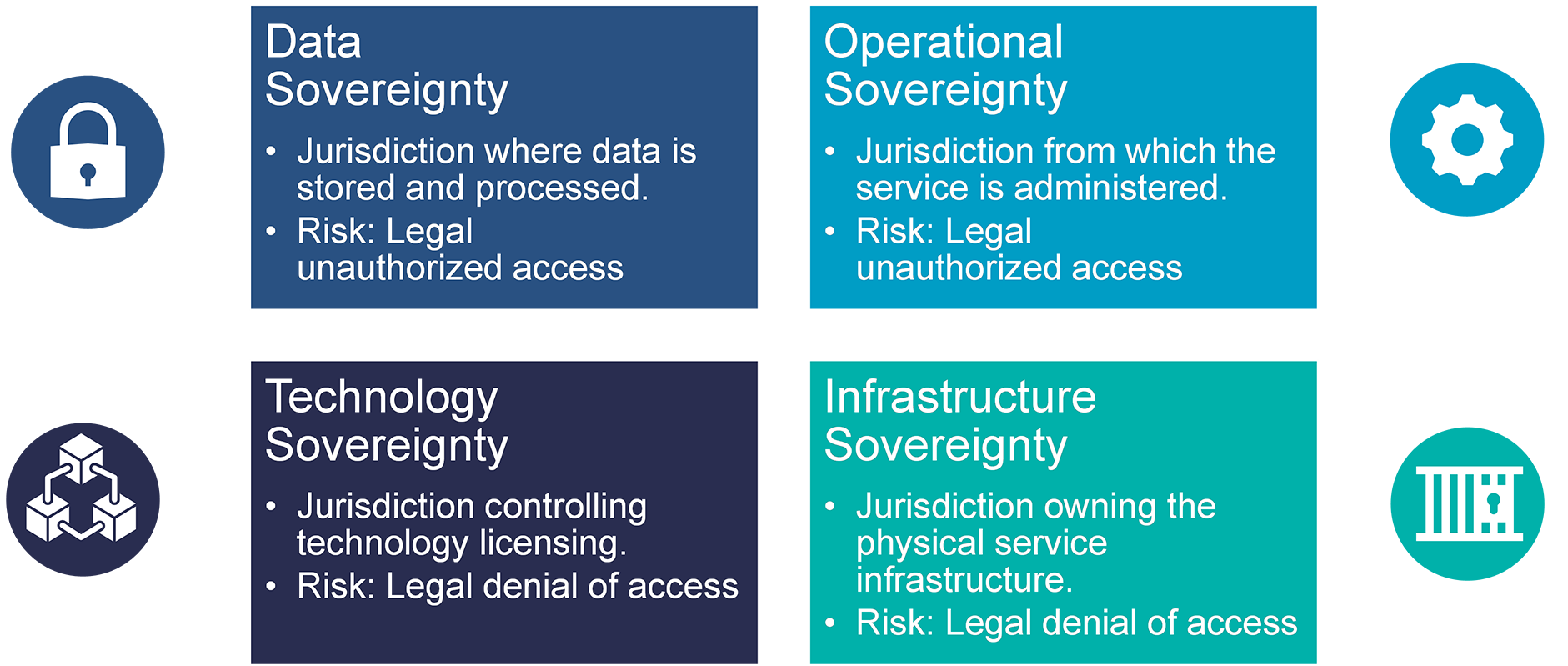
In my previous blogs I identified the four major areas of sovereignty risk illustrated above. In this blog I will assess where Microsoft’s approach reduces risk, as well as remaining residual risks.
Data Sovereignty
The Jurisdiction where data is stored and processed
Risk: Legal unauthorized access
Microsoft continues to position the EU Data Boundary as the foundation of its data sovereignty approach. The 2026 updates extend this boundary further, notably including:
- AI workloads and processing
- Microsoft 365 Copilot data handling
- Associated telemetry and logs
- Support for confidential computing (encryption during processing)
This is a significant step forward. By bringing AI processing explicitly into scope, Microsoft addresses a gap that had emerged with the rapid adoption of generative AI services.
However, the core risk, legal unauthorized access, is only partially mitigated.
While data may be stored and processed within the EU and handled by European personnel, Microsoft remains a US-headquartered provider. As such, it is still subject to extraterritorial legal frameworks, including potential lawful access requests under US legislation such as the US CLOUD Act.
Residual Risk: Microsoft reduces the likelihood of unauthorized access through localization and operational controls but does not eliminate the legal basis for such access.
Operational Sovereignty
Jurisdiction from which the service is administered
Risk: Legal unauthorized access
Microsoft’s 2026 announcements place increased emphasis on operational control, including:
- European governance structures and oversight
- Increased use of EU-based personnel for service operations
- Enhanced policy controls and “sovereign landing zones”
- Partner-operated cloud delivery (e.g., Bleu, Delos Cloud)
These measures aim to ensure that day-to-day administration occurs within the relevant jurisdiction, aligning operational control with regulatory expectations.
However, the underlying control plane and service architecture remain globally integrated. Critical service management capabilities ultimately reside within Microsoft’s global operational model. However, Microsoft say Azure Local can run indefinitely in a fully disconnected / air-gapped mode, provided you handle updates and lifecycle management locally.
This creates a structural limitation: even if operations are regionally executed, ultimate administrative authority is not fully decoupled from the parent organization.
Residual Risk: Microsoft improves operational sovereignty through regionalization and governance, but does not fully localize administrative authority for all delivery models, leaving residual exposure to legal access risks.
Technology Sovereignty
Jurisdiction controlling technology ownership and licensing
Risk: Legal denial of access
This is the area where Microsoft’s approach remains most constrained. Across its sovereign cloud offerings, including Azure, Microsoft 365, and AI services, customers remain dependent on:
- Microsoft-controlled software licensing
- Proprietary platforms and APIs
- Centralized update and support mechanisms
The 2026 introduction of Azure Local with AI capabilities and support for disconnected operations represents a meaningful improvement. It enables:
- Local execution of workloads, including AI models
- Reduced dependency on continuous connectivity
However, these capabilities do not change the fundamental licensing model. Access to the technology stack remains governed by Microsoft, and therefore subject to legal or political restrictions that could limit availability. Microsoft says that it would take legal action to resist any imposition of controls by any government.
Residual Risk: Microsoft introduces more deployment flexibility, but technology sovereignty remains limited, with continued exposure to denial-of-access risks via licensing control.
Infrastructure Sovereignty
Jurisdiction where the physical service infrastructure is owned
Risk: Legal denial of access
Microsoft’s sovereign cloud model continues to rely heavily on hyperscale infrastructure owned and operated by Microsoft, even when located within the EU.
The 2026 updates introduce an important enhancement:
- Support for fully disconnected or air-gapped environments
- Expansion of Azure Local deployments, including on-premises scenarios
These capabilities provide a pathway toward greater infrastructure independence, particularly for:
- Government
- Defense
- Critical infrastructure sectors
In addition, the partner cloud model (e.g., Bleu in France, Delos in Germany) introduces elements of local ownership and operation.
However, for most customers using public cloud services, infrastructure ownership remains external. This means that access to infrastructure could, in extreme scenarios, be restricted or withdrawn.
Assessment: Microsoft offers partial mitigation through hybrid and partner models, but infrastructure sovereignty is not fully achieved in standard public cloud deployments.
Conclusion: From Sovereignty to Risk Management
Microsoft’s 2026 announcements reflect a broader industry shift: sovereignty is no longer presented as an absolute, but as a set of risks to be managed across multiple domains.
When considered across the four risk categories:
- Data sovereignty is meaningfully improved, particularly with AI now in scope
- Operational sovereignty is strengthened but still not fully localized
- Technology sovereignty remains largely unchanged
- Infrastructure sovereignty improves for specific groups of customers, but less so in their public cloud
The net effect is not the elimination of sovereignty risk, but its elements.
Responsibility shifts to customers, who must decide:
- which deployment model to use
- which risks are acceptable
- and how to combine controls across cloud, hybrid, and on-premises environments
For help, use our Buyer's Compass: EU Sovereign Cloud Services.
Microsoft’s sovereign cloud, therefore, should be understood as a framework to help to manage sovereignty trade-offs.
Final insight: Sovereignty in the cloud is no longer about where data resides, it is about what risks matter. Microsoft’s 2026 strategy makes progress, but that question remains only partially answered.