



What began as a limited discussion around data residency and regulatory compliance has evolved into a strategic conversation about Europe's economic competitiveness, technological independence, and ability to participate in the AI economy.
Recent geopolitical developments, accelerating investment in artificial intelligence, and increasing concerns over digital sovereignty are driving strong demand for European sovereign cloud infrastructure. At the same time, Europe faces significant structural challenges that could limit its ability to capitalize on this opportunity. The IMF's recent working paper Europe's Productivity Weakness identifies many of the underlying economic factors that continue to constrain Europe's innovation and productivity, several of which apply equally to the sovereign cloud market.
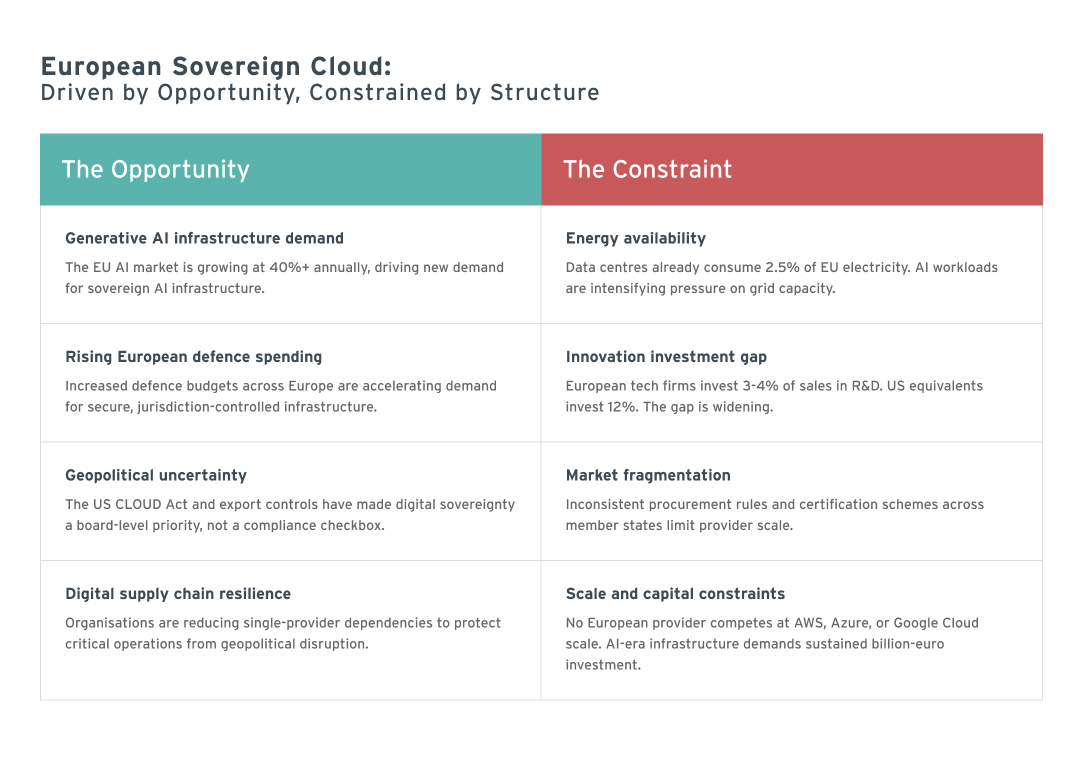
The future success of European sovereign cloud providers will therefore depend not only on growing demand but also on Europe's ability to overcome these structural barriers.
Growth Drivers and Opportunities for EU Sovereign Clouds
The market opportunity for European sovereign cloud has never been greater. Artificial intelligence, geopolitical change and growing strategic investment are converging to create a once-in-a-generation opportunity for European cloud providers to compete on more than trust alone.
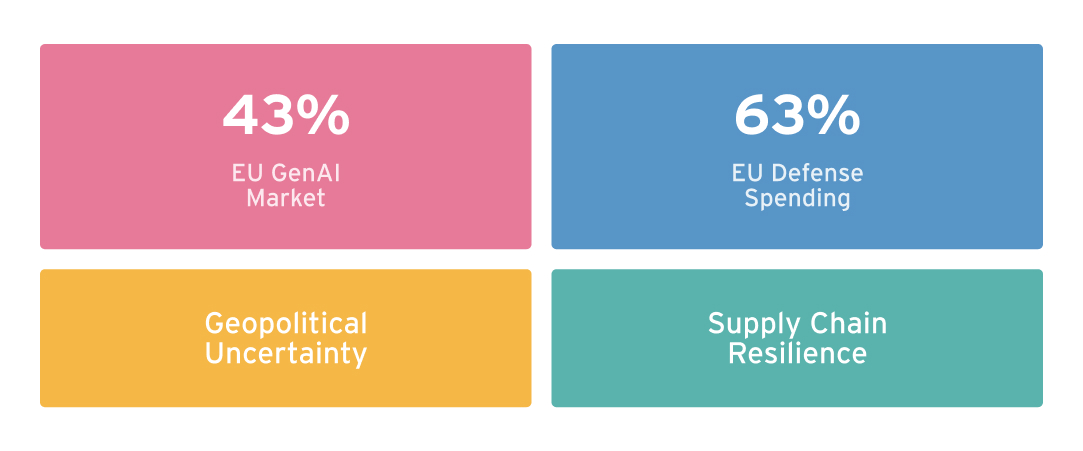
- Generative AI (GenAI) is creating a new cloud market: GenAI is fundamentally changing cloud infrastructure requirements. Unlike previous generations of enterprise software, GenAI requires vast amounts of computing capacity, specialized GPU infrastructure, high-performance networking, and scalable storage. As organizations move from experimentation to production deployment, AI infrastructure is rapidly becoming the next major growth engine for cloud services.
Forecasts suggest the European AI market will continue to grow at over 40% annually, with the GenAI segment growing even faster. Every new AI application increases demand for cloud-native AI platforms, inference services, vector databases, model hosting, and sovereign AI infrastructure. For European cloud providers, this represents an opportunity to compete in a rapidly expanding market rather than attempting to displace established hyperscale cloud service providers (CSPs) in traditional infrastructure services. - Rising European defense spending: The rapid increase in European defense investment is creating a second major growth opportunity. Defense organizations require sovereign digital infrastructure capable of supporting secure communications, intelligence analysis, autonomous systems, AI-enabled decision support, and classified workloads.
European initiatives such as ReArm Europe and increasing national defense budgets are accelerating investment in secure digital infrastructure. Sovereign cloud providers can support these requirements through trusted cloud platforms operated under European jurisdiction and aligned with national security requirements. - Geopolitical uncertainty: Geopolitical risk has become one of the strongest drivers of sovereign cloud adoption. Growing concerns around the US CLOUD Act, international sanctions, export controls, supply chain disruption, and increasing geopolitical tensions have elevated digital sovereignty from a compliance issue to a board-level strategic consideration.
Many organizations are now evaluating where their critical applications are hosted, who operates their infrastructure, which legal jurisdictions apply to their data, and how resilient their digital operations would remain during periods of international instability. This shift is expanding demand for cloud services that provide stronger guarantees around legal, operational, and technological sovereignty. - Digital supply chain resilience: Modern supply chains depend upon digital infrastructure. Manufacturing, healthcare, utilities, financial services and government all rely upon cloud-based platforms to operate critical business processes.
As recent geopolitical events have demonstrated, resilience is no longer limited to physical supply chains. Organizations are seeking resilient digital supply chains that minimize dependencies on single providers, foreign jurisdictions, or concentrated technology ecosystems. European sovereign cloud providers can play an important role by providing trusted alternatives that improve operational resilience while reducing strategic dependence on external infrastructure.
Challenges and Structural Restraints
Despite strong market demand, European sovereign cloud providers must overcome structural challenges that have constrained Europe's technology sector for decades.
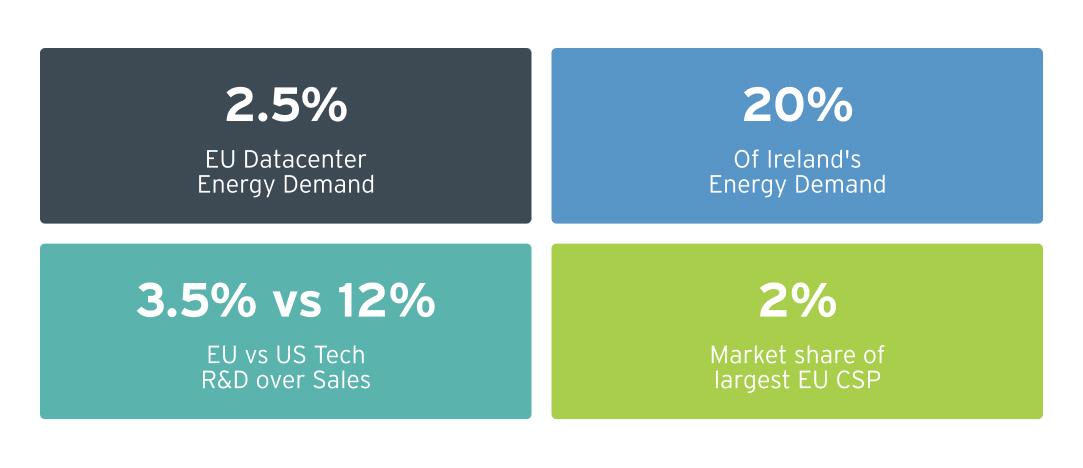
- Energy availability: Cloud infrastructure is becoming one of Europe's largest consumers of electricity. Data centers are already estimated to account for approximately 2.5% of EU electricity demand, while countries such as Ireland have seen data centers consume around one-fifth of national electricity production.
The rapid growth of AI significantly increases these pressures. GPU clusters require substantially more power than traditional cloud infrastructure, creating challenges around electricity availability, grid capacity, sustainability objectives, and planning approval. Access to affordable renewable energy may become one of the limiting factors for Europe's sovereign cloud providers. - Lower investment in innovation: Perhaps the most striking observation from the IMF report is the widening innovation gap between Europe and the United States. European technology firms continue to invest significantly less in research and development than their US counterparts. The report notes that R&D expenditure among European listed technology firms has remained around 3–4% of sales, while comparable US firms have increased investment to approximately 12% of sales.
This innovation gap directly affects the cloud market. Continuous investment is required to develop AI services, automation capabilities, cloud platforms, cybersecurity technologies, and advanced management tools. Without sustained investment, European providers risk falling further behind the innovation cycles established by the US hyperscale CSPs. - Market fragmentation: Despite decades of economic integration, Europe remains a fragmented digital market. The IMF argues that European firms continue to operate within a much smaller effective market than their US competitors because regulatory, commercial and operational barriers continue to limit scale.
This fragmentation affects sovereign cloud providers directly. Different procurement frameworks, regulatory interpretations, national certification schemes, and customer preferences increase operational complexity and reduce economies of scale. Completing Europe's Digital Single Market for cloud services remains one of the most important long-term growth opportunities. - Limited market scale: European cloud providers also face a significant scale challenge. While Europe has many capable national and regional cloud providers, none individually approaches the market presence of AWS, Microsoft Azure or Google Cloud. The largest European provider still represents only a small percentage of the overall European cloud infrastructure market.
Scale matters because cloud economics increasingly depend upon global infrastructure, AI investment, procurement leverage, software ecosystems and continuous platform innovation. Without greater scale, many European providers may struggle to match the pace of investment required by the AI era. - Access to growth capital: The IMF identifies lower levels of equity financing and venture capital investment as another structural weakness within the European economy. Young innovative firms frequently struggle to obtain the funding required to scale rapidly, particularly those investing heavily in intangible assets and advanced technologies.
These same challenges apply to sovereign cloud providers. Building AI-ready cloud infrastructure requires billions of euros of investment in data centers, GPU clusters, networking, software platforms, and operational capability. Ensuring sufficient access to long-term investment capital will therefore be essential if Europe wishes to build globally competitive sovereign cloud providers.
From Compliance to Competitiveness
The conditions for European sovereign clouds have never been stronger. But demand does not automatically translate into competitive infrastructure.
The opportunity extends well beyond compliance or data residency. Sovereign clouds have the potential to become one of the foundations of Europe's future digital economy, enabling trusted AI adoption, supporting strategic industries, strengthening resilience, and improving long-term productivity. If Europe can combine its regulatory leadership with deeper market integration and increased investment in innovation, sovereign cloud could evolve from a defensive response to geopolitical uncertainty into a powerful engine of European competitiveness and economic growth.
How can European organizations reconcile security imperatives (NIS2) with the adoption of AI while remaining dependent on US hyperscalers? Forum INCYBER and KuppingerCole Analysts invite you to decode the realities of digital autonomy on July 15, 2026 at 5:00 pm (CEST).







