



If you’ve ever chuckled at a meme about a “stupid AI,” you’re not alone. They’re everywhere - and most of them completely miss the point. What they usually show isn’t the failure of artificial intelligence, but the failure of humans to give it the right guidance.
The real problem isn’t that AI can’t think; it’s that we keep expecting it to.
The illusion of intelligence without supervision
Artificial intelligence remains a creature of its data and design. It’s excellent at spotting anomalies - but has no clue what those anomalies actually mean. Take enterprise systems such as SAP: an AI might flag the spike of end-of-year transactions in finance as a suspicious deviation, while any human accountant would instantly recognize it as standard procedure.
This is precisely where today’s Security Operations Centers (SOCs) reach their limits. AI systems are flooded with countless alerts and “risk signals,” often stripped of the context that gives them meaning. Correlation across systems is still far from perfect. As a result, it is (or should be) up to human analysts to fill in the blanks - adding the missing context, interpreting intent, and reconstructing what’s really happening.
The challenge: until there is enough contextual understanding, increasing the degree of correlation may actually make things worse. It can lead to misleading results, simply because the growing volume of data makes it harder to extract meaning. And if only limited human feedback is available, AI will start to generalize everything in that narrow frame - interpreting unrelated signals as if they were, for instance, end-of-year financial activities - until the next wave of contextual learning comes along, such as operational changes during a summer factory shutdown. In essence, there is a widening gap between massive data volumes and scarce human feedback, a gap that cannot be bridged at scale.
In this environment, human analysts play a crucial role - not only by providing context, but by continuously refining and adjusting rules, integrating domain knowledge, and offering the qualitative insight that AI systems still lack. Over time, these efforts enable the models to deliver more meaningful and accurate responses. The outcome is not necessarily fewer human tasks, but more complex and more valuable ones, as they provide the understanding AI still depends on to make the right decisions.
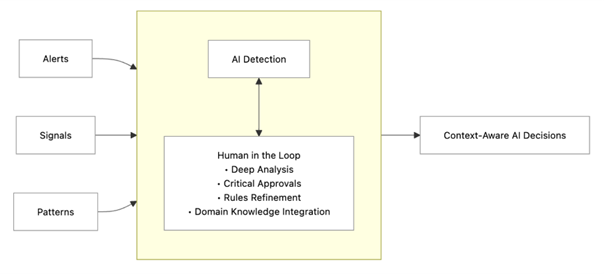
To fix this, we don’t need “smarter” AI. We need better-trained AI - systems that are not just fed with data but guided with context. Supervised learning, refined through ongoing human feedback, allows AI to slowly grasp why certain anomalies are harmless while others are worth an alarm. It’s not the size of the dataset that determines success, but the depth of understanding built into it.
The limits of shared learning in a world built on context
Some argue that massive datasets - like those collected by large security vendors - will eventually solve this problem. That approach only works in areas where the data itself carries meaning, such as network telemetry or known threat patterns. Once business context enters the picture, everything changes - and it inevitably has to. The point is simple: the moment you want to work in a truly risk-based way, business context must become part of the equation.
Every enterprise has its own logic, processes, and operational rhythms. Much may look similar across organizations, yet the willingness to share business context quickly fades once questions of sensitivity arise. It is difficult to draw a clear line between what counts as generic context and what constitutes confidential, strategic, or competitive information that must remain internal. As a result, cross-enterprise AI learning - while effective in areas like network security - largely fails when it comes to domains shaped by business context.
The human in the loop is here to stay
The real takeaway is that AI does not - and will not - replace human expertise in domains that depend on understanding nuance, context, and intent. Its task is to learn continuously and, over time, to narrow the range of situations that still require human judgement. In security operations, for instance, AI should aim to eliminate false negatives, minimize false positives, and deliver only those alerts or events to analysts where human insight truly makes the difference.
Looking at this from a broader perspective, the myth of a “fully automated workforce” dissolves quickly. AI can execute rules, but it cannot create them without instruction. Future human jobs will therefore not vanish - they will evolve. One of their most valuable forms will be continuously teaching AI the complex rules of the real world- something only genuine, experience-based human expertise can provide - translating human expertise into structured knowledge that machines can actually use.
When bad input meets bad output
The many laughable AI-generated phishing and spam attempts flooding inboxes today are living proof of this. Contrary to many expectations, they aren’t better or more convincing – they are just differently bad. And it hardly helps to counter bad AI from attackers with equally bad AI on the defenders’ side. The reason remains the same as before: poor training data, weak supervision, and a lack of domain-specific refinement - this time in the worlds of fraud and social engineering.
AI is only as intelligent as the human effort invested in shaping it. Until we stop treating it as an oracle and start treating it as an apprentice, the memes will keep writing themselves - and the real stupidity will remain entirely human.









