



Privileged Access Is No Longer About Privileged Accounts
Privilege in the enterprise is no longer defined by a handful of administrator accounts. It is defined by the ability of an identity to perform actions that affect systems, infrastructure, security controls, or other identities. That shift changes how organizations should think about Privileged Access Management (PAM). The objective is no longer simply to protect privileged accounts but to govern privileged actions wherever they occur.
Historically, PAM focused on administrators managing servers, networks, and enterprise applications. Credential vaulting, password rotation, and session monitoring became the foundation of privileged access security. These capabilities remain important, but they no longer reflect the full scope of privilege within modern enterprises. For more information on this, check out our latest analyst chat.
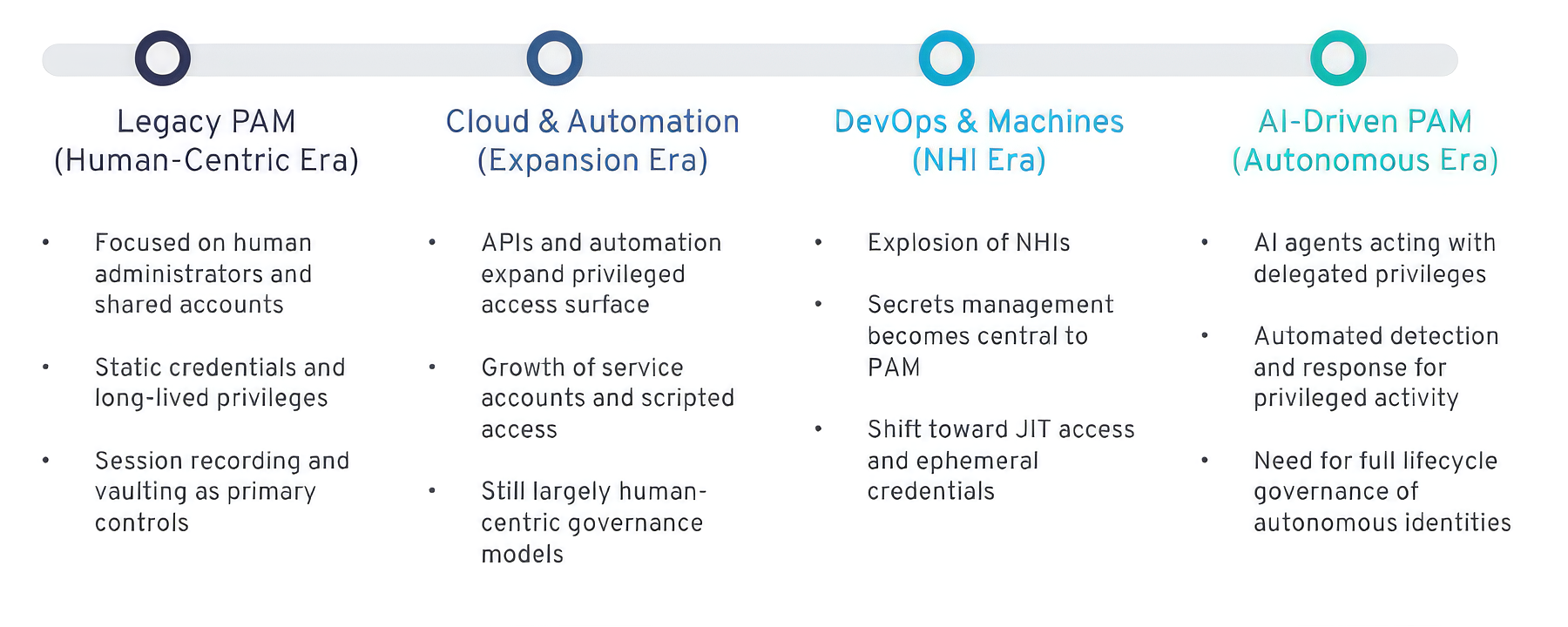
Today, privileged activity is performed by a growing mix of human and non-human identities (NHIs). Artificial Intelligence (AI) agents, service accounts, Application Programming Interface (APIs), automation pipelines, workloads, and cloud services execute operational tasks continuously, often without human intervention. In many organizations, these machine identities significantly outnumber employees. Because they frequently operate with broad permissions, they have become one of the largest sources of privileged activity across enterprise environments.
Privilege Becomes Dynamic
Cloud platforms, SaaS applications, containers, and API-driven services have transformed enterprise infrastructure into highly dynamic environments. Permissions are granted, modified, and removed continuously as workloads scale and services are deployed. Privilege is no longer tied to a static administrator account. It has become a fluid set of capabilities distributed across identities, policies, roles, and services.
As a result, PAM has expanded. Modern solutions increasingly provide privileged identity discovery, secrets management, policy-driven authorization, Just-in-Time (JIT) access, cloud entitlement management, and continuous monitoring across hybrid and cloud-native environments. Together, these capabilities support least privilege by reducing persistent permissions and ensuring elevated access exists only when required.
This evolution is also reshaping the market. Established PAM vendors now compete alongside identity providers, cloud-native specialists, and broader cybersecurity platforms. At the same time, the boundaries between PAM, Identity Governance and Administration (IGA), Cloud Infrastructure Entitlement Management (CIEM), and Identity Threat Detection and Response (ITDR) continue to blur as organizations seek integrated identity security rather than isolated point solutions. For more information on this, check out our latest Leadership Compass PAM.
Rethinking Standing Privilege
Despite these advances, many organizations still operate under an assumption inherited from traditional IT: privileged access should exist continuously because it may be needed later. Even mature PAM deployments often maintain administrator accounts or service identities with standing permissions that remain available long after their last use.
Zero Standing Privilege (ZSP) challenges that assumption. Rather than asking how privileged access should be protected, ZSP asks whether it should exist before it is actually required. Under this operating model, no human, machine, workload, or AI agent permanently retains privileged permissions. Access is granted only for a specific task, under defined conditions, and only for the time needed to complete that task. Once the work finishes, the privilege disappears automatically.
However, ZSP is not another product category. Organizations cannot purchase ZSP as a standalone solution. Instead, it represents an operating model supported by technologies such as PAM, IGA, CIEM, ITDR, secrets management, and identity fabrics that coordinate these capabilities into a unified architecture. ZSP should therefore be understood as an architectural approach rather than a separate technology.
JIT access plays an important role, but it should not be confused with ZSP. Many JIT implementations grant temporary access to pre-existing privileged accounts or entitlements that remain permanently available. ZSP goes a step further by eliminating persistent privileges wherever possible. The objective is to remove dormant entitlements, reduce the attack surface, and ensure that elevated permissions exist only for the duration of a legitimate operational need.
As enterprise environments become increasingly automated and identity becomes the primary security boundary, the management of privilege shifts from protecting privileged accounts to minimizing privileged access itself. That transition represents one of the most significant changes currently shaping the future of identity security. In the coming weeks, we will publish an Advisory Note on how to achieve ZSP and assess your organization's maturity model.







