



Enterprise security teams have always needed asset maps to visualize, design, deploy, and manage their security controls. Historically, those maps included networks, devices, and perimeter boundaries. Over time, they expanded to include users, applications, APIs, cloud services, and SaaS applications. The rise of AI agents adds a new layer of emerging complexity: digital actors operating on behalf of people, embedded inside SaaS applications, interacting with enterprise systems, and increasingly collaborating with other agents. In this new environment, the question is no longer simply "who has access to what?" It becomes "what delegated authority does an agent have, what can it do, which other agents can it invoke, which applications and data can it reach, and who is accountable for its actions?" To answer these questions, organizations need a new map: the agentic enterprise graph.
AI Agents Disrupt Governance
AI agents radically change the governance and control environment because they are not only resources to be inventoried but are also semi-autonomous digital actors. They may act on behalf of an employee, a team, a business process, or a SaaS application. This shifts the problem from mapping access to mapping delegated action. An agentic enterprise graph is a way to begin surfacing and tracking those relationships. The new enterprise graph should include people, personal agents, departmental or corporate agents, SaaS-embedded agents, applications, permissions, and available actions. More importantly, it should show the relationships among them: who owns the agent, who delegated authority to it, which systems it can reach, which data it can use, which actions it can take, which other agents can it invoke, and how its actions are logged. This is not just another architecture diagram. It is a governance-enabling view of the agentic enterprise.
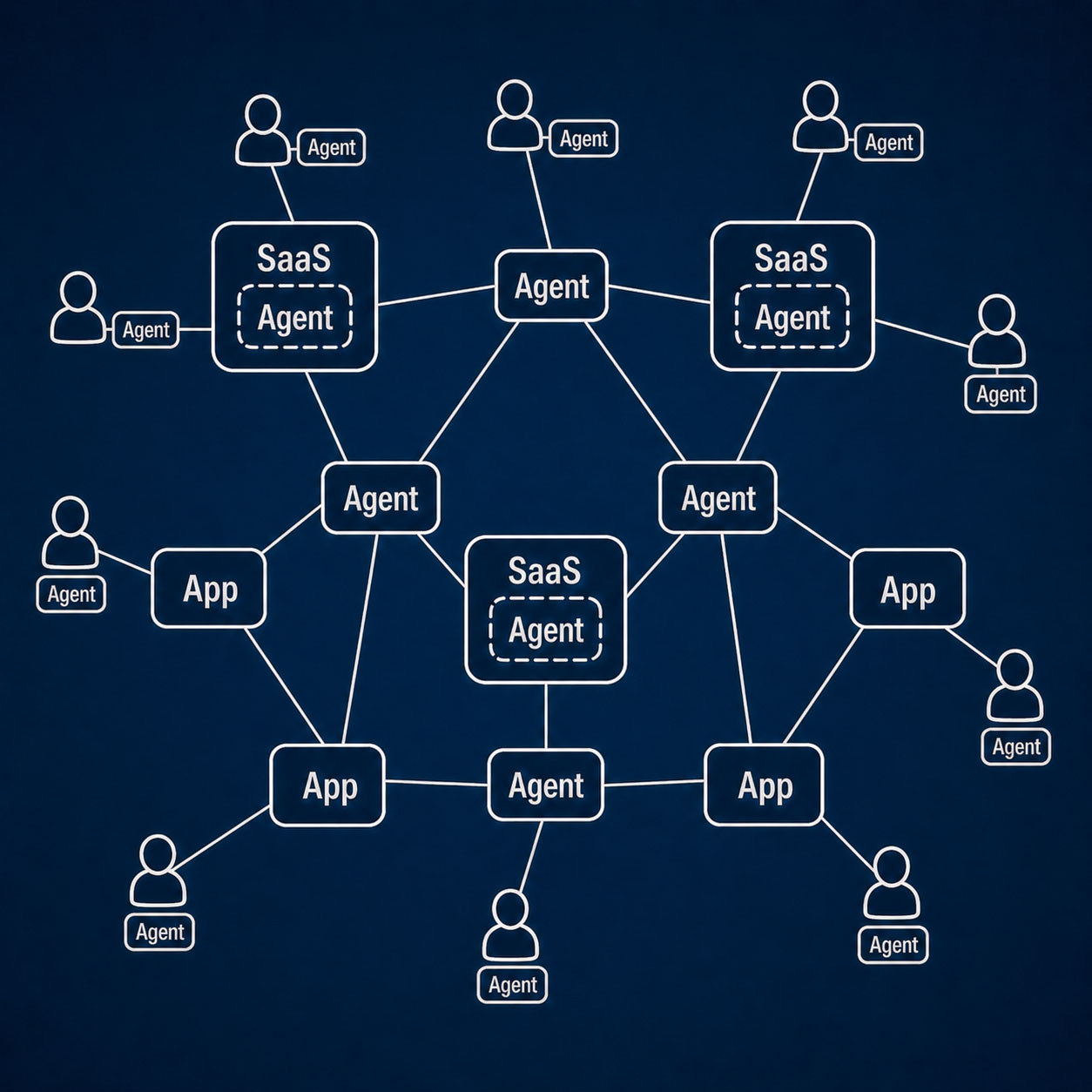 Charting a new enterprise graph
Agents are Authorized to Act
Delegation is a key point. Agents matter because they do not merely present information; they can be authorized to act. A personal agent may draft communications, query internal systems, create tickets, assemble reports, or trigger workflows on behalf of its person. A departmental agent may support finance, sales, security, or service management processes. A SaaS-embedded agent may act inside a system that already houses sensitive enterprise data. In each case, organizations need to know what authority was delegated, who approved it, and what limits apply. Those limits may be based on the task, system, time, data type, risk level, or action. Just as important, the organization needs to be able to suspend, narrow, or terminate that authority quickly and easily.
The need for a new enterprise graph becomes more urgent when agents begin to interact with other agents. A single agent-to-application connection may be relatively easy to understand. But a personal agent invoking a SaaS agent, which in turn triggers a workflow agent or calls another application, creates the risk that transitive trust will allow unexpected actions, resulting in unwanted outcomes. Privileges can chain across systems. Automation paths can become dramatically harder to follow. Accountability can become unclear. Audit trails may be split across multiple systems. The risk is not only what one agent can do in isolation. It is what the connected graph of agents, applications, APIs, and data collectively allows.
SaaSpocalypse?
It is also important not to think that agents replace applications. They, in general, do not. Applications, regardless of the noise raised as part the recent SaaSpocalypse panic, remain systems of record, execution, collaboration, regulatory control, and data access. The CRM, ERP, HR, ITSM, collaboration, security, and data platforms all remain critical enterprise services. What changes are how those systems are invoked. Agents will increasingly become the interface through which work is requested, coordinated, and executed. Therefore, any useful enterprise graph must include applications and human users, not just agents.
The Agentic Enterprise Graph and the Identity Fabric
Security and governance teams should expect the agentic enterprise graph to enable several practical capabilities. It should support agent discovery, ownership assignment, delegated authority mapping, permission visibility, application and data reachability, agent-to-agent interaction visibility, activity logging, risk scoring, and lifecycle control. The graph should connect with existing control systems, including IAM, IGA, PAM, ITDR, SSPM, API security, DSPM, and AI governance and position agents to be full members of the Identity Fabric. Otherwise, the enterprise agent graph risks becoming another isolated IT asset inventory that provides visibility without operational impact.
The agentic enterprise graph is not just about visualization. It is the source of a control model for the agentic enterprise. Before organizations can safely scale agentic AI, they need to understand the relationships among people, agents, applications, data, and the associated delegated authorities. In a world where agents can act, invoke, decide, and coordinate, the map is not just a tool for understanding complexity. It becomes the foundation for governing it.







