



A few things are clear in the discussion about the rise of reusable digital identity, but the rest is murky. We do know for sure that there must be an active, functioning exchange between issuers of digital identity credentials, the (voluntary) holders of those credentials, and the verifiers/relying parties that create value from the exchange of those credentials. Without a critical mass of all three of these roles, there will be significant challenges to shifting from a centralized model to a user-held model of digital identity.
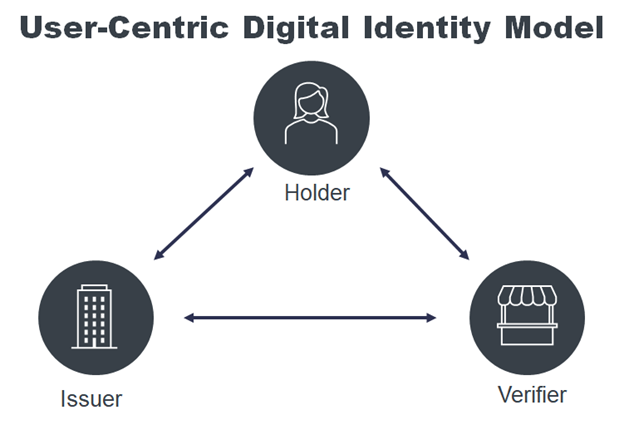
The critical aspects that are still ambiguous include how that ecosystem can be spurred into action: how many individuals are expected to voluntarily request digital identity credentials? How will the inevitability of multiple wallets be a multiplier or a hindrance to wider adoption? Where will they be able to use them? Which industries, and specifically which organizations will be able to actively participate in this paradigm shift towards user-held digital identity, and what are their benefits?
KuppingerCole Analysts took the time to crunch the numbers.
How many individuals?
The addressable population for user-held digital identity is 2.6 billion individuals globally, meaning that this number of people will voluntarily request and hold digital identity credentials based on a government-issued ID.
The defining factors of this group are that they are part of a digitally-equipped population within the age range of 15-80, in countries likely to participate (or have already established) user-held digital identity programs. A note on the age exclusion, we expect a delay (but not a permanent one) on delegated identity management features. When those features are mature enough, the young and elderly must also be added to the total addressable market.
Digital Identity vs User-Held Digital Identity
We’re talking about user-centric digital identity, where individuals are in possession of the digital identity credentials issued to them. Credentials are typically held on a user’s mobile device in a “digital wallet”, or storage mechanism.
This is different than simply “digital identity”, where users may not have possession of or control over the digital identity credentials that describe them, meaning credentials are held centrally in an issuer-controlled environment.
When we projected how many individuals will participate in user-held digital identity schemes, we excluded the populations of countries with influential digital identity schemes, like India and China.
Adoption Rates
We won’t see adoption that reaches the total addressable market all at once. Rather, we estimate approximately 400 million new credentials to be issued per year starting in 2026. If this were a linear adoption, it would take about 6.5 years to reach the current estimated addressable population. However, we’re not expecting this to be a linear adoption.
We’re anticipating a spike in adoption from European residents in the first years after the EUDI wallet launches (from 2026-2029), followed by measured adoption in the rest of the world. The US market has high potential, but also several factors that may slow adoption of the mDL: disparate rollouts in each state, interoperability challenges between state deployments, and privacy questions about what right a police officer may have to search an individual’s phone when checking a driving license are among those barriers.
ID Wallet as a Multiplier
The ID wallet as a storage mechanism for user-held identity is a complicating factor, potentially multiplying the number of credential issuances and identity exchanges, but inhibiting the interoperable growth of the issuer/holder/verifier ecosystem.
That there will be multiple wallets available is an understatement: the mandated wallets from each EU member state, sometimes from US states, in addition to privately developed ones across the world including big tech providers. The estimates come out easily to near 100 wallet options.
In our ideal functioning ecosystem, users will be able to bring the appropriate credential from their issuer to any verifier that they want to do business with (rent a car, make a purchase, open an bank account, etc.). Issuers and verifiers must therefore support multiple wallets. The more overlap between which wallets an issuer and verifier support, the easier it is for the user to user the wallet of their choice to conduct identity transactions.
It's very likely that there will be use-case specific wallets (professional, personal every-day use, personal confidential use for health/financial investments, etc.) and credentials may be issued multiple times to the same individual, but housed in different wallets.
Given this, we estimate that individuals will have on average five high-quality identity credentials (based on a government-issued identity that requires an identity verification process in order to issue or renew). These must be renewed approximately every three years. With an estimated 2.6B individuals participating in user-held identity schemes, there will be 13B high-quality credentials in use, with 4.3B credentials being renewed per year. These will be spread across multiple wallets.
Which organizations and industries can participate (and benefit?)
At the most general level, all organizations with consumer-facing digital services can participate, meaning either issue or accept/verify digital credentials as a streamlined means of onboarding or user authentication. This is estimated to be 143.6 million companies globally.
There are of course more specific ways to consider which organizations can participate: by industry (where regulated industries like financial services, public services, insurance, healthcare, and gaming and gambling will have strong benefits, supported by travel and education).
Depending on how accepting the general population is of the privacy policies applied to these digital credentials, digital services including social media platforms, streaming and media platforms, age-restricted services, and eCommerce and marketplaces are also positioned to benefit. Solutions need to be adaptable and scalable; flexible enough to accommodate varying levels of assurance for each use case or process, while also being scalable to meet the evolving demands of interoperability and security.
This doesn’t even consider the ripe market for applying these credentials to workforce IAM use cases, for onboarding, credentialing, and managing digital and physical access for employees, partners, suppliers, contractors, and more.
Triggering the Ecosystem
Establishing an active ecosystem of issuers, individuals who hold digital credentials, and organizations that integrate them into onboarding, authentication, and transaction processes is essential to a successful paradigm shift to user-held digital identities.
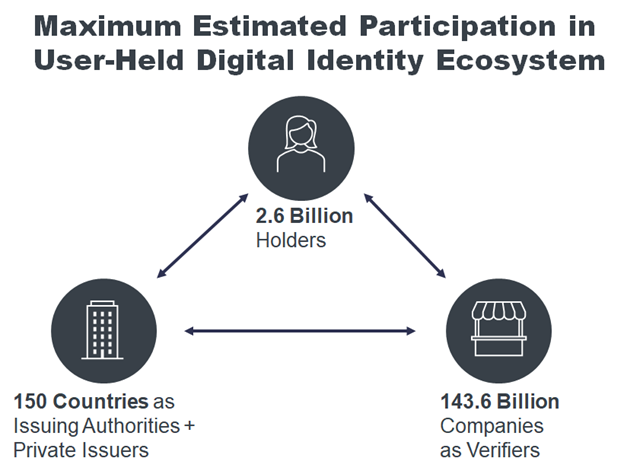
There is relative assurance through the eIDAS 2.0 mandate for EU member states to issue digital identities to residents starting in 2026, and the mDL currently available in 15 states and under active development in 11 others, along with initiatives around the world. Excluding countries with severe diplomatic tensions, active conflict, and social instability, the potential governmental issuing authorities is approximately 150 countries. This doesn’t account for the potential private issuers that will likely play an important role.
KuppingerCole’s estimation of the potential maximum participants in the holder and verifier roles should serve to give a clearer view on the range of possibilities on user-held digital identity adoption.
But what this should really do is trigger conversation: the use cases for your organizations, the potential partners available, the estimated timelines, and the next steps. The EIC is a great place to learn more about what’s happening on the technology front, from active deployments to exchanging ideas. Let’s continue the conversation in Berlin!









