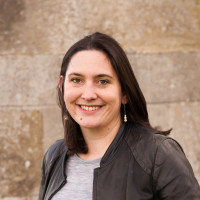
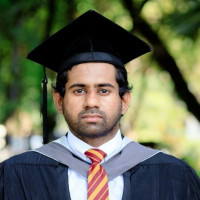
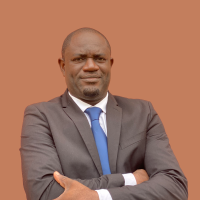
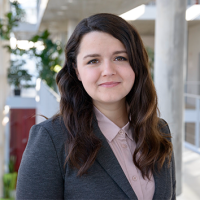
So I am Elizabeth Garber. I am the person that Alan referred to earlier. I do a lot of the work ensuring that the awards get opened up, that we have an application process and a judging process, and that people are able to actually get to the events that they have won a ticket to. But you don't want to hear from me. You want to hear from our lovely past winners. So I'm going to ask you all to go down the line.
Rachelle, I know that you've just introduced yourself, but do it again, please. And tell us what year you won. That's a good question.
Yeah, so I'm Rachelle Sellung. I'm a researcher at Fraunhofer Institute in Stuttgart, Germany in the team of identity management.
Yeah, I believe I won in 2022, three of 2023. I'm not sure.
Yeah, thank you. Time flies when you're having fun, right?
Yeah, so I won in 2023. And I think that that was one of the first times I was at such a big industry conference with so many different stakeholders that I really had the chance to go in their circles and learn what's important to them, what kind of requirements do they have, and really see how things can be implemented and be used and affect people's lives. And I thought that was really inspiring and helped motivate me to make more of an effort to get out of my own research bubble and to have those conversations. Yeah.
I'm going to invite you to introduce yourself, Thea, because in the spirit of the awards that we run, this is one of the first EICs. I know you've been to EIC before, but you're a relatively new face in the industry, and you're awesome. So introduce yourself.
OK, yeah, happy to do so. I'm Thea Kirsch. I work for ESPRIN, the Federal Agency for Breakthrough Innovation here in Germany. And I'm part of the team developing the UDI wallet. This is my first EIC in this position.
Yeah, and I'm happy to support with any translation that I can offer. We'll see how that goes. But one of the things that I love about EIC is that it's, I mean, it's here in Berlin. I'm personally based in Berlin, but it's a very international crowd gathering here. And I think that's beautiful, and I think it's great that we're getting more and more people also coming in from countries like Cameroon, for example. And that brings us to Ferdinand. Make sure we're speaking into the microphone. We can have an extra one. Go ahead.
OK, bonjour, bonjour, tout le monde. Je suis Ferdinand. Je viens du Cameroun. C'est ma première fois d'être là. Je suis professionnel à l'Office du Baccalauréat, l'administration qui délivre les diplômes pour l'enseignement secondaire au Cameroun, parce que nous avons deux sous-systèmes, un sous-système francophone et un sous-système anglophone. Nous gérons également les examens, l'organisation des examens. Can I already translate? Yeah.
So yeah, as you already heard, this is Ferdinand. He comes from Cameroun.
It's his, like it's your first time here at EIC. And you work in the Office du Baccalauréat.
Yeah, so the agency, the institution that in Cameroun is responsible for organizing the secondary education. So in Germany, this would translate to Abitur. I believe in the Anglo-Saxon system, this would be like your high school diploma, basically.
OK, on continue. Dans mon rôle, je crée des identités pour des enseignants qui enrôlent les candidats dans notre système.
En fait, nous avons le ministère d'un côté et nous avons l'administration qui gère les examens de l'autre côté. Et c'est le ministère qui crée les identités des élèves. Les enseignants enrôlent ces identités.
Nous, nous avons la charge de gérer ces identités et préparer les données pour la hiérarchie qui va exploiter ces données pour l'organisation des examens. Donc, en fait, nous gérons les identités beaucoup plus de ces enseignants et des élèves.
Yeah, so anyone working in the education sector is going to be familiar with this role and the processes around it. So basically, to organize exams and the enrollment of students, of the candidates for the baccalauréat, so for the final exam of the high school career, it's necessary to create, yeah, identities for the different students and to organize the collection of data.
Of course, also the instructors, the teachers, play a role in all of this. And yeah, the ministry and the agency in the education sector, of course, plays a huge role in that, yeah. Great.
OK, I'm going to ask Sachin now. Please introduce yourself to our audience here.
Hey, guys, so thanks for having me remotely. Sorry, I didn't get able to make it. But I'm Sachin, and I work for Envision Pharma Group as a senior engineer. And my previous company, WSO2, I mainly focused on identity access management, security architectures, and cloud systems. And my recent work also around these modern identity patterns, interoperability, and event-driven approaches. And in the last year, I got this award for Kim Cameron, and then I was able to meet Elizabeth as well in IAW in San Francisco.
So yeah, happy to be here. And yeah, it's nice to meet you guys. Happy to have you. And you're based where? In Sri Lanka. Sri Lanka. Thank you.
OK, so I would love to hear from each of you. Let's start with you, Rachel. We're just going to keep going in that order, I guess. How did you find the Kim Cameron Award? How did you find out about it in the first place? What was your story? What was my story? I believe I found out through Don Thibault.
So yeah, we worked together in the Leytas Research Project that we all know now. Yeah, he was part of the OYX partner that was there. And he was always very inspirational to me. I think he helped mentor my development in identity because it was at the very start of my career in this field. And I'm really thankful that he introduced this award to me and also introduced me to a lot of very interesting people like you. I also have a Don Thibault origin story. Yeah.
Yeah, go ahead, Ferdinand. How did you find out about the award? And why did you choose to apply? I found out about the award. I would like to tell you that it all started about 10 years ago. I was interested in dematerialization. But our systems are a little bit backward. So that's where I got interested in modern systems.
One day, I came home from class. I was teaching at an institute. And then I found a diploma on the way that had been cut. And it was wet with mud. I said to myself, but who owns this diploma? What can it become now? We couldn't read his name or his registration. And then I asked myself some questions. I continued my research. I started to look at how we could solve this problem. And while I was interested, I saw that there were systems that already existed. It's true that I had already started to be interested in decentralized systems.
And so, on the Internet, I started to follow Kim Hamilton, who is at the Decentralized Identity Foundation, the Linux Foundation. And then I discovered Jan Glazer. And it was on the wall of Jan Glazer that I discovered the competition. And that's where I applied. I'm actually happy because I didn't know Jan Glazer. And it was through him that I discovered the award, and that I discovered this whole community. I also discovered IDPRO. And I also discovered that Jan Glazer had a concern.
He said to himself, but identity professionals, they need to be provided with technical support, knowledge support. And he created, he put this certification with his team, which allows to upgrade the knowledge of those who work in the field of identity. and how they are organized in Cameroon.
And, for example, how it would be organized in the U.S. or in Germany. So there has been, you have been really interested in how other systems worldwide are organized. And I actually really like this story. So you came across a paper certificate that was cut in half because a car went across it, did it? So it really brings us back to this question of the fragility of paper documents. And how do you ensure once a paper document is destroyed, how can you re-establish the credentials? And along this thought process, you did all your research and you came across the different organizations.
You said IDPRO, you referred to Jan Glazer. And I guess this is how you ended up engaging with this community and applying for the award. Yes. Yeah. That's a great story. Thank you. I didn't know all that.
Sachin, how about you? How did you find out about the Kim Cameron Award and why did you choose to apply?
Actually, I heard it from one of colleagues that I worked with. And then he said that there's this kind of award and you can apply to it. So at that time, I did my master's which is related to identity domain. So with that, I applied to it with the proposal of my project as well. And then Elizabeth has contacted me. So with that, I got the award. And then she helped a lot, actually, to getting things done, like the papers, to getting the documents done, visas and everything. And even collaborating with the FIDO Alliance team as well.
And yeah, that was a great opportunity to be there and have this much of community and identify, work with many new people. Like Atul, who was the co-chair of SSF and K Group. So at that time, I was working on that project and was able to meet him and discuss a lot of new things with him as well. That's Atul Shubhagwale from the OpenID Foundation, chair of the Shared Signals Framework Working Group.
Yeah, thank you. So yeah, a lot of our past winners have gone on to join and participate more and more in working groups at not just the OpenID Foundation, but others, IETF, et cetera. And it's really great to see people, once they meet the community, start to get their hands dirty and really dive in and participate more in those efforts. But I don't want to talk too much. I'd rather ask you all questions before we run out of time. I would love to know, what's one thing you took away from your trips? Like those first, I know, Rachel, it's been a while since your award.
But like, what's one thing you took away? And we'll go in a different order. I'm going to go Rachel, Sachin, and then Ferdinand.
Ferdinand, you are currently on your trip. You're here now at EIC with us. So let's start with you, Rachel. What's one thing you took away? What's one thing I took away? I guess just to be open. I don't know. I think for me, it was important just to listen to all the different perspectives that I wasn't as always engaged with.
So yeah, I think, yeah, it was a lot of observation, listening, and just talking with one another. And I think that's actually really important.
I mean, I know you've had a number of collaborations since then. So you've met a lot of people in the community.
So yeah, it's worked out well. Good.
Sachin, how about you? What's one thing you left with? And you can refer to, because I know we managed to tack on our partners at the Internet Identity Workshop were amazing and enabled Sachin to make the most of his trip to California.
Actually, it was amazing. I mean, I went to Authenticate and I went to the IAW as well. And then even in the Authenticate, I was able to meet a lot of new people like starting from the providers and the application level vendors. And if you go to their workshops and you identify that all of them are like, there's a good strong bond between them. And my key takeaway was like the people, like the people I met. And there's people who are doing researches, people who are doing like, there are individual people who need to know about this new stuff.
And there's people who wanted to like explain whatever the projects they have been working on. There are some vendors who are providing their new features. So there's actually the community and the bond between them. And then the knowledge that you get with like a few days, like within what is happening in the industry and everything that can be done from UI and Azure, how to contribute to it and like how to do things differently. So thanks for the DIF team for doing this thing.
And then I know Victoria is also there and we can get more and more new awards and get people around from different countries, from the people from one corner of the world and get into this place and providing this opportunity for them to be collaborative with the people in the industry. So I got the most out of it, as Elizabeth said, in my last trip. Sorry that I didn't make it this time. That's OK. We're glad that you were able to present yesterday remotely. Yeah.
All right, Ferdinand, are you ready to tell us what you're leaving EIC with? Or do you need more time? Because I could ask you a variant if you want. I don't see enough time, but I learned yesterday, I saw Paul Sébastien's presentation. I already followed him on the network and I had the opportunity to see the presentation yesterday on the fabulous project of the European Union on decentralized currency, LoWallet, which allows you to have a set of credentials in the application wallet.
These are applications that we deserve to develop, because we have procedural problems that take up a lot of our time. And these are solutions that can allow us to improve governance in our countries. Because for a Cameroonian who is today, for example, in Russia, if he wants to have his baccalaureate, he cannot have his baccalaureate.
However, he wants to continue his studies, but he has the right to education. Russia is under embargo. DHL does not issue a diploma in Russia. The student is obliged to remain without a diploma.
However, if we had dematerialized the procedure, or if we had digital diplomas, we would have solved the problem. So this is one of the presentations that I liked the most yesterday. It is true that on a humanitarian level, I liked the presentation of Sébastien and Elisabeth. Because it concerns our countries, the problem of identity.
You see, for example, in Cameroon, it is about 13% of the population who have a problem of double identity, about 4 million people. There are also those who do not even have an identity. There are also people who are apathetic in Africa. You see those who are nomads. He is either Cameroonian today, Nigerian tomorrow. It's a real problem. And Africa is causing problems on a security level in cyberspace. Because you want to build a cyberspace with an acceptable level of confidence, except that there are physical borders. But on cyberspace, the borders are not physical.
So we also have the duty in Africa to build an acceptable level of confidence. And how are we going to do that if we do not approach technological innovation from where it is happening? This is the reason why I think we are like the myth of the cave. I am looking for the light and it is this light that I am looking for. Because here there are professional networks. It is what we do not sell because we complain about intellectual property. But that is not intellectual property.
We only have Kali, so we have only built professional communities that for the moment have just copied what you have already done and implemented it. We need support. We need material, platforms that can allow us to do it. And we need to make sure that other people understand the importance of this. Because in our countries, the rulers do not understand it. It is not their problem. So how do we do it? Even if you have suggestions, you cannot do it because the relations are in a single sense. It is an independent hierarchy. But from the bottom up, the relations are not welcome. Thank you.
The second question was actually by my colleagues who presented the German national ID wallet yesterday. So of course I am smiling that that stood out to you. And you highlighted this idea of the UDI wallet as an infrastructure that works across borders and enables to issue credentials in a user-friendly, end-to-end digital way. And this is also one of the things that we love about the UDI wallet, about the idea of it. And Rachel, you also mentioned just in your Q&A, you mentioned the troubles that you went through as a student coming from the U.S. to Germany.
And you mentioned a similar example. You said, well, if someone from Cameroon is studying abroad and they need to have their baccalaureate, their final, their credit certificate issued, how is that going to work in a digital way? And this is why you found the UDI wallet as a cross-border initiative really interesting and fascinating. You also highlighted Elisabeth's presentation and the presentation by Sebastian on Wednesday.
And both of your presentations also spoke about the human factor that is at the core of digital identity, especially what it means not to be recognized by identity systems, to be excluded from them.
And you said that invisibility is a problem in Cameroon, and that you're facing many challenges in kind of solving these problems, and that you think that the government initiatives and the resources that you have in Cameroon need to be further developed, and that you see that there's a lot of, yeah, like passion and capabilities in this community, and that hopefully going forward, there will be more kind of exchange between these different levels of governance and implementation. Incredible job, Thea. Thank you.
Okay, well, we have run out of time on this panel. I want to thank each and every one of you for being here, for applying to the awards, and for sharing your wisdom with us.
Rachel, Sachin, Ferdinand, thank you so much. And oh my goodness, Thea. She jumped in at the last second to really help make sure that we could convey the wisdom that Ferdinand had. So thank you so much. Thank you.