Why don't you like this?



Description
Short Summary
Interesting Facts
Notable Quotes
Recommendations
Takeaways


Please note that a newer
version of this paper is available, published on
November 19, 2025. You might want to check it out instead.
Introduction
The demand for remote access to industrial systems has increased significantly in recent years, driven by the need to improve operational efficiency, reduce costs, and enable faster response times to technical issues. As industrial environments become more digitized and integrated with enterprise IT systems, SRA has become a foundational requirement to maintain continuity of operations without compromising the safety or integrity of critical infrastructure.
Remote connectivity to OT and ICS environments brings obvious benefits in terms of convenience and responsiveness. It enables internal technicians, external vendors, and support contractors to access control systems remotely to troubleshoot, diagnose, and perform maintenance without the need for on-site visits. This reduces time to resolution, minimizes travel costs, and enables faster incident response. However, it also significantly increases the attack surface by creating new pathways into sensitive environments that were previously isolated by design.
Most OT systems were never designed with remote access or cybersecurity in mind. Many still operate with legacy protocols and hardware that lack native authentication or encryption, making them vulnerable to unauthorized access, manipulation, or sabotage. Attackers are increasingly targeting OT networks, not just for financial gain, but also for espionage, disruption, and in some cases, physical damage. These risks are particularly high in critical infrastructure sectors such as energy, manufacturing, transportation, and water management, where operational disruptions can have far-reaching consequences.
SRA provides a way to mitigate these risks by enforcing strong access controls, isolating protocols, enabling secure third-party access, and providing full visibility into remote sessions. Unlike traditional remote access solutions that were designed with IT in mind, SRA for OT and ICS environments must accommodate specialized systems and use cases. This includes support for legacy and proprietary protocols, protection for systems that cannot be patched regularly, and access policies that account for strict uptime requirements and constrained maintenance windows.
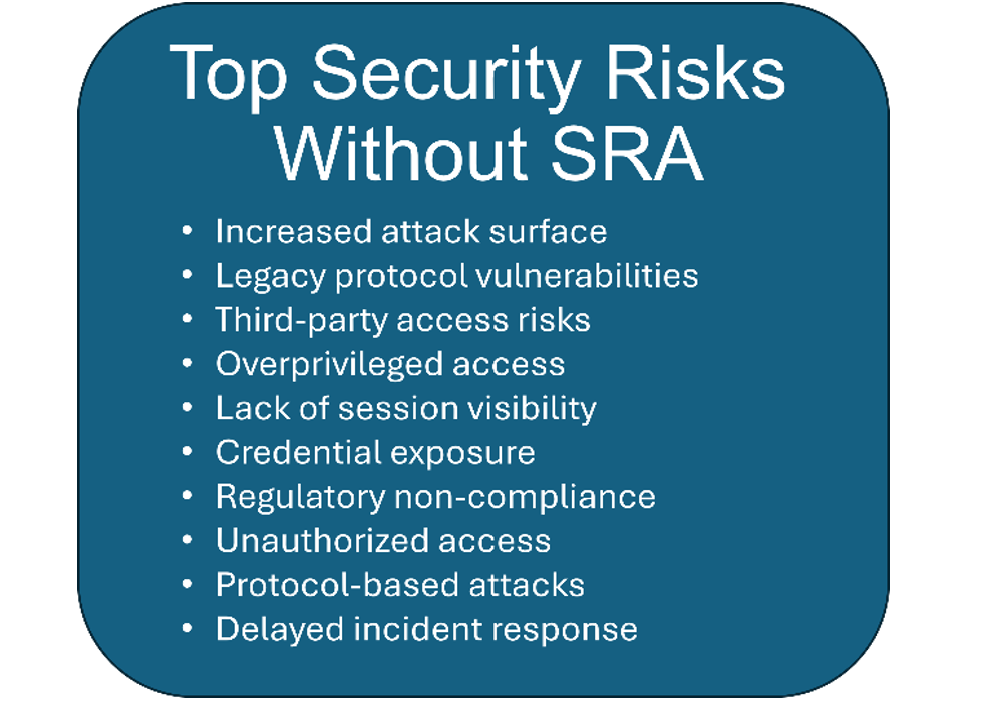
Figure 1: Reasons for implementing SRA
Beyond security, the business case for SRA includes compliance with regulatory mandates, improved resilience against cyber threats, enhanced incident response capabilities, and the ability to support remote operations safely. SRA is essential for enabling secure integration with smart technologies, predictive maintenance platforms, and data analytics services that require access to real-time operational data.
As industrial operations become increasingly connected and data-driven, it is essential for organizations to reassess how access is managed and monitored. SRA should not be treated as an add-on, but rather as a core component of a secure and modern operational strategy in OT environments. This Advisory Note examines the key capabilities of SRA, the challenges it addresses, the compliance requirements that drive its adoption, and the business advantages it can deliver.
Highlights
The full “Highlights” chapterCreate a free account
Secure Remote Access in OT and ICS: Context and Capabilities
The full “Secure Remote Access in OT and ICS: Context and Capabilities” chapterCreate a free account
Technical Requirements, Use Cases, and Compliance Drivers
In the full chapter: OT-specific Access Challenges and Requirements, Key Capabilities for Securing Remote Access, Regulatory and Operational Drivers, and Business Benefits and Strategic AlignmentCreate a free account
Recommendations
The full “Recommendations” chapterCreate a free account
Related Research
Market Compass: Cybersecurity for Industrial Control Systems
Leadership Brief: How to get a Grip on OT Cybersecurity
Whitepaper: Zero Trust Network Access for OT Environments
Blog: Securing Industrial Control Systems (ICS)
Copyright
© 2026 KuppingerCole Analysts AG. All rights reserved. Reproducing or distributing this publication in any form is prohibited without prior written permission. The conclusions, recommendations, and predictions in this document reflect KuppingerCole Analysts' initial views. As we gather more information and conduct deeper analysis, the positions presented here may undergo refinements or significant changes. KuppingerCole Analysts disclaims all warranties regarding the completeness, accuracy, and adequacy of this information. Although KuppingerCole Analysts' research documents may discuss legal issues related to information security and technology, we do not provide legal services or advice, and our publications should not be used as such. KuppingerCole Analysts assumes no liability for errors or inadequacies in the information contained in this document. Any expressed opinion may change without notice. All product and company names are trademarks™ or registered® trademarks of their respective holders. Their use does not imply any affiliation with or endorsement by them.
KuppingerCole Analysts supports IT professionals with exceptional expertise to define IT strategies and make relevant decisions. As a leading analyst firm, KuppingerCole Analysts offers firsthand, vendor-neutral information. Our services enable you to make decisions crucial to your business with confidence and security.
Founded in 2004, KuppingerCole Analysts is a global, independent analyst organization headquartered in Europe. We specialize in providing vendor-neutral advice, expertise, thought leadership, and practical relevance in Cybersecurity, Digital Identity & IAM (Identity and Access Management), Cloud Risk and Security, and Artificial Intelligence, as well as technologies enabling Digital Transformation. We assist companies, corporate users, integrators, and software manufacturers to address both tactical and strategic challenges by making better decisions for their business success. Balancing immediate implementation with long-term viability is central to our philosophy.
For further information, please contact clients@kuppingercole.com.
Introduction
Highlights
Secure Remote Access in OT and ICS: Context and Capabilities
Technical Requirements, Use Cases, and Compliance Drivers


OT-specific Access Challenges and Requirements
Key Capabilities for Securing Remote Access
Regulatory and Operational Drivers
Business Benefits and Strategic Alignment
Recommendations
Related Research
Copyright
Table of Contents


Table of contents
Close
Introduction
Highlights
Secure Remote Access in OT and ICS: Context and Capabilities
Technical Requirements, Use Cases, and Compliance Drivers
OT-specific Access Challenges and Requirements
Key Capabilities for Securing Remote Access
Regulatory and Operational Drivers
Business Benefits and Strategic Alignment
Recommendations
Related Research
Copyright










