Why don't you like this?



Description
Short Summary
Interesting Facts
Notable Quotes
Recommendations
Takeaways


Introduction
Cloud Native Application Protection Platforms (CNAPP) are evolving beyond their original role of securing cloud infrastructure and are becoming the operational foundation for securing AI-powered applications, services, and business processes.
CNAPP solutions now manage risk across cloud infrastructure, applications, identities, data, and Generative Artificial Intelligence (GenAI) services. While the first generation focused on Cloud Security Posture Management (CSPM), Cloud Workload Protection (CWPP), Cloud Infrastructure Entitlement Management (CIEM), and related cloud security functions, the market is now entering a new phase driven by GenAI-native applications and autonomous security operations.
Cloud security is a shared responsibility. Cloud Service Providers (CSP) are responsible for the security of the service they provide, and it is up to the cloud customer to secure their use of the service. CNAPP solutions provide integrated tools to help organizations using cloud services to identify and manage the risks for which they are responsible across the development and production lifecycle for low-level cloud-native infrastructure, cloud-based workloads, and GenAI-based applications and services.
Organizations are deploying large language models (LLMs), AI agents, retrieval-augmented generation (RAG) architectures, vector databases, and AI-powered business processes at scale. These workloads introduce new attack surfaces and security challenges that traditional cloud security tools were not designed to address. As a result, leading CNAPP vendors are extending their platforms with AI-SPM, AI asset discovery, model governance, AI attack path analysis, runtime protection for AI workloads, and controls for AI development pipelines.
At the same time, cloud security platforms are using agentic AI to transform how they operate. Rather than simply using AI to help identify risks, leading CNAPP solutions leverage AI agents to investigate incidents, validate exposures, prioritize remediation, and automate operational workflows. Vendors in this report, including Microsoft, Palo Alto Networks, Wiz, CrowdStrike, Qualys, and Uptycs are leading this transition toward more autonomous cloud security operations.
Another major trend is the convergence of cloud security, exposure management, runtime protection, Cloud Detection and Response (CDR), and security operations. The leading platforms combine posture management with runtime telemetry, attack path analysis, exploitability validation, and threat intelligence to focus security teams on risks that are both reachable and actively exploitable.
Cloud-native applications are built from highly dynamic, distributed components, such as containers, Kubernetes, serverless functions, APIs, and infrastructure-as-code, deployed across multi-cloud environments where traditional perimeter-based security and siloed tools are ineffective. Organizations face challenges including lack of visibility, misconfigurations, excessive entitlements, software supply chain risks, and runtime threats that span development and production environments for cloud and GenAI workloads.
The leading vendors in this Leadership Compass are distinguished not only by the breadth of their traditional CNAPP capabilities, but also by their ability to integrate cloud security, AI security, runtime intelligence, and security operations into a unified platform. As enterprises continue to adopt AI-native applications and autonomous systems, the future of the CNAPP market will be defined by platforms that can secure cloud and AI environments holistically while reducing operational complexity through automation and intelligent risk prioritization.
To better understand the fundamental principles this report is based on, please refer to KuppingerCole Analysts Research Methodology.
Key Findings
- The CNAPP market is evolving from cloud-native application protection to become the security foundation for AI-native enterprises.
- AI-SPM is evolving beyond detection of shadow AI, with leading vendors providing visibility into AI services, models, vector databases, AI pipelines, model governance, and AI-specific attack paths.
- Agentic AI is a key innovation area. Several vendors now provide AI agents capable of investigating alerts, validating exposures, recommending remediation actions, and automating security workflows.
- Runtime intelligence is used to prioritize risk. Most platforms now correlate runtime telemetry with vulnerabilities, identities, network exposure, and attack paths to focus attention on risks that are exploitable in production.
- Security graph technologies and attack path analysis are core capabilities, enabling organizations to understand how identities, workloads, data stores, networks, and AI services interact to create potential attack paths.
- CNAPP and CDR capabilities are converging as vendors integrate posture management, runtime detection, threat intelligence, incident investigation, and automated response into unified platforms.
- Multi-cloud support remains a baseline requirement. Organizations expect consistent visibility, governance, and protection across AWS, Microsoft Azure, Google Cloud Platform, and hybrid environments. But coverage of OpenStack and Oracle Cloud Infrastructure (OCI) is patchy.
- Identity is a critical component of cloud security. CNAPP solutions incorporate CIEM capabilities to identify excessive privileges, privilege escalation paths, toxic combinations, and workload identity risks.
- Agentic AI increases the number of Non-Human Identities (NHIs), emphasizing the importance of identity and entitlement controls.
- Data Security Posture Management (DSPM) capabilities continue to expand, with leading vendors correlating sensitive data exposure with identity, network, and workload risk to improve prioritization.
- Kubernetes security remains a major concern. Vendors with deep runtime protection, workload identity analysis, Kubernetes Security Posture Management (KSPM), and container runtime monitoring maintain a significant advantage in cloud-native environments.
- The market continues to consolidate around integrated platforms rather than standalone tools. Organizations increasingly prefer solutions that combine CSPM, CWPP, CIEM, DSPM, DevSecOps security, AI security, and threat detection within a single operational framework.
- The strongest vendors are extending CNAPP beyond posture assessment into unified risk management platforms that continuously identify, prioritize, investigate, and remediate risks across cloud and AI environments.
Market Analysis
In the full chapter: Delivery Models and Required CapabilitiesCreate a free account
Leadership
Selecting a vendor of a product or service must not be based only on the information provided in this KuppingerCole Analysts Leadership Compass. The Leadership Compass provides a comparison based on standardized criteria and can help identify vendors that should be considered for further evaluation. However, a thorough selection process should include a detailed analysis and a Proof of Concept (PoC) or pilot phase, based on the specific criteria of the customer.
Overall Leadership
Every vendor's name and exact position, and the analysis of this chartSubscribe
Product Leadership
Every vendor's name and exact position, and the analysis of this chartSubscribe
Innovation Leadership
Every vendor's name and exact position, and the analysis of this chartSubscribe
Market Leadership
Every vendor's name and exact position, and the analysis of this chartSubscribe
Product and Vendor Evaluation
This section provides a structured evaluation of each product and vendor included in this KuppingerCole Analysts Leadership Compass. Each profile contains a description of the company and its offering, an analysis of relevant capabilities for this market segment, and an assessment of strengths and challenges. Where applicable, vendors are positioned as Leaders in the Product, Innovation, or Market categories.
AccuKnox – AccuKnox Zero Trust CNAPP
A preview of the evaluation of AccuKnox, free with an accountCreate a free account
Aqua Security – Aqua Cloud Native Security Platform
A preview of the evaluation of Aqua Security, free with an accountCreate a free account
CrowdStrike – CrowdStrike Falcon Cloud Security
A preview of the evaluation of CrowdStrike, free with an accountCreate a free account
Fortinet – FortiCNAPP
A preview of the evaluation of Fortinet, free with an accountCreate a free account
IBM – Cloud Security and Compliance Center Workload Protection
A preview of the evaluation of IBM, free with an accountCreate a free account
Microsoft – Defender for Cloud
A preview of the evaluation of Microsoft, free with an accountCreate a free account
Orca Security – Orca Cloud Security Platform
A preview of the evaluation of Orca Security, free with an accountCreate a free account
Palo Alto Networks – Cortex Cloud

A preview of the evaluation of Palo Alto Networks, free with an accountCreate a free account
Qualys – TotalCloud
A preview of the evaluation of Qualys, free with an accountCreate a free account
SentinelOne – Singularity Cloud Native Security

A preview of the evaluation of SentinelOne, free with an accountCreate a free account
Sysdig – Sysdig Secure
Free preview: this evaluation is shown in full. The other 14 are in the full report.
| Leader in |  |  |  |  |
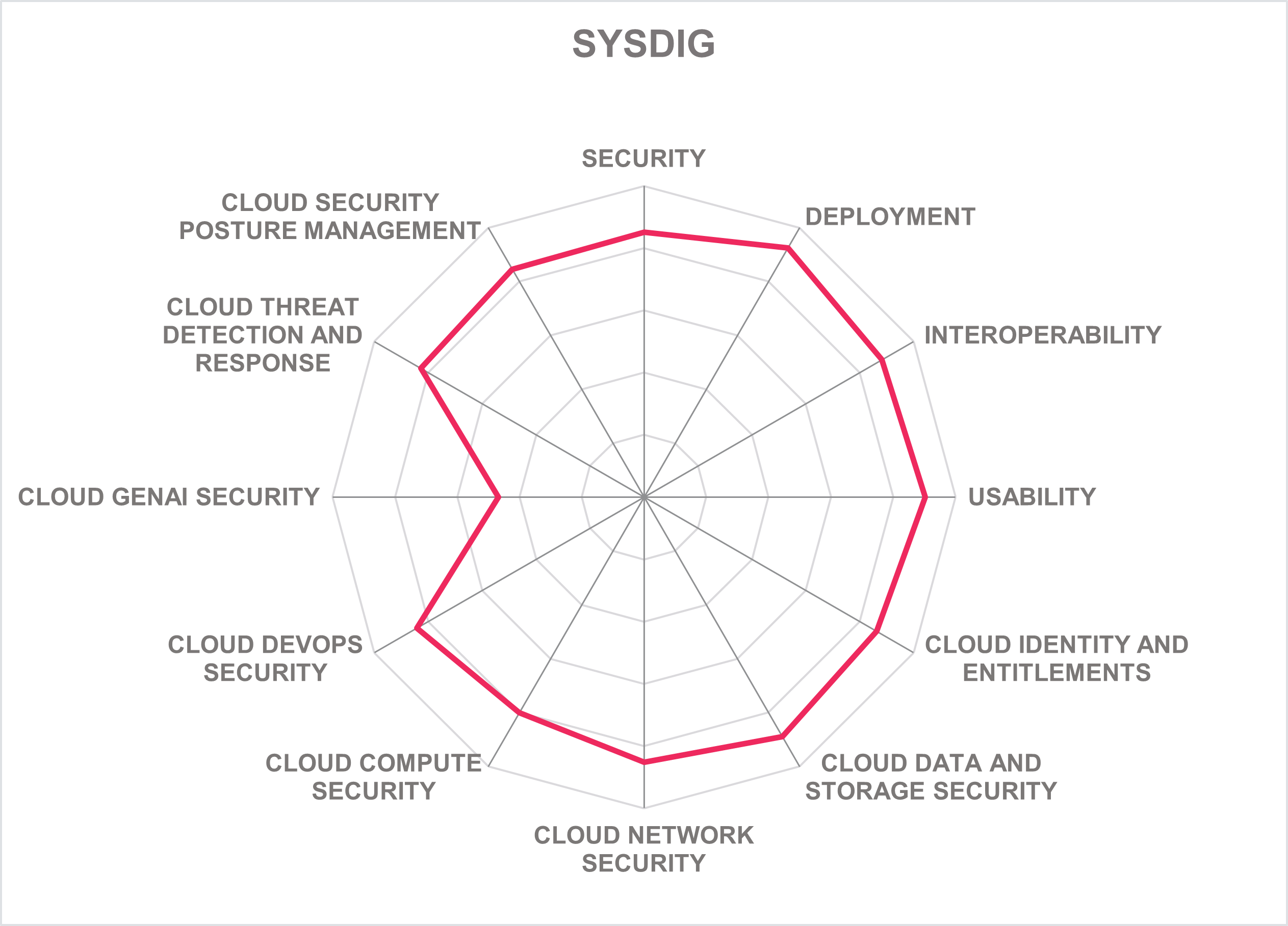
Sysdig Secure challenges the assumption that cloud security should be driven primarily by posture and vulnerability data. Instead, it uses runtime intelligence to determine which risks are exposed and which threats are currently active.
Founded in 2013 and headquartered in San Francisco, California, Sysdig is a cloud-native security vendor known for container, Kubernetes, and runtime security. Sysdig Secure combines CSPM, CIEM, cloud workload protection, Kubernetes security, DevSecOps security, cloud detection and response, and emerging AI security capabilities. The platform uses runtime context to prioritize vulnerabilities, misconfigurations, and identity risks based on whether affected assets, permissions, and services are actively used within production environments.
Sysdig Secure supports AWS, Azure, Google Cloud, OCI, OpenStack, OpenShift, Kubernetes environments, and hybrid deployments. Its strongest capabilities are centered on runtime security, cloud-native workload protection, Kubernetes security, and real-time threat detection based on Falco and eBPF-based telemetry.
Sysdig also offers runtime detections for AI coding agents built on its existing AI Workload Security solution. Sysdig Headless Cloud Security extends its CNAPP capabilities beyond traditional UI workflows to operate natively within AI coding agents. This offers security teams the runtime detection, vulnerability prioritization, and policy enforcement of a cloud security platform that is natively integrated with the same tools where development and AI-assisted operations are occurring.
Sysdig Sage™, the platform's AI cloud security assistant, facilitates multi-step conversations in natural language. It summarizes security events, provides insights into specific incidents, and offers context-aware recommendations.
The platform provides CIEM capabilities covering the full range of cloud-native identities, including IAM roles, service accounts, API keys, and workload identities. It identifies excessive permissions, administrative privileges, least-privilege violations, separation-of-duties conflicts, privilege escalation paths, compromised credentials, exposed secrets, and inactive accounts. Permission analysis also includes inherited permissions and cross-account access relationships. Identity risks are incorporated into attack path analysis and runtime-aware risk prioritization. Supported identity providers include Active Directory, Google, and Okta.
The platform focuses on storage risks but does not include full DSPM capabilities. It evaluates cloud storage configurations, public exposure, encryption controls, geographic placement, backup policies, and internet accessibility across cloud storage services and databases. These cover virtual file store, object storage, MySQL, Oracle, Microsoft SQL Server, PostgreSQL and cloud databases such as Amazon RDS, Microsoft Fabric Warehouse as well as data lakes.
For cloud and Kubernetes network risks, platform capabilities include analysis of virtual networks, subnets, routing configurations, security groups, load balancers, internet-facing assets, and segmentation controls. Sysdig identifies unintended exposure, overly permissive firewall rules, insecure protocols, weak encryption configurations, exposed management interfaces, and lateral movement opportunities. Network findings are correlated with workload activity, identity exposure, and runtime telemetry to prioritize required mitigations. In Kubernetes environments, Sysdig automates least-privilege network policy generation, accelerates the Zero Trust network segmentation process, and provides process-level visibility.
For compute service and serverless related risks, Sysdig Secure provides vulnerability assessment, workload configuration analysis, malware detection, drift detection, file integrity monitoring (FIM), runtime monitoring, serverless security, workload ownership analysis, suspicious process detection, privilege escalation monitoring, and forensic investigation capabilities. Coverage spans Linux, Windows, Kubernetes, containers, OpenShift, OpenStack, and major public cloud environments via both agent-based and agentless deployment models. Runtime telemetry allows Sysdig Secure to distinguish actively exploitable vulnerabilities from dormant risks, reducing alert volume and improving remediation efficiency. The Cloud Attack Graph also correlates assets, activities, and risks to surface attack paths and accelerate incident response.
Sysdig Secure DevSecOps security capabilities include IaC scanning, container image security, registry scanning, vulnerability management, software composition analysis, CI/CD integration, code-to-cloud visibility, SBOM support, configuration drift detection, and software supply chain security. The platform supports major IaC technologies, container ecosystems, Kubernetes deployments, and development pipelines. IaC misconfigurations and vulnerabilities are surfaced at the commit and pull request stages, with remediation patches for Terraform and CloudFormation auto generated before issues reach production. Runtime findings are correlated with development-stage security issues, focusing remediation on what is actively exploitable.
For GenAI related risks, Sysdig Secure validates that GenAI services are secured and can only be accessed according to policy. This covers AI and ML engines like OpenAI, Amazon Bedrock, Anthropic, Google Vertex AI, IBM watsonx, and TensorFlow, and AI coding agents including Claude Code, OpenAI’s Codex, and Gemini CLI. It does not validate secure model lifecycle and deployment.
For threat detection and response Sysdig Secure is based on Falco, the open-source cloud-native threat detection engine it originally created and contributed to the CNCF, together with eBPF-based telemetry for real-time detection and response. The platform provides sub-second detection, runtime monitoring, forensic investigation, incident management, workflow integration, threat intelligence correlation, and automated response capabilities. Its ability to correlate posture, vulnerability, identity, and runtime signals helps to accelerate investigations and reduce response times.
Sysdig Secure CSPM capabilities include continuous asset discovery, configuration assessment, compliance monitoring, drift detection, risk scoring, attack path analysis, KSPM, and support for major regulatory frameworks and CIS benchmarks. Its runtime-powered prioritization, which uses observed activity, active permissions, network connections, and workload behavior helps to identify vulnerabilities most likely to present real operational risk.
Organizations seeking an AI-powered CNAPP solution with strengths in runtime security, Kubernetes protection, cloud-native threat detection, and runtime-aware risk prioritization should consider Sysdig Secure.
| Strengths |
|
| Challenges |
|
Tenable – Tenable One Cloud Exposure (CNAPP)
A preview of the evaluation of Tenable, free with an accountCreate a free account
Uptycs – Uptycs Unified CNAPP and XDR
A preview of the evaluation of Uptycs, free with an accountCreate a free account
Upwind – Upwind Cloud Security Platform
A preview of the evaluation of Upwind, free with an accountCreate a free account
Wiz – Wiz AI-Application Protection Platform
A preview of the evaluation of Wiz, free with an accountCreate a free account
Vendors to Watch
Armo
ARMO, founded in 2019 and headquartered in Tel Aviv, Israel, specializes in Kubernetes and container runtime security.
AWS
Amazon Web Services (AWS) is a subsidiary of Amazon providing on-demand cloud computing platforms and APIs to individuals, companies, and governments, on a metered pay-as-you-go basis.
Caveonix
Cav (formerly Caveonix) delivers unified cloud security posture management and workload protection for hybrid multi-cloud environments.
Cyscale
Cyscale Ltd. specializes in cloud security automation, providing agentless contextual analysis of cloud misconfigurations, vulnerabilities, access issues, and data risks. Its Security Knowledge Graph powers contextual threat identification and prioritization.
Datadog
Datadog is a public company offering a comprehensive analytics and observability platform for infrastructure, applications, logs, and security.
Data Theorem
Data Theorem is an application security vendor specializing in automated managed security for mobile apps and APIs.
Elastic
Elastic (formerly Elasticsearch) is a US-based company known for its search and log analytics platform, Elastic Stack, which powers a range of solutions including Elastic Security, enabling threat detection, prevention, and incident response across diverse IT environments.
Fidelis Security
Fidelis Cybersecurity is a company specializing in extended detection and response (XDR), deception, and network security solutions.
Oracle
Oracle Corporation is a globally recognized enterprise software vendor focusing primarily on databases, cloud infrastructure, and enterprise software solutions.
Rapid7
Rapid7 is a Boston-based cybersecurity company founded in 2000, offering a broad portfolio spanning SIEM, vulnerability management, cloud security, application security, and SOAR.
Skyhigh Security
Skyhigh Security is a cloud security company offering solutions focused on cloud access security broker (CASB), data protection, and threat prevention.
Trend Micro
Trend Micro, founded in 1988 in Tokyo, is a major global player in endpoint, email, web, and IoT security, as well as cloud protection, supporting both traditional and next-gen workloads.
A preview of why each of these 12 vendors is worth watchingCreate a free account
Related Research
Whitepaper: The Future of Cloud Security
Buyer's Compass: EU Sovereign Cloud Services
Leadership Compass: The Emerging AI Security Operations Center (SOC)
Leadership Compass: Generative AI Defense
Leadership Compass: Privileged Access Management (PAM)
Leadership Compass: Data Security Platforms
Leadership Compass: Cloud Backup for AI Enabled Cyber Resilience
Copyright
© 2026 KuppingerCole Analysts AG. All rights reserved. Reproducing or distributing this publication in any form is prohibited without prior written permission. The conclusions, recommendations, and predictions in this document reflect KuppingerCole Analysts' initial views. As we gather more information and conduct deeper analysis, the positions presented here may undergo refinements or significant changes. KuppingerCole Analysts disclaims all warranties regarding the completeness, accuracy, and adequacy of this information. Although KuppingerCole Analysts' research documents may discuss legal issues related to information security and technology, we do not provide legal services or advice, and our publications should not be used as such. KuppingerCole Analysts assumes no liability for errors or inadequacies in the information contained in this document. Any expressed opinion may change without notice. All product and company names are trademarks™ or registered® trademarks of their respective holders. Their use does not imply any affiliation with or endorsement by them.
KuppingerCole Analysts supports IT professionals with exceptional expertise to define IT strategies and make relevant decisions. As a leading analyst firm, KuppingerCole Analysts offers firsthand, vendor-neutral information. Our services enable you to make decisions crucial to your business with confidence and security.
Founded in 2004, KuppingerCole Analysts is a global, independent analyst organization headquartered in Europe. We specialize in providing vendor-neutral advice, expertise, thought leadership, and practical relevance in Cybersecurity, Digital Identity & IAM (Identity and Access Management), Cloud Risk and Security, and Artificial Intelligence, as well as technologies enabling Digital Transformation. We assist companies, corporate users, integrators, and software manufacturers to address both tactical and strategic challenges by making better decisions for their business success. Balancing immediate implementation with long-term viability is central to our philosophy.
For further information, please contact clients@kuppingercole.com.
Introduction


Market Analysis
Leadership
Product and Vendor Evaluation
AccuKnox – AccuKnox Zero Trust CNAPP
Aqua Security – Aqua Cloud Native Security Platform
CrowdStrike – CrowdStrike Falcon Cloud Security
Fortinet – FortiCNAPP
IBM – Cloud Security and Compliance Center Workload Protection
Microsoft – Defender for Cloud
Orca Security – Orca Cloud Security Platform
Palo Alto Networks – Cortex Cloud
Qualys – TotalCloud
SentinelOne – Singularity Cloud Native Security
Sysdig – Sysdig Secure
Tenable – Tenable One Cloud Exposure (CNAPP)
Uptycs – Uptycs Unified CNAPP and XDR
Upwind – Upwind Cloud Security Platform
Wiz – Wiz AI-Application Protection Platform
Vendors to Watch
Armo
AWS
Caveonix
Cyscale
Datadog
Data Theorem
Elastic
Fidelis Security
Oracle
Rapid7
Skyhigh Security
Trend Micro
Related Research
Copyright








Table of Contents


Table of contents
Close
Introduction
Market Analysis
Leadership
Product and Vendor Evaluation
AccuKnox – AccuKnox Zero Trust CNAPP
Aqua Security – Aqua Cloud Native Security Platform
CrowdStrike – CrowdStrike Falcon Cloud Security
Fortinet – FortiCNAPP
IBM – Cloud Security and Compliance Center Workload Protection
Microsoft – Defender for Cloud
Orca Security – Orca Cloud Security Platform
Palo Alto Networks – Cortex Cloud
Qualys – TotalCloud
SentinelOne – Singularity Cloud Native Security
Sysdig – Sysdig Secure
Tenable – Tenable One Cloud Exposure (CNAPP)
Uptycs – Uptycs Unified CNAPP and XDR
Upwind – Upwind Cloud Security Platform
Wiz – Wiz AI-Application Protection Platform
Vendors to Watch
Armo
AWS
Caveonix
Cyscale
Datadog
Data Theorem
Elastic
Fidelis Security
Oracle
Rapid7
Skyhigh Security
Trend Micro
Related Research
Copyright









