



This guest post reflects the views of the author and does not necessarily represent the views of KuppingerCole Analysts. It is provided for informational purposes only and should not be interpreted as independent research, analysis, endorsement, or advisory services by KuppingerCole Analysts.
I analyzed 10,098 open identity management positions on Stepstone, 6,943 IAM professional profiles on LinkedIn, and historical data from TexKernel for 2024 and 2025 to present current role distribution in the IAM field, tool and industry demand shifts, and geographic concentration across German cities.
Key findings: 77.6% of positions require senior-level experience, SailPoint and Okta mentions increased significantly in 2025, and emerging ITDR/NHI specializations are growing.
You'll also find compensation ranges for IAM roles, city-by-city demand, and practical hiring approaches for the current market.
Germany's Identity and Access Management (IAM) sector is facing a workforce shortage, similar to the one in IT in 2020. My analysis of 10,098 open identity management positions on Stepstone demonstrates the real landscape of the market in role distribution, tool requirements, and geographic concentration.
Current Role Distribution
The country's strict regulatory environment drives companies toward immediate, ready-made solutions rather than long-term talent development strategies. We can see it with our own eyes when checking job platforms:
- Junior IAM Analysts (0 - 1.5 years): 5.2% of openings (524 positions)
- Mid-Level IAM Engineers (2 - 4 years): 13.9% (1,406 positions)
- Senior IAM Specialists (5 - 8 years): 52% (5,260 positions)
- IAM Architects, Managers & Experts: 25.6% (2,595 positions)
- Experience not specified: 6.8% (687 positions)
When we examine the available candidate pool, the picture is upside down:
- Junior candidates: 3.4:1 candidate-to-role ratio, with ~97% open to opportunities
- Mid-level specialists: 1.3:1 ratio, ~23% open to opportunities
- Senior specialists: 0.53:1 ratio, ~7% open to opportunities
- Architects: 0.21:1 ratio, less than 1% open to opportunities

We have two distinct battlegrounds. Recent graduates and junior professionals face a high competition for limited entry-level positions with over 100 applicants for each, while companies fight for experienced specialists and architects with employer branding, salary & benefits means. This inverted pyramid reveals a challenging corporate mindset: most German organizations seek professionals who can navigate complex identity ecosystems immediately.
The 77.6% concentration in senior and architect roles highlight an evident tendency — companies want professionals who've already solved the exact technical challenges they're facing today. Organizations are seeking professionals who can architect IAM frameworks from the ground up: those who understand how access structures mirror organizational hierarchies, how temporary employment relationships create privileged access vulnerabilities, and how non-human identities (NHI) fundamentally reshape traditional IAM approaches.
Tool Demand
2024 Tool Mention Frequency (TexKernel historical data for 2024):
- Microsoft Entra ID/Azure AD: 89% of IAM positions
- Active Directory: 79%
- SailPoint: 14%
- CyberArk: 12%
- Okta: 9%
2025 Current Distribution (TexKernel historical data for 2025):
- Microsoft Entra ID/Azure AD: 68% (-21 percentage points)
- Active Directory: 71% (-8 pp)
- SailPoint: 34% (+20 pp)
- Okta: 31% (+22 pp)
- CyberArk: 28% (+16 pp)
Microsoft still stays on top of IAM tools, even losing 21 percentage points this year to 2024. This shift reflects not the technical dissatisfaction but the evolution of IAM requirements — organizations recognize that identity governance requires purpose-built platforms that deliver specialized functionality for their specific needs, can offer unique functionality needed for CIAM, enterprise IAM, IGA, MIM, ITDR, and NHI, with the flexibility to integrate across ecosystems. This increased differentiation between tools has significantly changed the market landscape in the last year.
Geographic Distribution
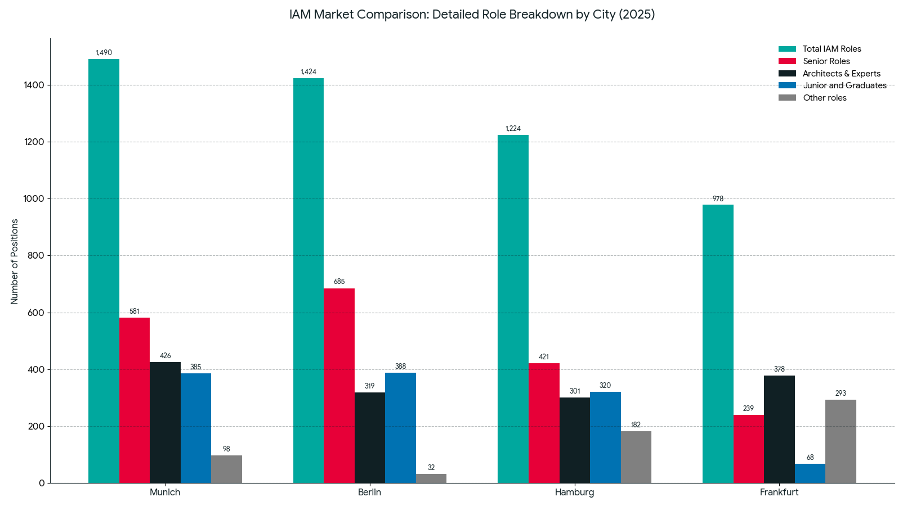
Munich: 1,490 IAM positions
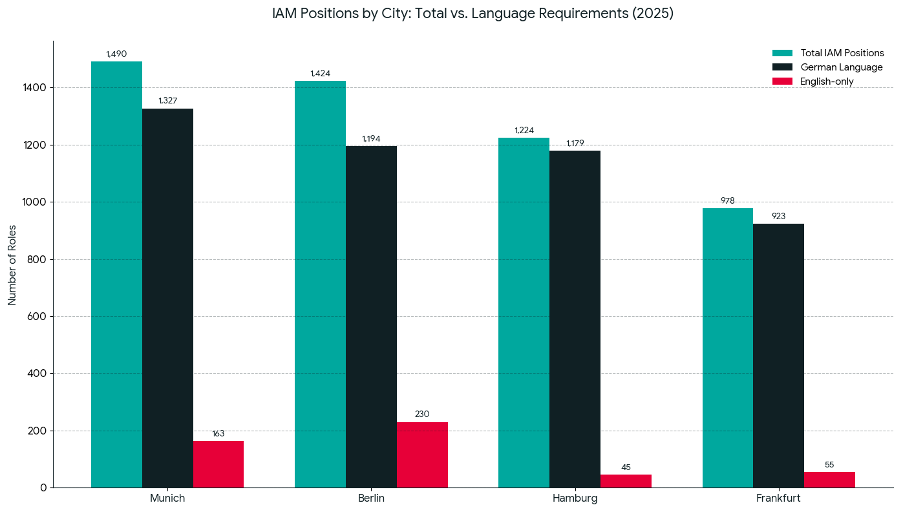
- Communication language: German (1327 roles/ 89%), English-only (163 roles/ 11%)
- Role Concentration: 28.6% Architects & Experts, 39% Senior
- Field: 51.2% IT and SaaS, 29.7% Consulting and Services
Berlin: 1,424 IAM positions
- Communication language: German (1194 roles/ 83.6%), English-only (230 roles/ 16.2%)
- Role Concentration: 22.4% Architects & Experts, 48.1% Senior
- Field: 54% IT and SaaS, 26.9% Consulting and Services
Hamburg: 1,224 IAM positions
- Communication language: German (1179 roles/ 96.3%), English-only (45 roles/ 3.7%)
- Role Concentration: 24.6% Architects & Experts, 34.4% Senior
- Field: 48.4% IT and SaaS, 28.4% Consulting and Services, 12.1% Wholesale & retail
Frankfurt: 978 IAM positions
- Communication language: German (923 roles/ 94.1%), English-only (55 roles/ 5.6%)
- Role Concentration: 38.6% Architects & Experts, 24.4% Senior
- Field: 48.4% IT and SaaS, 32,6% Consulting and Services, 13.6% Banking and financial services
Stuttgart: 730 positions (Vehicle manufacturing & suppliers/ Mechanical and plant engineering)
Cologne: 703 positions (Wholesale & retail)
Düsseldorf: 619 positions (Consulting services)
Ideal for English-speaking professionals: Berlin with 230 positions or Munich with 163 open roles.
Ideal for junior talents and graduates: Berlin with 388 roles, Munich with 385 roles, and Hamburg with 320 roles.
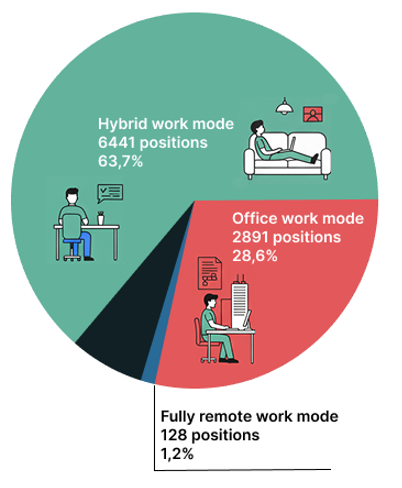
Remote and onsite work modes:
- Most of the roles offer hybrid home office work mode: 6441 positions (63.7%).
- Onsite presence required in 289 positions (28.6%).
- Full-time home-office is possible for only 128 positions (1.2%).
- There are also roles with no information about the place of the work: 638 positions (6.3%).
Frankfurt's 38.6% architecture jobs concentration reflects the financial sector's regulatory focus, where organizations need professionals who can articulate identity architectures to auditors, regulators, and board members. For professionals earlier in their IAM journey, Berlin, Munich, and Hamburg offer easier start in growing startups and as well-established corporations with diverse growth opportunities.
Identity Threat Detection and Response (ITDR) and Non-Human Identity (NHI) Trends
“Just when it seemed nothing else could happen, voilà, welcome to ‘Hawkins’ and the ‘Stranger Things’ world.” This is how Dr. Rondini, an IAM expert from my network, describes the current IAM development trajectory. Jokes aside, the speed of AI development and its heavy usage in software development changed the direction that we are going with IAM ecosystems, which obviously will reflect the talent market.
While #NHI and #ITDR dominate LinkedIn feeds, I wanted to cut through the hype and examine the hard numbers: How is this translating into actual job openings? The fact is that these new roles, virtually non-existent in early 2024, are now step by step taking a meaningful market share. Let’s make our predictions there.
Growth Trajectory for IAM positions:
- 2024: 32,933 positions
- 2025: 39,850 positions (+21%)
- 2026 Projection: ~ 48,219 positions and more (+21% min)
ITDR and NHI positions (Historical Data for 2025):
- Jobs, required ITDR: 2% of total positions (797 openings)
- Jobs, required NHI: 1% of total positions (408 openings)
According to “The State of Non-Human Identity Security” report from 2024:
- 25% of organizations are currently investing in NHI security
- And 85% of organizations (globally) will be investing in NHI by 2026.
Based on this, I can expect for 2026 (conservative scenario):
- ITDR: (2x growth) = 1,600 positions
- NHI: (3x growth) = 1,200 positions
Growth Drivers:
NIS2 Directive Compliance: Critical sectors must now detect identity threats fast. Companies need specialists who understand both the technical side and can explain what's at stake to the board in plain language.
Non-Human Identity: The workload-to-human identity ratio has exploded from 92:1 in 2024 to 144:1 in 2025.
AI agents: 25% of companies use them now, 50% will by 2027. Professionals who can manage these dynamic machine identities, not just traditional logins, will shape IAM's future.
Cybercrime Economics: Cybercrime cost German businesses €289 billion in 2025 – a 40% increase from the previous year – with attacks increasingly traced to state actors and organized crime groups.
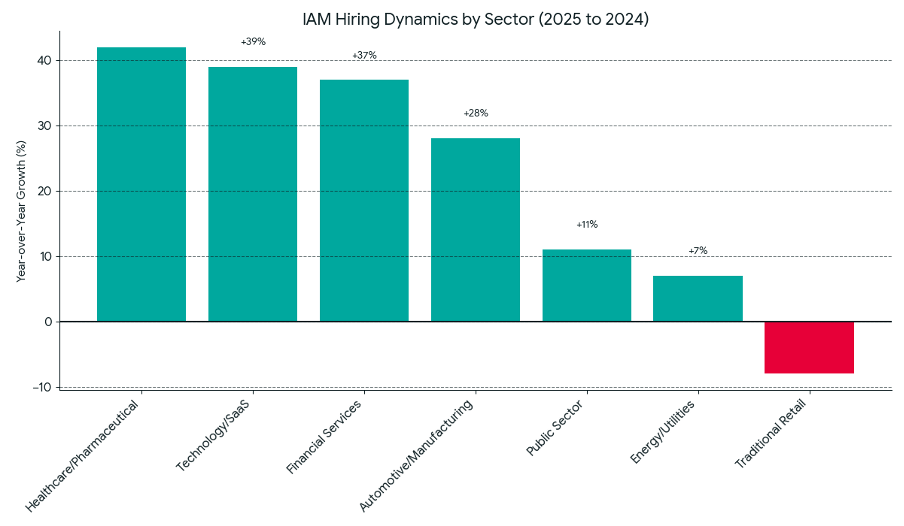
IAM Growth by Sectors 2025 to 2024
Based on the TexKernel historical data for 2024 and 2025, we can observe the following trends:
Financial Services: +37% IAM hiring growth
- Driver: Open Banking APIs, DORA, digital identity requirements
- Focus: CIAM specialists and API security
Healthcare/Pharmaceutical: +42% growth
- Driver: GDPR compliance, research collaboration
- Focus: Patient identity management and federated access management
Automotive/Manufacturing: +28% growth
- Driver: Connected vehicles, supply chain digitization
- Focus: OT/IT security and supply chain access
Technology/SaaS: +39% growth
- Driver: Cloud migration acceleration, remote workforce, zero-trust adoption
- Focus: Cloud IAM, SSO, MFA, Passwordless
Declining/Stable Sectors:
Traditional Retail: -8% decline
- Digital transformation is completed, focus shifting to operational efficiency
Energy/Utilities: +7% (moderate growth)
- NIS2 compliance creating sudden 2026 demand spike expected
Public Sector: +11% (moderate growth)
- Digital government transformation
2025 Compensation Bands (Germany-wide averages)
- Junior IAM Analysts: Range: €42,000 - €55,000
- Mid-Level IAM Engineers: Range: €58,000 - €78,000
- Senior IAM Specialists: Range: €75,000 - €100,000
- IAM Architects: Range: €95,000 - €135,000
Special roles (2025):
- ITDR Specialists: €80,000 - €110,000
- NHI Security Engineers/ Architects: €75,000 - €110,000
- Zero Trust Architects: €90,000 - €120,000
From my analysis of salaries mentioned on Stepstone, German organizations compensate IAM top experts up to 14% above top IT positions — this reflects current market realities. In an environment defined by NIS2, DORA, and GDPR frameworks, where non-compliance penalties can reach 4% of revenue, companies aren't paying for technical execution, they're investing strategically in professionals who can have a real ROI for their companies that could be predicted, planned, and counted.
The German IAM Market: Summary
Germany's IAM market is growing fast — and that's good news for everyone involved.
For IAM Professionals: Strong Demand, Clear Growth
Whether you're an experienced architect or just starting your first IAM role, the next few years look very promising. The market grew 21% in 2025 and I’m projecting similar and even higher growth in 2026. New specializations like ITDR and NHI security are creating career paths that didn't exist two years ago.
This isn't a temporary trend. As companies rebuild their security around identity, IAM professionals will stay in high demand for years to come.
For Companies: Four Practical Solutions
The shortage is real — only 0.21 architects available per open position, and most of them are not looking for a change. But there are ways to solve this:
1. Hire and Train Junior Talent
Companies that invest in training programs can hire eager graduates at €42,000-€55,000 and develop them into specialists. A 12–18-month training investment gives you professionals who understand your specific needs.
2. Go Remote and English-Friendly
Only 1.2% of IAM roles offer full remote work right now. Only 7.7% accept English-only applicants. An architect in Hamburg costs probably the same remotely — but your talent pool grows from a hundred plus local candidates to thousands across Germany and the EU.
3. Use Specialized Consultancies
Not every company needs a full-time ITDR specialist at €110,000 per year. Fractional IAM expertise through consultancies costs 30-40% less and gives you immediate access to senior knowledge for specific projects like NIS2 compliance or zero-trust implementation.
This demand isn't temporary. Three big forces are driving it:
- Regulations: NIS2, DORA, and GDPR aren't going away. Penalties reach millions of euros.
- Cybercrime: German businesses lost €289 billion to cybercrime in 2025—a 40% increase from 2024.
- Digital transformation: Every cloud migration, every AI project, every digital service needs IAM architecture.
We're not in a hiring crisis. We're in a growth phase: 39,850 positions in 2025 growing to ~51,400 in 2026. Germany's IAM market is hiring. And it will keep hiring.
Methodology Note: This analysis synthesizes data from 12 primary sources including job platforms (StepStone, LinkedIn), historical data for job ads from TexKernel for comparison of 2025 and 2024, and industry research reports (KuppingerCole, Deloitte, Entro Labs, Bitkom, Cloud security alliance). Prognoses for 2026 were made by author based on industry reports. Salary figures represent median ranges for IAM positions represented on Stepstone on November 11, 2025.







