



The definition of identity has expanded significantly. Applications, containers, APIs, scripts, and service accounts now operate as independent identities along with your employees, customers and partners across cloud and hybrid environments. These non-human identities (NHIs) are deeply embedded in IT infrastructure. In many organizations, they outnumber human identities by a factor of 25-50. Jensen Huang of Nvidia expects this number to balloon to millions over the next decade due to rise in AI agents. However, they remain loosely governed, are often invisible, frequently overprivileged and are targeted by threat actors. That combination introduces operational and security risks.
When identity creation becomes continuous
Modern architectures automatically generate identities as a byproduct of automation and development processes. CI/CD pipelines, infrastructure-as-code and microservices continuously create and retire identities. Many of these identities are ephemeral in nature. The challenge is most of these identities lack clear ownership
Traditional IAM systems are designed to manage human identities with predictable, human-scale lifecycles. NHIs do not follow that pattern. They are dynamic, distributed, and tightly coupled to workloads. And sometimes are the workloads. This mismatch creates governance gaps.
Fragmentation across tools and teams
DevOps teams manage pipelines and secrets. Security teams monitor for threats. IAM teams focus on human users. But who owns the NHIs? This fragmentation creates gaps. The outcomes are familiar. Orphaned service accounts, hardcoded credentials, and inconsistent credential rotation, among others. All of which consistently contribute to security incidents and breaches. NHIs amplify these issues because they operate continuously and often with elevated privileges. If you have ever audited a long-standing instance of Active Directory, you understand the issues.
Furthermore, this fragmentation also slows down response times when incidents are detected. Without a unified view, detecting misuse or over-privileged access becomes reactive rather than proactive. Over time, this not only increases security exposure but also adds operational friction, making it harder to consistently scale identity governance.
From visibility to orchestration
Most organizations are still working on NHI discovery. Knowing which NHIs exist is one of the key challenges of managing NHIs. It is hard to manage what you don’t know about. This is typically followed by classification of identities based on risk.
The needed further shift is toward improved orchestration. This means both automating and managing how NHIs are created and retired, enforcing least privilege, continuously monitoring behavior, and adjusting access based on context. With this shift identity moves from a static control to a dynamic, actively managed one.
Traditional IAM and PAM systems were not designed for NHIs. NHIs enable automation and scale. But without proper governance, they can create uncontrolled access paths. The solution for these challenges is policy-driven automation. Access decisions based on identity, context, and behavior should be evaluated continuously. The NHI Management (NHIM) solutions focus on discovery, real-time provisioning, workload identity federation, credential rotation, compliance and monitoring, and integration with cloud-native platforms
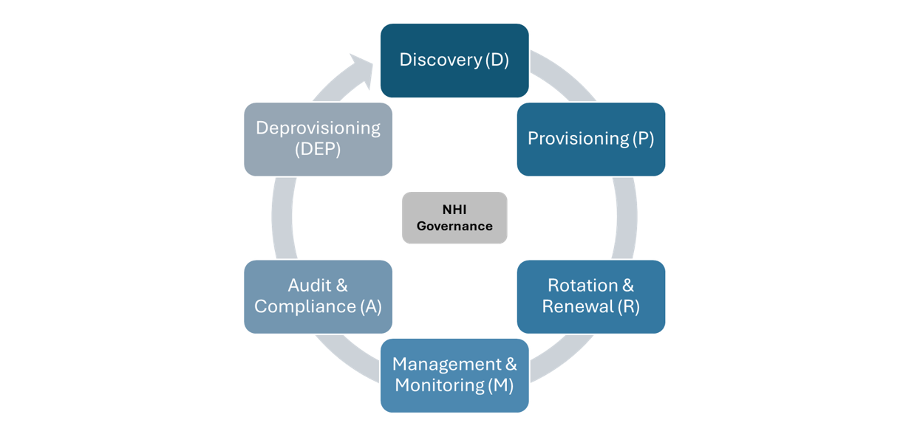
Above is an NHI governance model that can reduce complexity by linking steps with particular objectives into a holistic NHI management lifecycle. By including related goals, such as monitoring being part of broader management practices or rotation being a specified renewal activity, these steps will deliver on the strategic objectives for secure and effective identity and secrets governance.
Building maturity in NHI governance
Clear ownership is the starting point for NHI management. A centralized governance model with defined responsibilities across IAM, security, and development teams creates critical transparency.
Access policies must evolve. NHI lifecycle management should cover provisioning, rotation, monitoring, and decommissioning. Access controls need to be granular and aligned with least privilege.
Processes need to be automated. Discovery, provisioning, and decommissioning should be consistent and embedded into development pipelines, and automated especially for NHIs. Manual management does not scale.
NHIM platforms, secrets management, PAM, and CIEM tools when used together provide visibility and enforcement. Integration with IGA can ensure alignment with broader governance and compliance needs.
Equally important is the human factor. Having a human-in-the-loop for critical decisions can further enhance guardrails around NHI management.
Balancing speed and control
NHIs, in particular with the rise of AI agents, are no longer peripheral to identity strategies. NHIs are now central to how modern applications operate and scale. Orchestrating them at scale means automating lifecycle management, enforcing consistent policies, integrating with DevSecOps pipelines, and continuously monitoring behavior. As the wave of AI agents start to really hit in 2026 and beyond the spotlight on effective NHI management is only going to get brighter.







