



In today’s hybrid IT environments, identity is the new perimeter and managing it effectively is more complex than ever. Organizations are increasingly turning to converged Identity and Access Management (IAM) platforms to streamline operations, reduce risks, and simplify compliance. These unified solutions integrate Identity Governance and Administration (IGA), Access Management, and Privileged Access Management (PAM) capabilities into a cohesive framework, eliminating the inefficiencies and blind spots created by siloed tools.
The Case for Convergence
Traditionally, IAM programs evolved through separate point solutions: IGA tools managed identities and entitlements, Access Management systems handled authentication and authorization, and PAM solutions protected privileged accounts. While each of these disciplines is critical, their isolated operation often leads to duplication, policy inconsistencies, and visibility gaps. The trend is slowly shifting away from loosely coupled/ uncoupled IAM tools to a more converged IAM suite however majority of the organizations still implement the former approach.
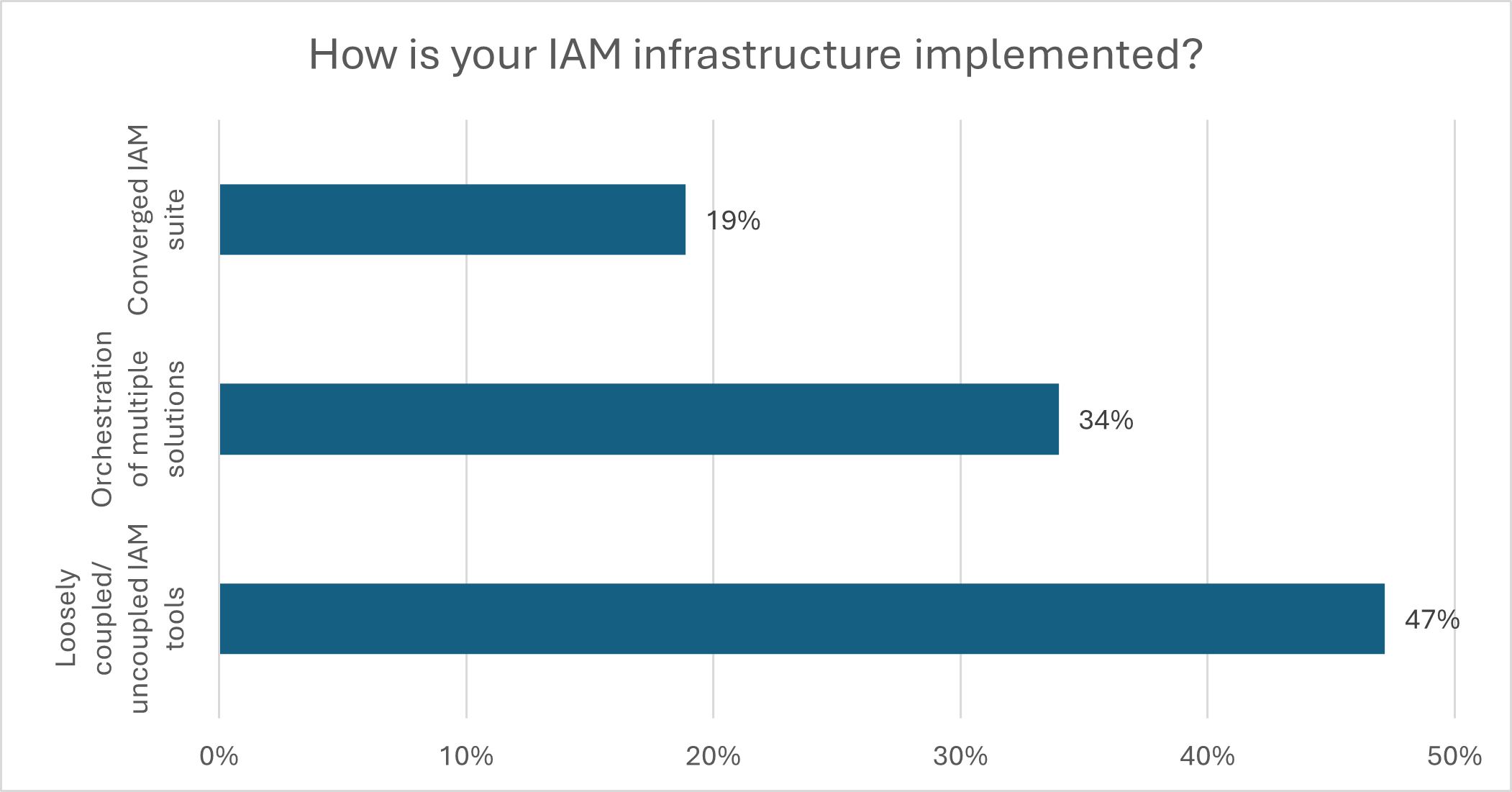
Source: KuppingerCole Analysts
Converged IAM platforms address these challenges by delivering an integrated approach. Instead of managing disparate policies and data sources, organizations gain a unified control plane for identity lifecycle management, access enforcement, risk analysis, and compliance reporting. This shift enables IT and security teams to operate with greater agility and precision.
Operational Efficiency through Integration
A primary driver for converged IAM adoption is operational efficiency. Maintaining multiple identity tools often means navigating different interfaces, overlapping features, and inconsistent user experiences. Integration work between tools can be costly, brittle, and time-consuming.
Unified platforms eliminate this friction by sharing a single identity model and policy engine across all IAM functions. This streamlines onboarding and offboarding processes, automates access reviews, and enables consistent enforcement of least privilege. Organizations benefit from faster deployments, simplified administration, and reduced total cost of ownership.
Moreover, with centralized analytics and reporting, converged platforms can more effectively detect anomalies, assess access risks, and provide actionable insights—capabilities that are difficult to achieve when data is fragmented across systems.
Minimizing Tool Sprawl and Complexity
As organizations grow and digitize, tool sprawl becomes a mounting challenge. Managing a patchwork of legacy IAM solutions increases not only operational burdens but also attack surfaces. Converged platforms help counter this by consolidating identity infrastructure into a single vendor ecosystem.
This consolidation is particularly appealing for enterprises undergoing digital transformation or cloud migration. Unified platforms are often built to support hybrid architectures, providing consistent identity services across on-premises applications, SaaS, and cloud-native workloads. Their ability to support protocols like SAML, OIDC, and SCIM out of the box reduces integration overhead and futureproofs IAM strategies.
Enabling Better Governance and Security
Convergence also enhances governance. By aligning IGA, Access Management, and PAM functions, organizations can implement end-to-end policy enforcement such as from defining access entitlements to controlling privileged sessions. Access certifications become more meaningful when informed by real-time usage data, and privileged accounts are better protected when tied to the same lifecycle workflows as regular user identities.
Security is improved not only through better visibility and control, but also by closing the operational gaps that attackers often exploit. Identity threat detection and response (ITDR) capabilities are increasingly embedded within converged platforms, enabling proactive defense against credential abuse and lateral movement.
Conclusion
Converged IAM platforms represent a pragmatic and forward-looking approach to identity security. By unifying critical IAM capabilities under one umbrella, organizations can simplify their architecture, reduce risk, and improve user experience while preparing for the next generation of identity-centric threats. For IT leaders seeking to modernize identity infrastructure without multiplying complexity, convergence holds a strategic importance.







