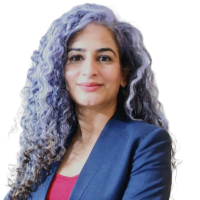
Thank you so much, team, for making the virtual presentation possible. Hi, everyone. I'm Priya Guliani, CEO of EarthID, a multi-award-winning decentralized identity platform built on the principles of privacy, inclusion, and trust. Fourteen years ago, I moved from India to the UK where I spent most of my career as a technology consultant helping businesses navigate digital transformation. But somewhere along the way, something shifted. During my year-long leadership program at MIT, I realized technology without purpose is just code. What we build must serve people.
And that belief became the foundation of EarthID. Since then, both EarthID and I have been internationally recognized by the industry, have been honored with several opportunities to share and discuss my thoughts on digital identity and inclusion at global stages, including the UK Parliament. I've also been featured as a standout fintech leader in the fintech power list by Innovate Finance UK. I also volunteer as the EMEA director at Government Blockchain Association to further drive the adoption of inclusive innovation.
Anyone who knows me knows how deeply I admire Aadhaar, what Paul Romer, a Nobel laureate and former World Bank chief economist, once called the most sophisticated ID program in the world. Today, I want to take you on a journey, a journey through two real lives touched by the world's largest digital identity system. And together we explore a difficult but essential question. When does technology become an enabler and when does it turn into a barrier? Let me start with a story.
In a small village called Bara in Rajasthan, India, a woman named Shanti Devi lived and depended on two sources of income. Wages from India's rural employment guarantee program and a pension to support herself and her disabled husband. Until 2010, her payments were delivered in cash by a postman handed to whoever happens to be at home. Sometimes the full amount never made it to her hands. A relative might collect it and there was little she could do. Even when she did receive it, Shanti had no safe place to save her money.
She was unbanked like millions of other women because opening a bank account required a formal ID, something many women simply didn't have. But today her life looks really different. Thanks to Aadhaar, her digital identity, Shanti now receives her benefits directly into her bank account, which she opened easily with just her Aadhaar number and a fingerprint. She can send and receive digital payments even without owning a smartphone. And most importantly, she is no longer invisible.
With her ID, she can exercise her rights, access services, and build economic independence, all while holding on to something every human being deserves, the dignity of owning their identity. Sadly for millions of others around the world, this dignity is still out of reach. More than 1 billion people today have no way to prove who they are. Without a recognized identity, they're locked out of essential services, healthcare, education, social safety nets, and even the private sector often shuts its doors to them.
Imagine not being able to open a bank account, enroll in school, or secure a phone connection, all because you cannot prove who you are. Their potential remains untapped and their aspirations quashed.
In India, Aadhaar has changed this narrative for over 1.3 billion people. Each individual is issued a unique 12-digit ID number linked to their biometric data, fingerprints, and iris scans, alongside basic information like name, gender, and address. Originally envisioned as a way to streamline the direct benefit transfer system, ensuring subsidies and welfare reach the right people, Aadhaar has grown into something much larger.
Today, it is woven into daily life, from accessing government services to making travel bookings, from opening bank accounts to securing mobile phones. The scale of Aadhaar's rollout is astonishing. It reached every corner of India, from the bustling cities to the most remote villages, where roads are still just dirt paths. When challenges emerged, whether it was elderly citizens struggling with their iris scans, or laborers whose fingerprints had worn from years of hard work, solutions were found, alternatives were created. No one was left behind easily.
Thanks to Aadhaar, millions who were considered too risky or too costly have finally entered the formal economy. Banks and mobile companies are enrolling customers they once ignored. Public services are reaching the people they're meant for. Aadhaar stands as a remarkable proof to what is possible when policy, design, technology, and human determination come together at scale. It hasn't just improved service delivery, it has transformed lives and reshaped the economy. Aadhaar enrolled over one million people in less than six years, a scale and speed the world had never seen.
What began as a system to improve direct benefit systems, ensuring subsidies reach the right hands, has become the foundation of something much larger, India's digital public infrastructure, or what we call DPI. Aadhaar, which quite literally means foundation in Hindi, became just that. The first layer of what is known as the India Stack, the most ambitious digital public infrastructure project in the world. The India Stack is a suite of interoperable digital platforms designed to be open, scalable, and inclusive.
What began with identity has now expanded into a powerful architecture made up of three key layers, identity, documents, and payments. This infrastructure didn't just improve governance, it supercharged innovation. India has now the world's largest real-time payments market, accounting for nearly half of global transactions in 2023. In 2024 alone, UPI, the Unified Payments Interface, facilitated over 208 billion digital transactions, representing 83% of India's digital payment volume. Every month, UPI processes over $165 billion across 8.9 billion transactions.
And these platforms are not just popular, they're economically powerful. According to McKinsey, India Stack added 0.9% to the country's GDP in 2022, with projections ranging from 2.9% to 4.2% by 2030. It's estimated to unlock $1 trillion in economic value by 2028. Even more remarkable, in India, people are becoming data rich before they're becoming income rich.
And that's powerful because it means even the ones with the modest earnings now have tools to prove their identity, access benefits, build credit histories, and data that they can leverage to access better healthcare, education, and government benefits. The magic here just doesn't lie in the tech itself, but in the model as well. India Stack is public infrastructure. It enables a presence-less, paperless, and cashless economy, delivered at scale, with consent and inclusion at core.
It's a living proof of what's possible when digital systems are built for public good, not for profit, but for people. Remarkable, isn't it? But technology's impact is not always universal. Even the most well-intentioned systems can have blind spots, and when they do, it's often the most vulnerable who fall through the cracks. Let me share another story, this time not of empowerment, but of exclusion. Jafar Alam was born in 1995 in Rakhine State, Myanmar, to stateless Rohingya parents. He never received citizenship.
When violent conflicts erupted in 2012, he and his family, like tens and thousands of others, were forced to flee. The few documents that proved their residency were lost in fire during the unrest. They first sought refuge in Bangladesh, but support there was patchy and arrests were common. Desperate and undocumented, Jafar and his older brother risked a dangerous journey to India.
There, he found shelter and informal work. After a year, he was issued a UNHCR refugee card, a lifeline that offered limited protection with access to basic services like healthcare. It also allowed him to register for a SIM card, a simple but vital connection to his community and the outside world. Using that refugee card, Jafar later applied for a long-term visa, which in turn allowed him to obtain an Aadhaar card in 2016, the same digital identity we just talked about. For a brief moment, things began to look hopeful.
With his Aadhaar, Jafar opened a bank account, secured better work, and even enrolled in school. The digital identity system that had empowered millions was finally empowering him.
Sadly, that moment didn't last. In 2017, the Indian government changed its stance, declaring Rohingya refugees as illegal immigrants, and they had to be deported.
Overnight, Aadhaar cards and visas for refugees were suspended, access to essential services became restricted, many like Jafar found themselves in a legal limbo. And then came the crackdown. Jafar's biometrics and demographic data, once a tool of inclusion, had now been recorded in a government database of undocumented individuals. That same year, the police conducted a mass verification exercise in his refugee camp. He was arrested, along with 14 others, and charged with illegally obtaining an Aadhaar card, a document he had once been rightfully issued.
When Jafar was finally released from prison, the world he returned to was no longer the one he had briefly began to trust. His Aadhaar card, once a symbol of new beginnings, had been frozen. That single document, which had opened so many doors for him, now shut them all at once. Without it, he could no longer continue his education. Sending or receiving money from family became impossible as well. Aadhaar had quietly become mandatory for remittances. What used to be a way for refugees to support each other across borders was now out of reach. Even everyday essentials became impossible.
Mobile phone network providers now required Aadhaar to issue a SIM card. Without one, Jafar lost not just communication, but connection to information, to community, and to hope. And as the political environment grew more hostile, his UNHCR refugee card, once a fragile shield, offered less and less protection. It didn't matter that he had once been issued a long-term visa. In practice, his identity had come to a void. Though Aadhaar was a legally recognized proof of residence and not citizenship, in reality, it had become a de facto passport to almost every essential service.
Education, healthcare, finance, utilities, subsidies, even access to a gas connection. Without it, life just didn't slow down. It stopped. For refugees like Jafar, Aadhaar no longer represented inclusion. Quite the opposite, in fact. It became a symbol of exclusion, of promises broken, rights denied, and life suspended in uncertainty. The very system that was meant to offer dignity had now pushed him further into invisibility. His dreams frozen, his freedom threatened, and his future uncertain. This is the fragile line technology walks between empowerment and exclusion.
And if these stories feel distant or exceptional, let's bring the lens closer to home. This isn't just a challenge faced in the Global South. It's unfolding right here in Europe as well. In Germany, Dr. Ibrahim Massawel, a Syrian orthopedic surgeon, found himself navigating a labyrinth of bureaucratic obstacles to have his medical credentials recognized. Despite his qualifications, the process was fraught with delays and complexities, preventing him from practicing his profession and contributing to the healthcare system. Or take the case of Anastasia, a Ukrainian refugee in Sweden.
Despite being granted temporary protection under the EU's directive, she faced significant hurdles due to the lack of Swedish personal identity number, which is essential for obtaining a bank ID. And without it, accessing basic services like banking, healthcare, and education became nearly impossible.
Meanwhile, in France, a significant portion of the elderly population faces digital exclusion. Reports indicate that 53.2% of individuals over 75 have no internet access at home. And many struggle with the digitalization of public services, leading to difficulties in accessing essential services like pension and healthcare. These stories underscore a critical point. When digital identity systems are designed without inclusivity at their core, they risk exacerbating existing inequalities and leaving the most vulnerable behind.
These stories remind us that even the most powerful technologies, when left unchecked, can deepen the very inequalities they were meant to solve. Digital ID systems, while promising inclusion in theory, can in practice push the most vulnerable even further to the margins. Especially for old and stateless individuals, the risk is profound. They often depend on external authorities to issue and manage their identities, exposing them to surveillance, exclusion, and loss of access at the stroke of a policy change. We must ask, what kind of systems are we building, and for whom?
Everyone, including refugees, deserve an identity system they can trust, one that puts them in control of their data, protects their privacy, and cannot be taken away at a moment's notice. So where does this leave us? On one hand, Aadhaar has become a powerful enabler. It lifted millions like Shantidevi into dignity, autonomy, and access, unlocking financial inclusion, government services, and new economic opportunities. But on the other hand, for people like Jaffer, the same system became a barrier, freezing his access to education, banking, and even his basic safety.
The truth is, technology by itself is neither good nor bad. It's a tool. It reflects the intentions, policies, and safeguards of the humans who design and implement it. When technology is designed inclusively, built with empathy, respect for rights, and resilience against misuse, it empowers. But when technology is designed without sufficient safeguards, or when policies change without protections for the vulnerable, it can entrench exclusion, discrimination, and fear. This brings me close to the core idea of today's talk.
Technology must be built with purpose, with inclusion as a foundational principle, and not as an afterthought. Identity must be user-centric. It must be privacy-preserving, and it must be resilient, especially for those on the margins. Identity should be something that protects you, not something that puts you at risk. What we learn from Aadhaar and from India's broader digital transformation is that scale alone is not enough. Speed alone is not enough. Even innovation alone is not enough. Inclusion by design is the real innovation.
It means designing systems where people control their own data. Consent is not a checkbox, but a genuine and informed choice. Vulnerable populations are consulted, represented, and protected at every step. Safeguards aren't retrofitted. They're baked into the foundations. The next decade, we'll see identity systems and digital public infrastructure and even AI technologies becoming even more deeply embedded into the daily life. We stand at a crossroads. The technologies we build today will shape the freedom of tomorrow. Let's choose not just to innovate faster, but to innovate fairer.
Let's make inclusion our measure of success and dignity our true bottom line to ensure that technology remains an enabler, not a barrier. Thank you for listening to me. My LinkedIn QR code is on the screen, and I would love to hear your thoughts, and I'm open to any questions. Are there questions from the floor you would like to ask Priya?
Okay, give the man a microphone. In the back. Take him the microphone, please.
Thank you, Priya, for the presentation. My name is Ashley. You have given really good examples of where some systems have worked, but have not worked at the same time. And then you talked about identity that is inclusive. Do you have concrete examples of some of the implementation where identity has been inclusive? I think Aadhaar is an excellent example of identity being inclusive, because it's an example which talks about the scale that the world had never seen before.
However, I think the point is that even when we built the strongest of the systems, we have to continuously check them, we have to continuously evaluate them, and we have to continuously evolve them as we consider cases, right? And I hear that we can't design for edge cases, but actually that's not true, because what we call edge cases are often just people who've been pushed to the edges. So you're going to encounter refugees, you're going to encounter difficulties of the migrants, you're going to encounter difficulties of the elderly, the undocumented, and they're not statistical anomalies.
They're human beings who deserve dignity, access, protection, just as much as anyone else. So it's about building systems that don't only work for the majority, and they're inclusive, and they're just complete with respect to figuring out that evolving with the needs of the new cases that we get. So I think with that, I mean, Earth ID, we are building on that foundations, we're continuously seeing those cases that I just mentioned, and we continuously evolve for it.
So I don't think that in my knowledge there is a perfect identity-inclusive system at this point, which has included everybody, but I think it's just about a conscious choice that you're making every day. All right.
Well, Priya, thank you so much for joining us and for helping us maybe think differently about the goals and the purposes of the systems that we help build and deploy. So thank you very much. Thank you.