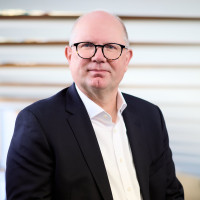
We weren't exactly sure about the fact that there's the short or the long intro. And so it sounded like it ended a little bit abrupt. So I went back and forth. So this time I was too late, I believe. While I was too early for my opening keynote. So I think that's well balanced at the end. So great to have you here for the closing keynote of the European Identity Conference 2025. I think it was number 18 or something like that we did. So it's quite a number of EICs over the years. I almost believe I'm the only one who was at all EICs right now in this room.
So at least not that many that attended at all. And clearly several that attended, 10 and more. And as usual, I don't want to talk too long. So I think last year, the year before I made a joke, my train is only leaving at 5.30. So I have plenty of time.
No, today is leaving at 3.30. So it won't take that long. And so what I want to do first is thank you. I think this is, I could do it at the end, but I may forget it. So I better do it at the beginning. Thank you to all attendees, to all sponsors, to the great team of PCC, the great team of Audiluma, and especially also the great team of Kubringer Kohl that made this event possible. I think only all together it works. And we all know it's a huge event. So plenty of things must sort of work well together and I think we did it very, very well again.
Also, a great thank to the new agenda team. So we had a new agenda team this year and I think they also created a really great agenda with a good balance between traditional and 2040 topics, etc. So thank you. Trending themes. I asked my colleagues and I got a very long list and I had to nail it down to 10. So there were way more themes we talked about. But I think there are some which are really, really relevant to keep in mind. I want to start with the one which at least was made to the biggest buzzword, which is around...
Oh, the buzzword is not here. The buzzword would have been non-human.
Basically, as you may have noticed, I prefer workload identity management over non-human identity management because non-human covers probably more and most of it is focused on that. But I think it's an important theme, but it's also something where we need to learn about how does this work with other types of identities? What is about the access piece, the security piece, the governance piece, ownerships and many other aspects around it? How does it play with secrets management? What do they converge?
I think there were many, many interesting conversations and discussions around that and I believe this is something which will be here, but which also will evolve. So I'm very confident this topic will look very different next year and the year after. We have these identities. They are here to stay. We need to get a grip on it. But the solutions will evolve and mature quickly. So maybe even the acronyms will, the entire scene will definitely evolve. A-identity, one of my favorite themes. So this intersection of A-I and identity is clearly one of the current themes.
On one hand, we have this and I like to speak of A-I less as artificial intelligence than as augmenting intelligence because I think that describes way better what A-I does. It augments humans in doing things hopefully better. We see a huge impact here on doing things in identity better. Maybe solving even things we didn't solve well over the past decades sometimes. On the other hand, we need identity to handle autonomous acting, A-I agents to handle the relationships, et cetera. So that will be a very interesting evolution and we are just at the start here.
As well as B2B trust, frameworks around that supply chain security. It is where really very, very practical use cases, very concrete requirements, concrete pressure exist. So this is one of the themes which sometimes falls a bit through the, it's a bit under the radar because we talk a lot about workload and consumers. But when we look at all the B2B related things, then it's a huge theme. We had some very interesting conversations and sessions around it today again.
Also how this comes together with, as I said, business wallets, for instance, which may be the wallets that really drive adoption. Resilience, serenity for IAM and organizational resilience are very important themes. So it's funny, a couple of years ago we did an advisory for a large firm around how can you kind of build some resiliency for my, back in the days, Azure Active Directory. And then it went a bit quiet, popped up every now and then. But I would say the last couple of weeks, I had plenty of conversations around that.
Clearly part of a geopolitical situation that drives thinking about how can I create more resilience, but also what happens if there's a major outage of a large IDP. And major outage that depending on the industry you're in might be something which we don't count in days and weeks, but in hours where we need already resilience. And organizations are depending on that. So we have the organizational resilience behind IAM themes, which is an important driver. And I think we need to also get better on really naming the concrete business impact that is behind that.
So what does it mean for a business when certain parts of IAM fail? We need to look at this and we need also to think about sovereignty, where we need to, when we need it, et cetera. Authorization. So some say authentication is solved. I would say theoretically a lot is solved. Practically for many it's still some longer way to go.
But yes, in authentication we are definitely more mature than in authorization. Authorization is still a big theme we need to address, we need to solve well. And as I've said earlier, I think it wasn't even the keynote, making authorization hard-coded into a software is just a bad coding and security practice, nothing else. So software that comes with static entitlements is totally outdated. It's badly done, full stop. Trust in identities, verified identities, fraud, deepfake. So is this Martin Orsis, an AI agent? All that stuff becomes increasingly important. Do we get a grip on deepfake?
How do we get a grip on that? How do we identify fraud? Very important themes. As I think some have noticed, I'm not so negative on that. So I think I have some, positively seen some hope that we will, as usual, when we have new threats emerging, it takes a while, there's a peak, and then we learn how to get it down to an acceptable level of damage at the end of the day. But we need to learn a lot here. Especially we need to understand, is this, again, the human and non-human acting on behalf of a human? And if it's a non-human, is it acting as the human intends the non-human to be or not?
So a lot of interesting questions. Also goes a bit back to AI identity, obviously. I think we still need to work hard on a vision that everyone understands for decentralized identity. Not a vision for our community, a vision for the society, for everyone, for the decision makers, for the citizens, for the individuals, for everyone. We need to get better here. And clearly the killer use case, we had some interesting conversations and panels today around what is the real business case for decentralized identity.
By the way, B2B, or business wallets, took a very interesting position in that conversation. They might be something which drives a lot, but there are others as well. We need to look at it. I think we can do so many things so much better with decentralized identity, but we need to do it right.
Back to, here, finally, NHIS, autonomous, authentic AI for NHIS. I managed to bring in four buzzwords within five words. I think this is a really great achievement. So this is really buzzword bingo at its best. There's something behind that. I think we have the situation, we have autonomously acting components, which is frequently authentic AI, and we need it in certain use cases. As I've said in a couple of talks, and others surely as well, we can't handle agile, dynamic, high-scale, large-scale environments like we have around workload identities.
With traditional human administration, it will not work. The humans are just too slow, and are capable of handling the complexity. So we need the augmenting element here. But we need to do it right again, so that things don't go rogue. Identity proofing for non-human identities, so not only trust in every type of identity, but the identity proofing for non-human identity is, again, something which falls a bit into these categories. How do we know this is what it is? So biometrics, pretty hard to do, probably some other sort of biometrics here.
And last but not least, surely, identity fabrics for today and tomorrow. And that's something also we will definitely work a lot on, is what is the pathway? What are the roads from where you may stand today to that tomorrow? What are the things you can do, and how can you sort of continuously evolve from your state of I am, which can be very different to sort of where it may be in 2040. Probably when we look back at this in 2040, then the world will look anyway very different.
But I think there are some elements in which are very logical, that we will see that we are moving in a certain direction. So this will be definitely also a very, very big, very important theme here, or was a very important theme. And I think it's here to stay. So we are talking about identity fabrics for quite a while. I would say the newer things really that popped up were really around workload on human identity and a bit of the AI stuff, which was here as well. So it's a mix of new themes, of evolving themes, of themes that just will remain relevant, are relevant.
And surely a lot of things we will see again in 2026. A lot we will write and talk about over the next year, you will work on. So these were some of the things I saw here. You probably took your own points with you where you said, okay, this is something I need to think about.
For me, every year with EIC, I have quite a number of thoughts and ideas which I need to work out over time after EIC. Most likely that will not happen in the train back today, where I'm more likely to relax a bit after these four days. But it's something I hope you all got some food for thought and some valuable ideas and recommendations for your work in the next year. What else? I think I need to do a bit of marketing.
Yeah, Casey membership. I think it's something you really should look at. Because it means you can access our research, you can access all, oops, all the old recordings, for instance, from last year's or the previous conferences, et cetera. You have access to the events, and you also, depending on the level, have different ways for access to the analysts and advisors. And I think that's something which is really worth to look at. We will have another event in mid-September, hands-on around the Identity Fabric, which has the nice name of Impact Day.
So this is really very concrete, looking at, come on, Jenny, did you put in some animated slides here? This is really looking at very concrete, practical aspects. I'm very sure that, for instance, the roadmap from where are you to Davis, where I am, to the Identity Fabric will play a very important role in that event. So I just hand this over to my colleagues so that they can think about what to put into this event overall.
Again, thank you, Dan. Thank you, as I've said, to everyone here in the room, to all the different teams supporting us, and especially, surely, also to our sponsors, our Platinum sponsors, our other sponsors.
We have, again, a very strong support from the industry. So thank you. Please also share your feedback. There's a QR code on that. I don't like QR codes, by the way. I'm not sure how this part of user experience ever could become reality. I find it really not very convenient to use. But it's a different thing. So that is another element. I'm pretty sure there are also ways to use the app to share the feedback. And I have to say also thank you for the ones who came up with this app. Not 100% perfect, but it was definitely our best event app we ever had. And we have a video.
And I was told I shouldn't speak during the video. So I'll stop here. This is my first time at EIC. My first time. Yes. Yes. First time in Berlin and also the first time at EIC conference. The second time that we are visiting this conference.
No, my second time. I've been here many times. I've been coming here for about 10 years now. I have been there from the very beginning in 2007.
Overall, it's very hospitable. It's very great. I really like it. Meet with people who are just really, really on top of it. From an identity standpoint, it's been top notch. It's great to be here to meet with organizations from around the industry. I've met so many people in the hallways, which is always the great thing about networking here. Both the sessions and the vendors are quite attractive for us. I like the format with the 20 minute concise sets of information. Every year I learn more. Some of the topics that interested me the most was, I would say, the debt assets.
That one very interested me because I had never even thought about something like that. As an American, I have an American point of view. And so the whole point was here is, okay, well, how do I expand that to more of a world view? I'm very interested in international interoperability. What are companies prioritizing at the moment within Europe and globally? Specifically within identity governance and administration. It's been really interesting to just listen to those topics and to engage with people that I otherwise wouldn't get to meet if I was still in my office in London.
The positive and the negative usage of AI, the deepfakes, the AI, the impact on the human identity. What I see as a very important topic is non-human identity. The combination is going to make some big changes, so I'm looking forward for that. EIC is the first place I want to come for any conference every year. Networking is for me the big name. Collaborative. I think that, yeah, collaborative. That's probably the word I'd use. I'm going to say forward-looking. Expansion. Intense. And engaging. One-stop shop for identity. Exciting. Fun. Deep knowledge. I'd just say awesome. It's amazing.
It's eventful. And we like it. So. Okay. Screen went black. I can speak again. So thank you for all who shared their opinions for this video. And that leaves me only with one more thing, which is the most important, aside of saying thank you. The most important is, save the date for EIC 2026. And so it's again in May, it's a little later. We have so many public holidays in Germany in May always, that it's always a bit tricky to find the time where it fits.
But I think for some of you, it might be very important to understand, at least to my knowledge, that it is not right the week, or the week right after RSA conference this time. Which I think made it pretty tough for some, that basically flew over from San Francisco directly here. So next year it will not be that closeness between these two events. I hope you all will be back there again. You can save your spot today already, hopefully it works.
And again, we have the option to be here as speaker, so we will have a call for speakers. Do it early, do it precise, because we have so many submissions there. And see you next year. So what I wish you right now is safe travels and relax over the weekend. Thank you. Thank you. Thank you.