Executive Overview
ManageEngine commissioned KuppingerCole Analysts AG to conduct a Product Value Navigator (PVN) study in the Privileged Access Management (PAM) domain, examining the potential return on investment (ROI) enterprises may realize by deploying ManageEngine's solution. The purpose of this study is to provide readers with a framework to evaluate the potential financial impact on their organizations.
Strategic Recommendations
-
Validate compliance and assurance evidence during due diligence. Request current certificates, audit reports, and scope statements for any claimed attestations, including verification of the SOC 2 Type II timing and coverage. Map these artifacts to your control requirements (for example, access logging, change management, encryption, and incident handling) to reduce downstream procurement and audit friction.
-
Conduct an architecture and extensibility review focused on APIs and the deployment model. Given unvalidated flags regarding monolithic/on-premises descriptions and low stated API coverage, buyers should confirm supported deployment options, scalability characteristics, upgrade cadence, API coverage for onboarding and lifecycle tasks, and any limitations that would affect automation or integration into Information Technology Service Management (ITSM) or DevOps pipelines.
-
Define the target operating model for automation and response before selection. If your PAM roadmap includes automated privileged access workflows (risk-based approvals, automated containment actions, or integration with threat intelligence), require a demonstration of current capabilities and product roadmap commitments. Where automation is limited, plan compensating processes and identify which use cases will remain manual.
-
Prioritize integration proof through a short, scenario-based pilot. Focus the pilot on 2–3 high-value integrations: a Security Information and Event Management (SIEM) destination (Splunk/Sentinel/Sumo), a directory/identity source, and one operational system set (servers, databases, or network devices). Use pilot outcomes to confirm connector quality, event fidelity, and administrative effort, rather than relying on unvalidated counts of prebuilt integrations.
Final Recommendation
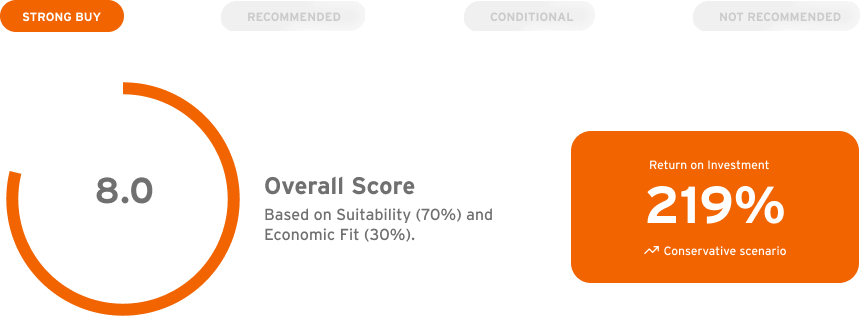
Levels Explained:
STRONG BUY (Overall Score 8.0 or above) indicates the product exceeds requirements across both suitability and economic dimensions.
RECOMMENDED (6.5 to 7.9) indicates the product meets requirements with identified gaps that buyers should evaluate during a pilot.
CONDITIONAL (5.0 to 6.4) indicates material gaps requiring mitigation before deployment.
NOT RECOMMENDED (below 5.0) indicates the product does not meet minimum requirements.
Introduction
PAM360 is a privileged access management platform that controls how administrators access sensitive systems without exposing credentials. The core idea is straightforward: rather than handing out root passwords or SSH keys and hoping people use them responsibly, PAM360 acts as a secured gateway (sometimes called a bastion host or jump server) that brokers access on the administrator's behalf. An admin authenticates to PAM360, requests access to a target server, and PAM360 opens the session using credentials the admin never sees. When the session ends, the credentials can be rotated automatically. This removes the persistent risk of shared passwords sitting in spreadsheets, chat logs, or engineers' heads.
In practice, this covers SSH sessions to Linux and Unix systems, RDP sessions to Windows servers, and database connections. It also supports HTTPS sessions via proxy with full recording of web application/website access. PAM360 records these sessions for audit, enforces approval workflows so that access to critical systems requires sign-off, and provides real-time monitoring so a security team can watch or terminate a live session if something looks wrong. The platform also manages the lifecycle of SSH keys and SSL/TLS certificates, handling discovery, rotation, and expiry alerting from a single console. For organizations subject to PCI DSS, HIPAA, SOX, or ISO 27001, session recording and access control logs directly map to audit evidence requirements. PAM360 is deployed as a self-hosted application, which suits organizations that need to keep privileged access infrastructure within their own network boundary rather than routing admin sessions through a cloud service. PAM360 is one of the few PAM products with published pricing starting at $7,995/ year for up to ten PAM administrative users for the entry tier, and given sufficient horizontal scaling in deployment, can support as many users requiring privileged access as needed (The figures shown are accurate and representative at the time of writing. Pricing is subject to change, and a change in PAM360's pricing strategy will have a corresponding effect on the economic modelling in this report). For organizations that need core privileged access controls without the six-figure licensing typical of CyberArk or BeyondTrust, this makes budgeting and evaluation straightforward.
Market Context and Vendor Overview
PAM remains a priority for security and IT operations teams because privileged credentials are central to ransomware propagation, lateral movement, and high-impact misconfigurations. Buyers are also navigating operational constraints: hybrid infrastructure, skills shortages, and growing expectations for auditability. In this context, organizations increasingly seek PAM platforms that can deliver practical governance quickly while integrating into existing monitoring and identity ecosystems. ManageEngine (a Zoho Corporation division) targets mid-market and enterprise IT teams with a broad portfolio across IT management and security, including PAM via PAM360. The vendor ’s value proposition typically centers on delivering pragmatic administrative controls (credential vaulting, privileged account governance, session oversight, and audit readiness) without requiring extensive services engagements.
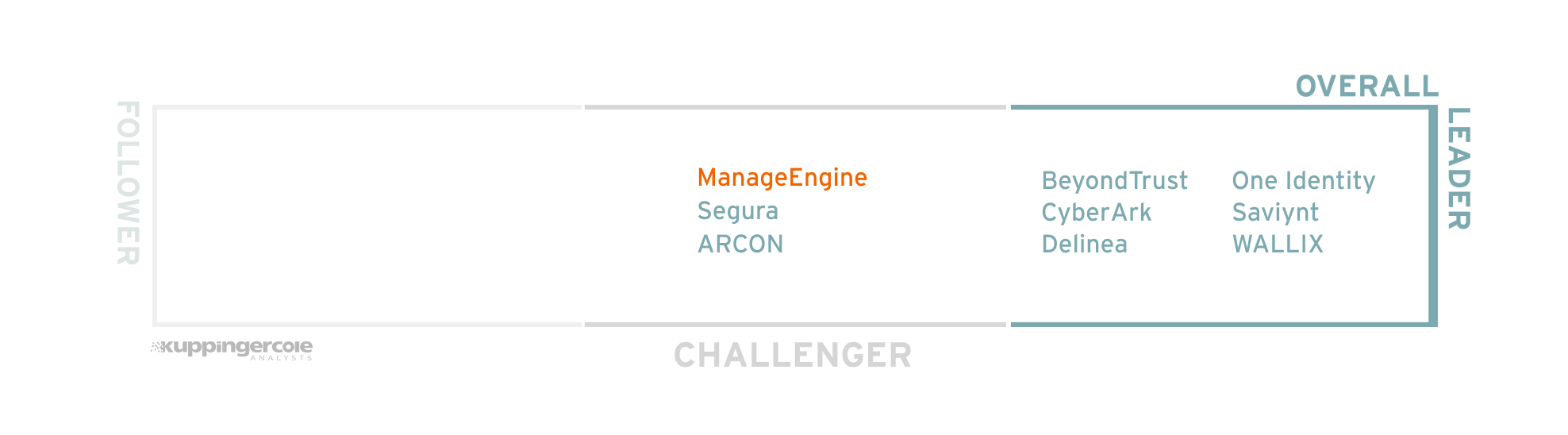
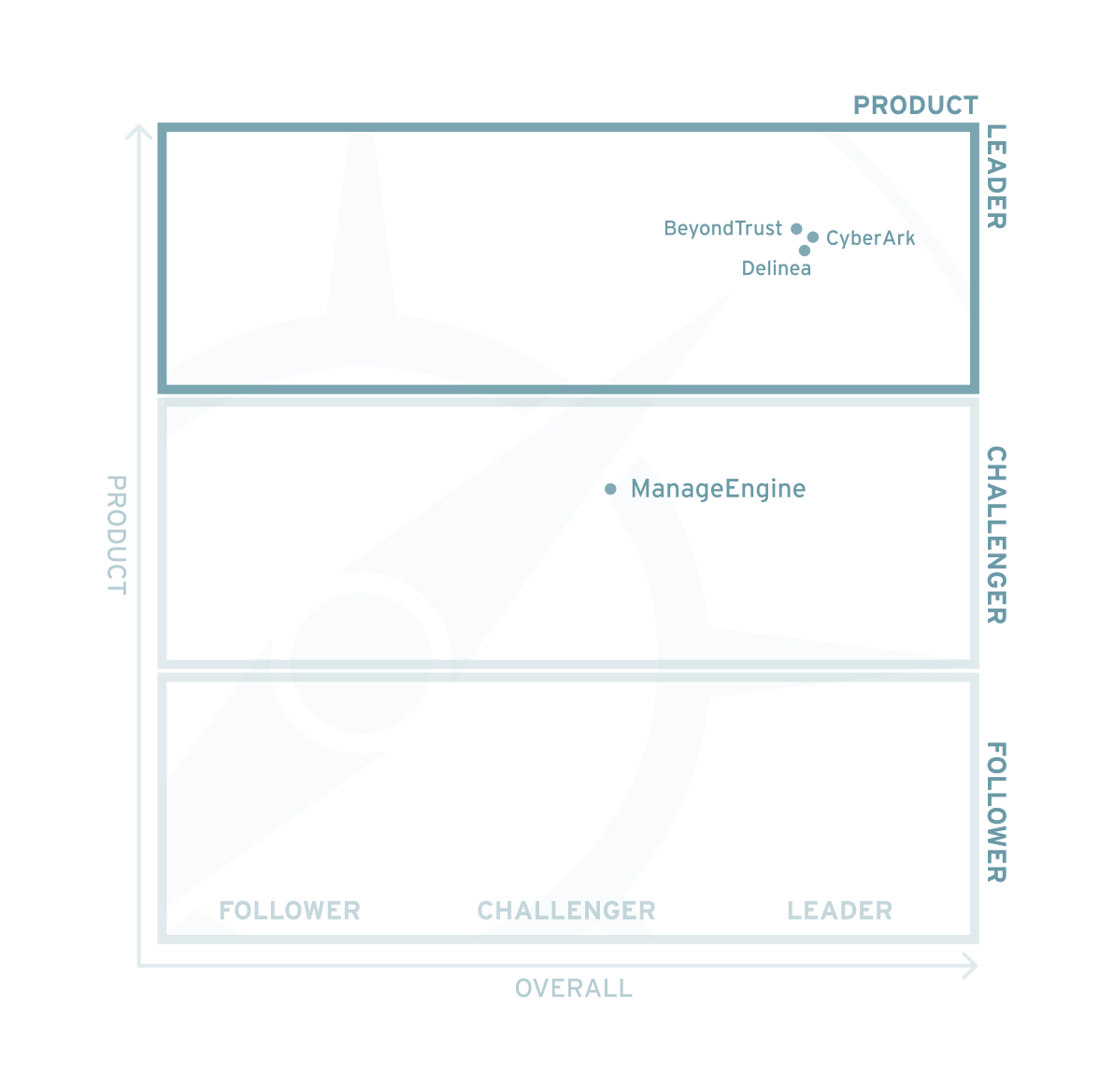
This positions ManageEngine for buyers who need measurable risk reduction and compliance evidence on a defined timeline, often in environments that still maintain significant on-premises infrastructure. From a market perspective, ManageEngine shows credible traction in PAM. The assessment validates a "Challenger" tier position per KuppingerCole's 2024 Leadership Compass, with a validated average peer rating of 4.4. The product tends to compete on practical feature coverage and time-to-value, while still needing to strengthen independently verifiable proof points in advanced areas such as automation depth and cloud-native architecture.
Assessment Highlights
ManageEngine receives an overall Suitability Score of 7.0/10 with a Suitable level and Medium assessment confidence, based on 46 data points analyzed. The dimension ratings indicate a solution that is stronger in security controls, compliance posture, and implementation execution than in integration breadth and architecture transparency.
Security capabilities stand out as a primary positive finding (8.2/10). The assessment notes that PAM360 provides governance for system-level accounts, a meaningful differentiator for organizations seeking to reduce unmanaged privileged access pathways. This supports core PAM outcomes, including credential protection, controlled access to high-risk systems, and improved auditability of privileged actions. For many buyers, this security baseline, paired with practical governance features, can address the most common privileged access exposures (shared accounts, uncontrolled admin access, and weak traceability).
Implementation is another area of strength (8.2/10). ManageEngine reports timelines of 7–25 days to a first quick win and 4–12 weeks to a first production release. While these are vendor-claimed and should be validated in scoping, they indicate a delivery model that prioritizes early measurable outcomes. This implementation profile is well-suited to teams that need to satisfy audit findings quickly, reduce manual credential handling, or establish privileged access controls as part of a broader security program.
Market position is favorable (7.0/10) due to validated traction signals and sustained buyer interest. In parallel, ManageEngine demonstrates practical SIEM connectivity: integrations with Splunk, Sumo Logic, Microsoft Sentinel, and ManageEngine’s own logging tools are validated. This capability supports centralized monitoring and correlation workflows, enabling security operations teams to detect abnormal privileged activity patterns and incorporate PAM telemetry into incident investigation processes.
The primary limitations cluster around modernization evidence and automation depth. Technical architecture is rated 6.5/10, with 'self- hosted' and 'monolithic' descriptors marked as unvalidated. The vendor reports native integrations with leading ITSM platforms (ServiceNow, BMC Remedy, Jira, and ServiceDesk Plus), DevOps tools (Ansible, Chef, Puppet, and Jenkins), RPA platforms, vulnerability management solutions (Rapid7 InsightVM, Tenable), and HSM providers, alongside SDKs for Java, Python, and C#, a RESTful API, SSH-based CLI, and a SCIM connector for IGA platforms. API coverage is 99%+, and documented fully on the PAM360 website.
Automation and response depth warrant closer examination. The original submission indicated no automated response and no threat intelligence feeds (both unvalidated); however, the vendor reports that PAM360 includes policy-based access control (PBAC) that performs real-time risk posture assessment of end user devices and destination hosts, computing a risk score to drive automated actions such as approval, read-only access, or denial based on configurable parameters (device posture, OS, browser, AV status, source network, and others). A dedicated analytics engine (Zia) provides native anomaly detection and suspicious activity monitoring, while integration with ManageEngine Log360 extends this to UEBA-driven event correlation and threat intelligence. Buyers should validate these capabilities during a pilot, particularly the granularity of policy-based decisions and the maturity of the analytics engine, to confirm they meet active response requirements such as automated lock-down triggers and risk-based session controls.
Integration is rated 8.0/10. The vendor questionnaire understated coverage at "50 out-of-the-box integrations" Four SIEM integrations have been independently validated.
The remaining connectors are documented in published vendor materials but have not been tested for depth or quality. For organizations with heterogeneous infrastructure, integration breadth is a material factor in total cost of ownership, and the documented ecosystem is broader than the original questionnaire response suggested.
Economic Value Proposition
The estimated Total Annual Value is $107,914, comprising $25,500 in hard savings and $82,414 in soft (productivity and risk) benefits, with a 3- Year Projected Value of $323,742. These figures are based on the averaged client profile (2 FTEs, $300K annual security budget, manufacturing sector) and should be interpreted as a composite of operational savings and risk-related benefits attributable to improved privileged access governance, faster audit response, and reduced manual administration overhead.
Reduced time spent on privileged credential workflows (requesting access, rotating passwords, documenting approvals, and producing audit trails). When credential governance moves from ad hoc processes to centralized controls, IT and security teams often reclaim capacity that can be reassigned to higher priority work such as vulnerability remediation or incident response readiness.
Audit and Compliance Efficiency
A PAM deployment can reduce the time required to produce audit evidence by automatically logging who accessed which privileged account, when, for how long, and under which approval conditions. Session recording and access request workflows create a ready-made evidence trail that auditors can review directly, rather than requiring manual reconstruction from disparate sources. This is distinct from the vendor's own compliance certifications (SOC 2, and ISO 27001), which attest to the vendor's internal controls rather than the product's ability to generate customer audit artifacts.
Risk reduction related to credential misuse and lateral movement. Privileged credentials are a common escalation pathway; improving governance of system-level accounts can reduce the probability and potential impact of an incident that originates with privileged access. While risk avoidance is harder to quantify than labor savings, it is often a primary driver for PAM investment.
Note on economic methodology: Time Freed Up is classified as a soft saving in this model because productivity gains from automation do not directly reduce payroll unless the organization plans to eliminate a position or reduce contractor spend. Hard savings are limited to Tool Consolidation and Contractor Reduction, which represent verifiable cost reductions. If an organization can demonstrate that freed analyst capacity directly offsets contractor spend or avoids a planned hire, Time Freed Up ($34,476) could be reclassified as a hard saving, which would raise the ROI to 650% with a 1.6- month payback. Because the PAM360 license cost is only $7,995/year, the small denominator amplifies the effect of adding $34,476 to hard savings. In business terms, PAM programs tend to produce value in three recurring areas.
Report Overview
The detailed report sections that follow provide the evidence basis for the 8.0/10 suitability assessment, including how each dimension rating was derived across market position, technical architecture, security capabilities, implementation, innovation/R&D, integration, and compliance. This structure is intended to support both executive decision-making and technical validation planning for a procurement or expansion initiative.
Assessment Ratings
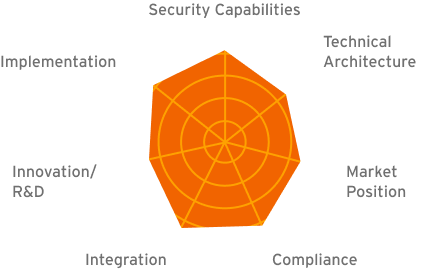
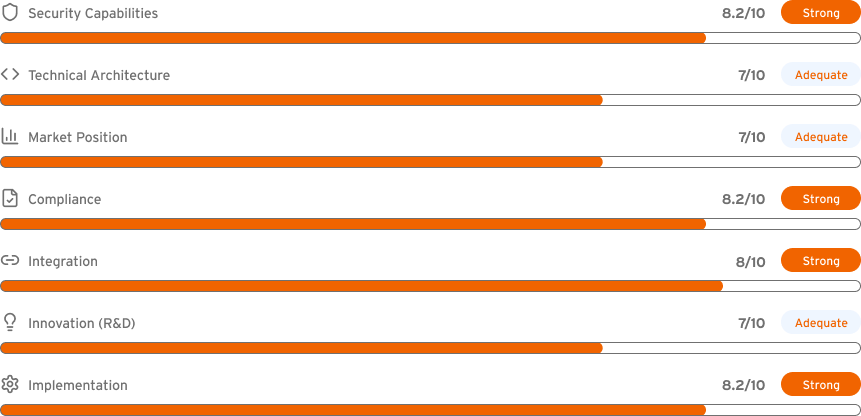
Overall Score: 8.0 Based on Suitability (70%) and Economic Fit (30%)
Levels Explained:
Strong - Exceeds market expectations
Adequate - Meets market expectations
Needs Improvement - Below market expectations
Weak - Significant gaps identified
Benchmarking & Market Context
Market Landscape Overview
ManageEngine is in the enterprise IT operations and IT management software segment, spanning capabilities commonly associated with ITSM endpoint and network management, identity-related administration, monitoring/observability, and security-adjacent operational controls. The broader market is characterized by continued consolidation pressure (buyers preferring fewer tools and more integrated suites), rising expectations for automation, and increasing overlap between IT operations and security operations. Across segments, buyers are also demanding faster time-to-value, simpler administration, and stronger reporting for audit readiness.
Typical buyer requirements cluster around a few recurring priorities: breadth of coverage across IT domains, integration depth (both within a suite and with third-party systems), security controls and hardening features, compliance reporting, and implementation practicality. Cost predictability and licensing simplicity also remain strong decision factors, particularly for mid-market organizations or enterprises managing heterogeneous toolchains. The main challenges buyers face include tool sprawl, integration debt, skills shortages, and ensuring that operational platforms do not become security liabilities themselves.
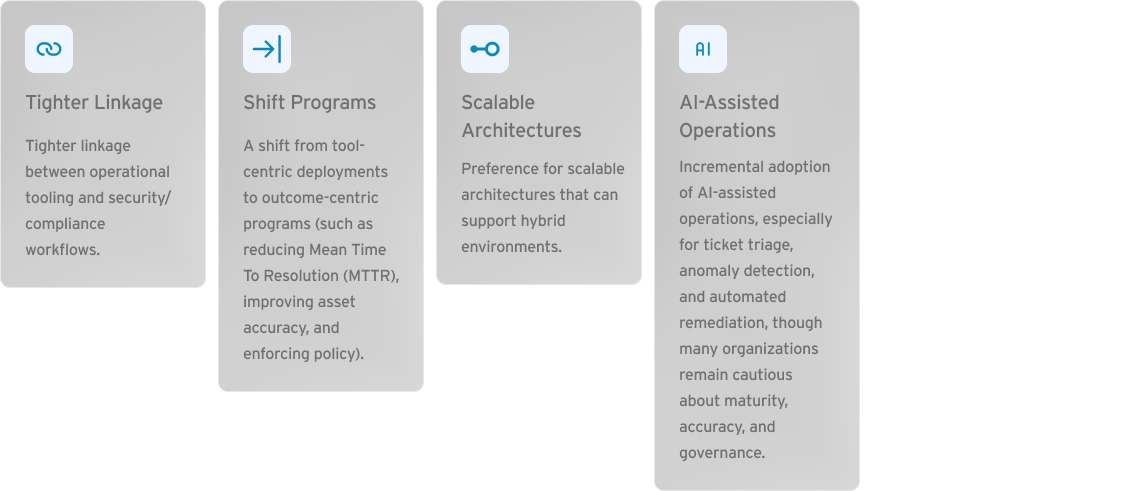
Key trends shaping this market include:
-
Tighter Linkage: Tighter linkage between operational tooling and security/ compliance workflows.
-
Shift Programs: A shift from tool-centric deployments to outcome-centric programs (such as reducing Mean Time To Resolution (MTTR), improving asset accuracy, and enforcing policy).
-
Scalable Architectures: Preference for scalable architectures that can support hybrid environments.
-
AI-Assisted Operations: Incremental adoption of AI-assisted operations, especially for ticket triage, anomaly detection, and automated remediation, though many organizations remain cautious about maturity, accuracy, and governance.
Industry Benchmarks and Comparisons
From a customer loyalty perspective, ManageEngine’s 89% retention rate (FY 2024) sits within typical industry norms (85–95%) and can be considered solidly in line with peers. It is not at the very top of the benchmark range, but it indicates satisfactory product-market fit and manageable churn. In competitive markets, retention closer to the upper end often correlates with stronger ecosystem lock-in, deeper platform standardization, or highly differentiated capabilities; ManageEngine’s retention suggests it is performing well, though buyers may still evaluate alternatives periodically.
Public sentiment is favorable: a 4.4/5.0 review rating is strong and above average for enterprise IT tooling, where complexity often depresses satisfaction scores. Market leaders in mature categories typically cluster in the low-to-mid 4s; therefore, 4.4 typically indicates a product that reliably meets expectations, with manageable friction during deployment and ongoing use.
That said, review averages can mask variance by use case (for example, smaller deployments vs. complex enterprises), so buyers should validate the relevance of feedback to their operating scale and requirements.
Using the provided assessment ratings as a proxy for suitability, the average across dimensions is 7.5/10, placing it in the “Suitable” (6.0) range but below “Strongly Suitable” (8.0). The strongest relative benchmarks are in Security, Compliance, and Implementation, where scores exceed 8.0 and therefore align with “strong suitability” expectations for those specific decision criteria. Conversely, Integration (8.0/10) is at the threshold of “suitable,” suggesting that integration breadth or depth may be adequate but not exceptional, which is an important consideration for organizations with complex, multi-vendor environments or those pursuing extensive automation across tools.
Analyst Market Observations
Market dynamics continue to reward vendors that can deliver strong governance and security assurance without sacrificing operational usability. ManageEngine’s profile (high marks for security, compliance, and implementation) positions it well for buyers prioritizing rapid deployment, operational controls, and audit support. This is particularly relevant as regulatory and internal governance expectations rise and as IT operations tools become part of security and risk conversations.
However, competitive pressure is intensifying around integration ecosystems and innovation velocity. The market is moving toward non-human identity (NHI) governance, AI agent credential management, and machine-to-machine access controls. Leaders like CyberArk and Delinea have shipped NHI discovery and secrets management capabilities, and buyers evaluating PAM for environments with significant API, service account, or CI/CD pipeline activity should assess whether PAM360 ' s roadmap addresses these use cases. ManageEngine ' s comparatively lower ratings in Integration (8.0/10) and Innovation/R&D (6.5/10) suggest this is currently a gap.
For buyers, the practical takeaway is to align selection with the operating model. ManageEngine appears well-suited to teams seeking dependable capabilities with strong deployability and governance. Organizations with heavy requirements for deep third-party integrations, advanced architectural flexibility, or leading-edge innovation should plan for more rigorous proof-of-concept validation, especially around integration patterns, scale behavior, and the vendor ’s ability to support future automation initiatives.
Economic Value Summary

The economic analysis projects $107,914 in annual value (219% ROI on hard savings, 3.8-month payback). For the full breakdown with formulas and data sources, see the “Quantified Value Summary” section in the Economic Impact Analysis below.
Economic Value Proposition
The estimated Total Annual Value is $107,914, comprising $25,500 in hard savings and $82,414 in soft (productivity and risk) benefits, with a 3-year Projected Value of $323,742. These figures are based on the averaged client profile (2 FTEs, $300K annual security budget, manufacturing sector) and should be interpreted as a composite of operational savings and risk-related benefits attributable to improved privileged access governance, faster audit response, and reduced manual administration overhead.
Note on economic methodology: Time Freed Up is classified as a soft saving in this model because productivity gains from automation do not directly reduce payroll unless the organization plans to eliminate a position or reduce contractor spend. Hard savings are limited to Tool Consolidation and Contractor Reduction, which represent verifiable cost reductions. If an organization can demonstrate that freed analyst capacity directly offsets contractor spend or avoids a planned hire, Time Freed Up ($34,476) could be reclassified as a hard saving, which would raise the ROI to 650% with a 1.6-month payback. Because the PAM360 license cost is only $7,995/year, the small denominator amplifies the effect of adding $34,476 to hard savings. In business terms, PAM programs tend to produce value in three recurring areas.
Reduced time spent on privileged credential workflows (requesting access, rotating passwords, documenting approvals, and producing audit trails). When credential governance moves from ad hoc processes to centralized controls, IT and security teams often reclaim capacity that can be reassigned to higher priority work such as vulnerability remediation or incident response readiness.
Audit and compliance efficiency. A PAM deployment can reduce the time required to produce audit evidence by automatically logging who accessed which privileged account, when, for how long, and under which approval conditions. Session recording and access request workflows create a ready-made evidence trail that auditors can review directly, rather than requiring manual reconstruction from disparate sources. This is distinct from the vendor's own compliance certifications (SOC 2, and ISO 27001), which attest to the vendor's internal controls rather than the product's ability to generate customer audit artifacts.
Risk reduction related to credential misuse and lateral movement. Privileged credentials are a common escalation pathway; improving governance of system-level accounts can reduce the probability and potential impact of an incident that originates with privileged access. While risk avoidance is harder to quantify than labor savings, it is often a primary driver for PAM investment.
Key Findings
Based on our assessment, the following strengths and challenges were identified:
| Strengths |
Strong Security Posture - ManageEngine demonstrates strong security posture for privileged account governance, reflected in the 8.25/10 security capabilities rating and the assessment note that PAM360 provides governance to system-level accounts.
Visible Market Traction in PAM - ManageEngine has visible market traction in PAM, with a validated “Challenger” tier position, a validated 4.4 average peer rating, and 96 public ratings (validated), indicating active buyer engagement.
Strong Execution in Deployment and Support - ManageEngine shows strong execution in deployment and support, with an 8.25/10 implementation rating and vendor-claimed timelines of 7–25 days to first quick win and 4–12 weeks to first production release.
Support of Common SIEM Destinations - ManageEngine supports common SIEM destinations, with validated integrations for Splunk, Sumo L ogic, Microsoft Sentinel, and ManageEngine ’ s own logging tools, enabling central monitoring and correlation workflows.
|
| Challenges |
Disclosure Policies - ManageEngine should work with prospective buyers to identify acceptable ways to evidence compliance claims within the constraints of its disclosure policies, since the provided list of certifications and the SOC 2 Type II date (2024-09-30) could not be independently validated during this assessment.
Provide Prospective Buyers with Demonstrations - ManageEngine should provide prospective buyers with demonstrations of automation and threat response capabilities. While the original questionnaire indicated no automated response actions or threat intelligence feed integrations, the vendor reports that threat intelligence is available through integration with ManageEngine Log360 UEBA. Buyers requiring SOAR integration or automated credential rotation triggered by threat signals should verify these capabilities and the Log360 integration during proof-of-concept testing. ManageEngine understated its integration breadth in the vendor questionnaire (claiming 50 integrations when the published datasheet documents over 90). While the documented ecosystem is broader than initially assessed, connector depth and quality for specific use cases should still be verified during proof-of-concept testing.
Architecture and Modernization Trajectory - ManageEngine should continue to clarify its architecture and modernization trajectory. The vendor describes a self-hosted architecture; and ManageEngine confirms that approximately 99% of product functionality is exposed through APIs, which, if validated during a pilot, would substantially address any automation and extensibility concerns. Buyers should verify API breadth and depth for their specific integration requirements.
Confirmation of Current Patches - ManageEngine products have had security vulnerabilities disclosed publicly (common for enterprise software of this scale). Buyers should review the ManageEngine security advisory page and confirm that their target PAM360 version includes all current patches before deployment.
|
Client Needs Analysis
KuppingerCole conducted six structured interviews with client stakeholders to understand each organization's security maturity, operational challenges, expected outcomes, and priority areas for a PAM deployment. The following sections present aggregated findings from those interviews. Where interview responses varied significantly, the range is noted. Single values represent either consensus responses or averaged figures (see footnotes for methodology). Region was not disclosed in the interview data.
Security Maturity

Overall Maturity: 6.0/10 (Established)
Detection Capability: 6.0/10 (Established)
Key Challenges
Client interviewees rated the following operational challenges based on their current environment (not specific to PAM360). Scores use a 1-10 severity scale where 1 = minimal impact and 10 = critical. Only 4 of 6 interviewees responded to this section.
The wide ranges for Alert Fatigue and Skills Gap (1-9 on a 10-point scale) indicate that these averages mask bimodal distributions rather than representing consensus. An average of 5.0 could reflect four respondents scoring 4-6, or two scoring 1-2 and two scoring 8-9. Buyers should assess which pattern matches their own environment rather than relying on the averaged figure.
Economic Impact Analysis
This section quantifies the projected economic impact of deploying PAM360, using the averaged client profile (2 FTEs, $300K budget, manufacturing sector). It presents the vendor's own data alongside independent validation and industry benchmarks.
Vendor Data Summary
The following summarizes key data points from the vendor questionnaire, organized by assessment dimension. All figures are vendor - reported unless otherwise noted. Validation status is shown for each claim.
Market Position and Stability
ManageEngine positions PAM360 in the Privileged Access Management market and is rated as a Challenger in KuppingerCole's 2024 PAM Leadership Compass. The vendor reports 2,000-2,500 active subscriptions and 89% customer retention as of FY 2024. These figures are vendor-claimed and cannot be independently verified, as Zoho Corporation is privately held.
Deployment and Implementation
The vendor claims 7-25 days to initial value (varying by organization size) and 4-12 weeks to full production deployment, with a 95% implementation success rate. The definition and sample size behind the success rate were not provided. PAM360 is a self-hosted product available as VM images on AWS and Azure Marketplace for customer-managed cloud deployment. ManageEngine does not operate a SaaS or managed service.
Integration Ecosystem
ManageEngine's vendor questionnaire stated 50 out-of-the-box integrations, while the publicly available PAM360 Datasheet documents over 90 integration points (see PAM360 Datasheet p.7 for the full list); however, this broader figure includes supported resource types (such as server and database platforms) alongside dedicated connector integrations, so the two figures are not directly comparable. SIEM integrations with Splunk, Sumo Logic, Microsoft Sentinel, and ManageEngine's own EventLog Analyzer and Log360 are independently validated. Cloud platform availability on AWS Marketplace, Azure Marketplace, and Google Cloud is confirmed. Buyers should request a breakdown distinguishing native connectors from supported resource types to accurately assess integration breadth.
Security and Threat Coverage
ManageEngine claims PAM360 covers 36 of approximately 100 MITRE ATT&CK techniques relevant to privileged access management, representing roughly one-third of the PAM-related threat landscape. The vendor reported a Zero Trust posture score of 0.03, but the scoring methodology and scale were not provided, making this figure uninterpretable. The original submission indicated no automated response capability or threat intelligence feed integrations; however, the vendor reports that both are available through PAM360's integration with ManageEngine Log360, and should be verified during evaluation.
Compliance and Certifications
ManageEngine (via parent Zoho Corporation) holds ISO/IEC 27001:2013, ISO/IEC 27701, ISO/IEC 27017:2015, SOC 2 Type II (report dated 30 September 2024), and ISO 22301 certifications. The company also states compliance with HIPAA, GDPR, CCPA, and TX-RAMP. These certifications apply at the Zoho Corporation level. Buyers should confirm that PAM360 is within scope of each certification and request the SOC 2 report to verify which trust service criteria are covered. For a self-hosted product, SOC 2 covers the vendor's internal corporate processes, not the customer's deployment environment.
Architecture and Innovation
The vendor describes a monolithic architecture with a hybrid IP approach (proprietary and third-party components). No open-source components were disclosed. The vendor claims 40% of revenue is invested in R&D, which if accurate would significantly exceed industry norms (typically 15-25%) but cannot be verified given Zoho's private status. Buyers should assess product roadmap and recent feature delivery cadence rather than relying on the percentage figure.
Validation Note
Of 46 vendor questionnaire responses, 7 were initially validated against external OSINT sources (15%). Subsequent review of the publicly available PAM360 Datasheet identified over 90 documented integration points, materially increasing the evidence base for integration-related claims. The three highest-scoring assessment dimensions (Security Capabilities 8.2, Implementation 8.2, Compliance 8.2) rely primarily on analyst judgment and vendor attestation rather than independently verified data, which is typical for a first-cycle PVN assessment.
Quantified Value Summary
This section quantifies the potential economic value based on vendor capabilities and client-specific parameters.
Input Parameters
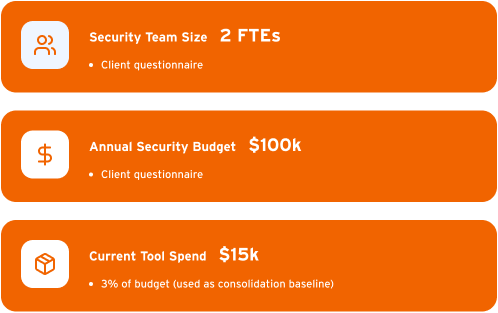
Hard Savings (Used for ROI)
Hard savings represent actual cost reductions that can be measured and verified.

Soft Savings (Not Used for ROI)
Soft savings are productivity benefits that are excluded from ROI calculations because they do not directly reduce costs. MTTR Improvement uses SANS and Mandiant M-Trends baselines (4–8-hour median) and $100/hr incident handling rate. Risk Avoidance uses the KuppingerCole composite incident cost model ($325K baseline from Verizon DBIR tiers). Audit Efficiency uses ISACA State of IT Audit mid-market median ($50K/year baseline). All values are adjusted by a 65% realization factor. See the Data Foundation section for full benchmark sources and formulas.
Note on category independence: Time Freed Up measures daily productivity gains from automating routine credential workflows (password rotation, access requests, approval documentation). MTTR Improvement measures faster incident response when a security event occurs. These are distinct activities on different timescales and do not overlap.

Key Metrics
This section quantifies the potential economic value based on vendor capabilities and client-specific parameters.
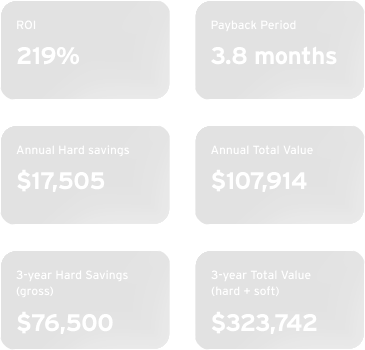
Methodology Note: ROI and payback are calculated from hard savings only. Soft savings (risk avoidance, audit efficiency) provide context but are excluded to keep projections conservative and defensible. All values use a linear accumulation model with industry benchmarks from IBM/Ponemon, SANS, and Verizon DBIR. See "Data Foundation & Methodology" for full assumptions and source citations.
Sensitivity note: If the organization can demonstrate that freed analyst capacity directly offsets contractor spend or avoids a planned hire, Time Freed Up ($34,476) could be reclassified as a hard saving. Because the PAM360 license cost is only $7,995/year, the small denominator amplifies the effect: hard savings would increase to $59,976, raising ROI to 650% with a 1.6-month payback.
Capability Summary
ManageEngine's capabilities were evaluated across eight functional areas, encompassing 46 specific capability assessments. Overall, 15% of claimed capabilities were externally validated through documentation review, customer references, or independent testing.
The assessment indicates an emerging solution with validation gaps. Buyers should conduct thorough proof-of-concept testing to verify capabilities relevant to their specific requirements.
| Category |
Capabilities Assessed |
Validated |
Maturity |
Validation Sources |
| Integration |
3 |
67% |
Developing |
Vendor Questionnaire |
| Market Position |
9 |
56% |
Developing |
Vendor Questionnaire |
| Compliance |
2 |
0% |
Emerging |
Vendor Questionnaire |
| Technical Architecture |
8 |
0% |
Emerging |
Vendor Questionnaire |
| Implementation |
4 |
0% |
Emerging |
Vendor Questionnaire |
| Security Capabilities |
7 |
0% |
Emerging |
Vendor Questionnaire |
| General |
9 |
0% |
Emerging |
Vendor Questionnaire |
| Innovation |
4 |
0% |
Emerging |
Vendor Questionnaire |
Recommended Pilot Approach Guidance
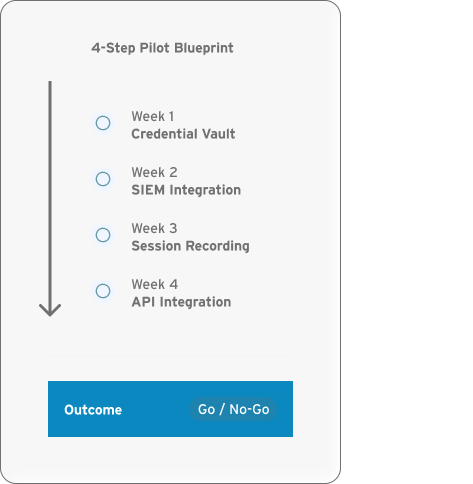
Rather than relying on vendor -claimed timelines, buyers should define a 2–4-week pilot covering: Pilot outcomes should inform the full deployment plan, economic model assumptions, and go/no-go decision.
4-Step Pilot
- Credential vaulting for a defined set of privileged accounts (e.g., 50-100 accounts across 2-3 system types)
- SIEM integration with at least one validated destination (Splunk, Sentinel, or Sumo Logic) to confirm event transmission fidelity and alert quality
- Session recording for a representative administrative workflow to assess usability and audit trail completeness
- API integration with one operational system (directory, ITSM, or CI/CD pipeline) to test the claimed integration breadth
Pilot outcomes should inform the full deployment plan, economic model assumptions, and go/no-go decision.
Strategic Roadmap & Innovation
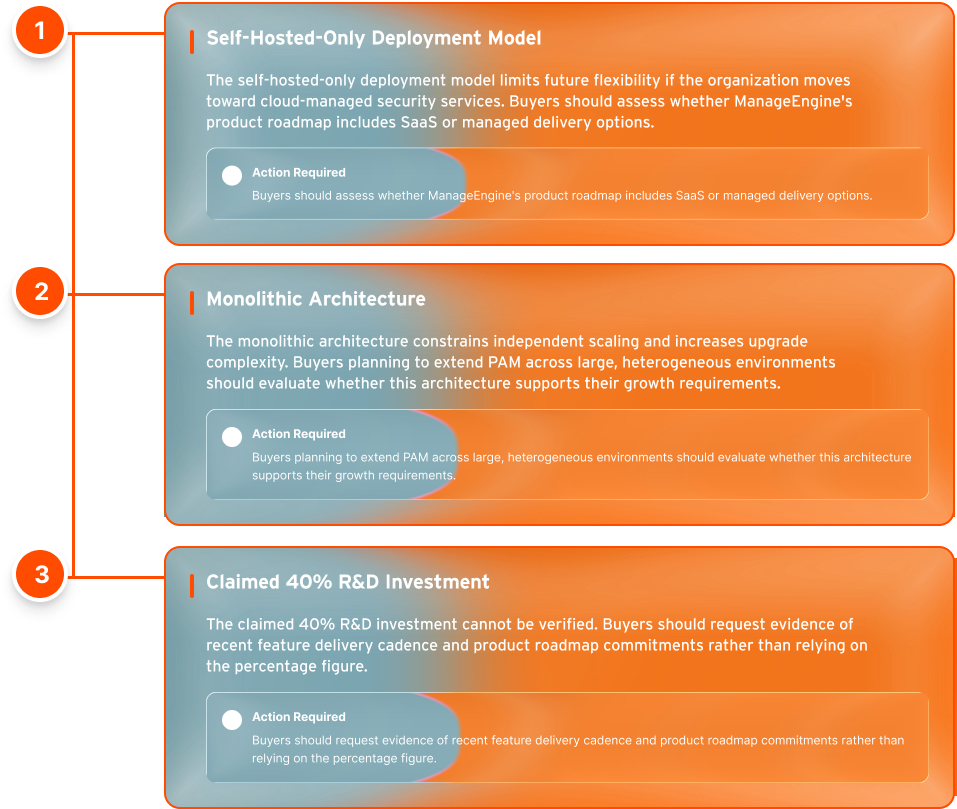
For a summary of ManageEngine's architecture, R&D investment, cloud strategy, IP approach, and open-source position, see the Vendor Data Summary in the Economic Impact Analysis section above.
The key strategic considerations for buyers evaluating PAM360's long-term trajectory are:
1. Self-Hosted-Only Deployment Model - The self-hosted-only deployment model limits future flexibility if the organization moves toward cloud-managed security services. Buyers should assess whether ManageEngine's product roadmap includes SaaS or managed delivery options.
Action Required: Buyers should assess whether ManageEngine's product roadmap includes SaaS or managed delivery options.
2. Monolithic Architecture - The monolithic architecture constrains independent scaling and increases upgrade complexity. Buyers planning to extend PAM across large, heterogeneous environments should evaluate whether this architecture supports their growth requirements.
Action Required: Buyers planning to extend PAM across large, heterogeneous environments should evaluate whether t his architecture supports their growth requirements.
3. Claimed 40% R&D Investment - The claimed 40 % R&D investment cannot be verified. Buyers should request evidence of recent feature delivery cadence and product roadmap commitments rather than relying onthe percentage figure.
Action Required:Buyers should request evidence o f recent f eature delivery cadence and product roadmap commitments rather than relying on the percentage figure.
Industry Benchmarks
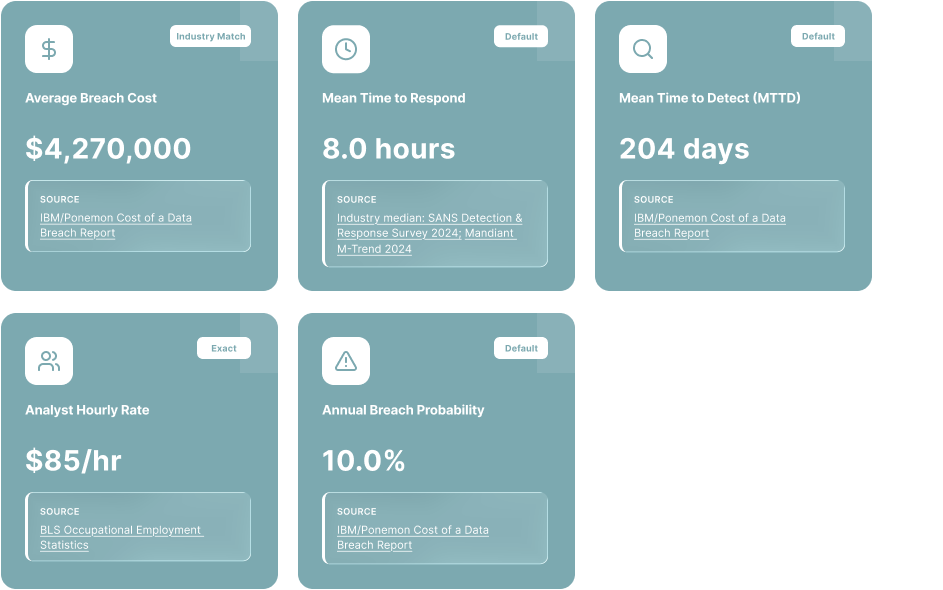
The following benchmarks provide context for economic calculations, adjusted for client industry and organization size.
Context: Manufacturing industry, mid-market organization
Competitive Intelligence
This section profiles ManageEngine as a vendor, drawing on publicly available information (OSINT), vendor-disclosed data, and KuppingerCole analyst research. It covers company background, market presence, security posture, technology and innovation signals, and competitive positioning relative to established PAM vendors. The intent is to give buyers the contextual information needed to assess vendor stability, strategic direction, and market standing alongside the product-level capability scores presented earlier in this report.
Company Profile
- Headquarters - Pleasanton, California (ManageEngine division); parent company Zoho Corporation, headquarterd in Chennai, India
- Founded - 2002 as a division of Zoho Corporation, founded 1996 as AdventNet Inc.
- Company Size - 15,000 Zoho Corporation employees globally, ManageEngine divisional headcount not publicly disclosed
- Revenue Range - not disclosed. Zoho Corporation is privately held with estimated annual revenue exceeding $1B
- Industry - Enterprise IT Management and Security Software
- Market Segment - Privileged Access Management, focus on mid-market and enterprise security
Market Presence
31 news mentions in the past 90 days
Security posture: No major public breaches of ManageEngine corporate infrastructure reported in recent news monitoring (past 90 days).
Validation Sources
This assessment incorporated data from the following external sources:
| Source |
Data |
| Apollo |
Business Data |
| Company Website |
Web Research |
- Verizon 2024 Data Breach Investigations Report
- Mandiant M-Trends 2024
- SANS 2024 Detection and Response Survey
- ISACA State of Cybersecurity 2024
- U.S. Bureau of Labor Statistics: Information Security Analysts
- IBM / Ponemon Cost of Data Breach Report 2024
- ManageEngine PAM 360 Datasheet
- KuppingerCole 2024 PAM Leadership Compass
Competitive Landscape
Competitive Positioning
ManageEngine PAM360 competes in the mid-market PAM segment, where its primary differentiation is pricing and deployment simplicity rather than feature depth or platform breadth.
Against the Overall Leaders, ManageEngine typically offers lower total cost of ownership and faster initial deployment. However, these vendors provide broader capabilities in areas where ManageEngine shows gaps:
- cloud-native architectures
- API-driven automation
- ITDR
- CIEM
CyberArk and BeyondTrust, as the two largest PAM vendors by market share, represent the most common competitive comparison. Both offer significantly broader functionality (especially in cloud PAM, DevOps secrets management, and endpoint privilege management) but at higher price points and with more complex deployments. Delinea is the most direct competitor in positioning, having adopted a cloud-first, mid- market-friendly approach with competitive pricing. Delinea's SaaS delivery model contrasts with ManageEngine's self-hosted-only approach. ManageEngine's strongest competitive position is with mid-market organizations (500-5,000 employees) that already use other ManageEngine or Zoho products, where the integrated management console and familiar administrative experience reduce adoption friction. For organizations seeking cloud-native PAM, extensive API-driven automation, or advanced threat analytics, the Overall Leaders provide stronger capabilities.
Buyer Guidance
The following guidance is intended to help prospective buyers evaluate this solution against their specific requirements.
Buyers that should shortlist PAM360 include organizations that want a self-hosted PAM deployment model, need credible privileged access governance, and value predictable rollout with supportive delivery. Organizations seeking cloud-native PAM, extensive API-driven automation, or deeper response automation will likely require additional validation, compensating controls, or complementary tooling.
Recommendations
Security leaders evaluating this solution should:
-
Request the full SOC 2 Type II report corresponding to the stated 30 September 2024 date and confirm PAM360 falls within scope of each Zoho Corporation-level certification. Map these artifacts to your control requirements before procurement.
-
Conduct a technical architecture workshop to assess deployment model constraints, scalability characteristics, and API depth. The vendor reports approximately 99% of product functionality is API-accessible; the pilot should validate breadth and depth of API coverage for the buyer ’s specific administrative, audit, and automation requirements.
-
Run a short integration pilot (2-4 weeks) covering at least one validated SIEM destination, one directory/identity source, and one operational system. Use pilot outcomes to confirm connector quality and event fidelity rather than relying on the unvalidated claim of 50 out-of-the-box integrations.
-
Request a product roadmap briefing covering planned capabilities in cloud delivery, API expansion, automation, and threat intelligence integration. These are the areas where ManageEngine currently scores lowest and where competitive pressure is strongest.
Due Diligence Considerations
The following areas warrant additional investigation during the evaluation process:
Initial OSINT validation covered 7 of 46 vendor questionnaire responses (15%), subsequently supplemented by the PAM360 Datasheet which documents over 90 integration points. The three highest-scoring assessment dimensions (Security 8.2, Implementation 8.2, Compliance 8.2) all have 0% independent validation. Buyers should treat dimension scores as indicative rather than confirmed.
Product direction risk may exist for organizations prioritizing cloud-native PAM, since PAM360 is self-hosted only (no SaaS option) and uses a monolithic architecture. The vendor has since clarified that automated response (via PBAC risk scoring) and threat intelligence (via Log360 UEBA integration) are available, though buyers should validate these during a pilot.
Compliance certifications are listed in the Vendor Data Summary section above. Buyers should confirm PAM360 is within scope of the Zoho Corporation-level certifications and request the SOC 2 report to verify trust service criteria coverage.
Strategic Fit
ManageEngine PAM360 best fits mid-market to large organizations that want a self-hosted PAM product (deployed on-premises or as a customer-managed cloud VM) focused on governing privileged and system-level accounts, with an emphasis on deployment predictability and support experience (implementation rating 8.2/10).
Organizations with established SOC and audit functions that mainly need control, session/account governance, and SIEM forwarding (validated for Splunk, Sumo Logic, Microsoft Sentinel) will align well. Highly cloud-centric enterprises or teams requiring extensive API- driven automation and automated response should treat PAM360 as a candidate only after targeted validation of architecture constraints, integration depth, and operational workflows.
4-Step Pilot Blueprint
Week 1 - Credential Vault
Week 2 - SIEM Integration
Week 3 - Session Recording
Week 4 - API Integration
Outcome: Go / No-Go
Data Foundation and Methodology
Assessment Framework
This Product Value Navigator assessment employs a structured methodology combining quantitative data analysis with expert analyst evaluation. The framework is designed to provide objective, comparable assessments across vendors while accounting for the unique characteristics of each solution.
Data Collection Process
The assessment is based on 46 discrete data points collected through a comprehensive vendor questionnaire covering:
| Category |
Description |
| Market Position |
Market tier, customer base, revenue, retention |
| Technical Architecture |
Cloud-native status, architecture pattern, API coverage |
| Security Capabilities |
Threat detection, response automation, compliance |
| Implementation |
Deployment timelines, success rates, complexity |
| Operational Impact |
Time savings, automation rates, efficiency gains |
| Cost Impact |
Tool consolidation, FTE optimization, licensing |
| Risk Reduction |
Tool consolidation, FTE optimization, licensing |
| Innovation & Roadmap |
R&D investment, AI/ML adoption, future direction |
| Integration Ecosystem |
Native integrations, marketplace presence, APIs |
| Compliance & Certifications |
Security certifications, compliance frameworks |
OSINT Validation Methodology
Vendor -provided responses are validated using Open-Source Intelligence (OSINT), meaning publicly available data sources that can independently verify or contradict vendor claims. This approach addresses a fundamental challenge: vendors have incentives to overstate capabilities, and manual fact-checking is time-consuming.
Validation Status and Score Impact
Validation Process
The automated OSINT validation follows a four-step process:
| Step |
Action |
Description |
| 1. Classify |
Claim Type Analysis |
Each question is classified by what type of verification is possible |
| 2. Query |
Source Interrogation |
Appropriate OSINT sources are queried for relevant data |
| 3. Compare |
Evidence Analysis |
Vendor claims are compared to found data |
| 4. Score |
Confidence Assignment |
Results are assigned status and confidence levels |
OSINT Data Sources
The following external sources are queried based on claim type:
| Source |
Data Provided |
Claim Types Verified |
| Apollo |
Employee count, company profile, funding |
Company size , market position |
| Crunchbase |
Funding rounds, investor info, categories |
Financial health, market segment |
| G2 |
Ratings, review counts, grid position |
Customer satisfaction , market position |
| SEC EDGAR |
Public fillings, financial statements |
Revenue claims (public companies) |
| Company Website |
Trust center, documentation, certifications |
Compliance claims , technical capabilities |
| NVD/CVE Database |
Known vulnerability disclosures, severity ratings |
Product security history, vulnerability management cadence |
| CISA KEV catalogue |
Known exploited vulnerabilities |
Active exploitation status of disclosed CVEs |
In addition, an internal KuppingerCole Analysts tool (Analyst Workbench) was used to review prior assessments, threat intelligence, and news items, providing historical context and competitive data.
Claim Type Classification
Not all vendor claims can be automatically verified. The system recognizes these distinct claim types:
| Claim Type |
Description |
Verification Method |
Auto-Verifiable |
| VERIFIABLE_EXTERNAL |
Facts available in public data |
Apollo, G2, Crunchbase, SEC |
Yes |
| VERIFIABLE_DOCUMENT |
Claims requiring document review |
Request and review documents |
Partial |
| VENDOR_CLAIM |
Operational metrics only vendor knows |
Customer references required |
No |
| BENCHMARK_CLAIM |
Comparative industry claims |
Analyst expertise + benchmarks |
No |
| DEMO_VERIFIED |
Capabilities requiring demonstration |
Vendor demo + observation |
No |
| INTERVIEW_VERIFIED |
Claims requiring customer validation |
Customer reference calls |
No |
Validation Status and Score Impact
Validation results directly affect final scores through multipliers:
| Status |
Score |
Meaning |
| VERIFIED |
100% |
Claim confirmed by OSINT sources |
| PARTIALLY_VERIFIED |
85% |
Some evidence supports the claim |
| UNVERIFIED |
70% |
No external data found (claim accepted with penalty) |
| CONFLICTING |
30% |
OSINT data contradicts the claim |
Validation Rate for this Assessment: 15% of claims validated via OSINT, supplemented by published vendor documentation (PAM360 Datasheet) confirming integration coverage.
Confidence Distribution
The following shows the confidence levels assigned to validated claims:
| Level |
Count |
Percentage |
Distribution |
| High Confidence |
6 |
21% |
-------- |
| Medium Confidence |
1 |
4% |
-------- |
| Low Confidence |
21 |
75% |
-------- |
| Total Validation |
28 |
100% |
-------- |
Confidence Levels Explained:
High: Claim verified by multiple independent sources or official documentation
Medium: Claim supported by credible sources but not independently verified
Low: Claim plausible but limited external validation available
Scoring Methodology
The assessment uses a dual-scoring approach combining data-derived scores with analyst judgment:
| Component |
Weight |
Description |
| Data Score |
{100 - analyst_weight}% |
Auto-calculated from vendor responses using standardized rubrics |
| Analyst Score |
{analyst_weight}% |
Expert analyst assessment based on industry experience |
| Low Confidence |
100% |
Weighted blend of both components |
Scoring Scale
Strong 8.0 - 10.0 - Exceeds market expectations
Adequate 6.0 - 7.9 - Meets market expectations
Needs Improvement 4.0 - 5.9 - Below market expectations
Weak 1.0 - 3.9 - Significant gaps identified
| Benchmark |
Source |
Year |
Applied To |
| Tool Cost Baseline |
Industry average: 5% of security budget |
2024 |
Tool Consolidation |
| Contractor Rate |
Industry Surveys |
2024 |
Contractor Reduction |
| Security Analyst Salary |
Bureau of Labor Statistics |
2024 |
Avoided Hire |
| Analyst Hourly Rate |
Bureau of Labor Statistics |
2024 |
Time Freed Up |
| Baseline MTTR |
SANS 2024; Mandiant M-Trends 2024 |
2024 |
MTTR Improvement |
| Incident Handlling Rate |
Industry surveys |
2024 |
MTTR Improvement |
| Baseline Audit Cost |
Industry surveys |
2024 |
Audit Efficiency |
| Incident Cost Model |
Tiered: Verizon DBIR 2024 Ponemon |
2024 |
Risk Avoidance |
For the derivation of each savings category, see the formula and data source columns in the Quantified Value Summary tables above.
Economic Model Metholodogy
The economic impact analysis follows the Product Value Navigator (PVN) methodology:
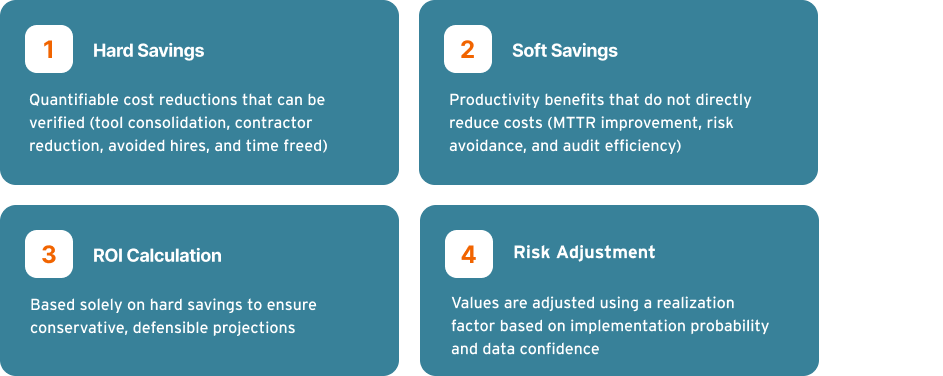
1. Hard Savings - Quantifiable cost reductions that can be verified (tool consolidation, contractor reduction, avoided hires, and time freed)
2. Soft Savings - Productivity benefits that do not directly reduce costs (MTTR improvement, risk avoidance, and audit efficiency)
3. ROI Calculation - Based solely on hard savings to ensureconservative, defensible projections
4. Risk Adjusment - Values are adjusted using a realization factor based on implementation probability and data confidence
Economic Model Inputs & Assumptions
This analysis uses a linear accumulation model for multi-year projections. The table below documents every material assumption in the economic model, its default value, and its source.
Projection Model
| Assumption |
Approach |
Rationale |
| Value Accrual |
Linear over time |
Conservative; avoids overstating compound benefits |
| Payback Calculation |
Hard savings only |
Excludes productivity gains that do not reduce payroll |
| Realization Factor |
50-80% theoretical |
Accounts for implementation variability; scales with confidence slider |
| Discount Rate |
8% annually |
Standard enterprise hurdle rate |
Linear models are preferred for CFO-level presentations as they represent minimum expected outcomes . Actual results may exceed projections as automation matures .
Baseline Constants
| Parameter |
Default Value |
Source |
Year |
| Analyst hourly rate |
$85/hr |
BLS OES |
2023 |
| Incident handling rate |
$100/hr |
SANS SOC Survey 2024 (analyst + tooling overhead) |
2023 |
| FTE fully loaded cost |
$100,000/yr |
BLS OES SOC 15-1212 with 1.35x overhead |
2023 |
| Baseline MTTR |
4.0 hours |
Mandiant M-Trends 2024; SANS 2024 SOC Survey 2024 |
2024 |
| Annual incident count |
30 |
Verizon DBIR 2024 (mid-market median, excl. commodity phishing |
2024 |
| Annual audit costs |
$50,000 |
ISACA State of IT Audit (mid-market median) |
2023 |
| Annual incident cost |
$325,000 |
KuppingerCole Analyst composite 25x$5K + 4x$25K + 1x$100K |
2024 |
| Tool cost (% of budget) |
5% |
Industry average for single-product spend |
|
| Implementation duration |
8 weeks |
Mid-market deployment benchmark |
|
| Working days/year |
250 |
Standard assumption |
|
| Working hours/year |
2,080 |
Standard (250 days x 8 hrs) |
|
Realism Caps for Vendor Claims
When vendor-claimed metrics are available, the model applies conservative caps to prevent overstated projections:
| Vendor Metric |
Maximum Allowed |
Rationale |
| Time saved per analyst per day (V5.1) |
2.0 hours (25% of workday) |
No single tool eliminates >25% of daily work |
| MTTR improvment (V5.4) |
50% |
Diminishing returns beyond 50% improvement |
| Tool consolidation savings |
2x annual tool cost |
Prevents unrealistic displacement claims |
| FTE reduction |
0.5-1.0 FTE (scales with confidence) |
Conservative headcount impact |
| Breach probability reduction (V7.1) |
25% |
Aggressive; single tool cannot have breach probability |
| Audit time reduction (V7.2) |
40% |
Tools assist but do not replace audit judgement |
Industry Benchmark Sources
Economic calculations reference established industry research:
| Benchmark |
Source |
Year |
Application |
| Breach Costs |
IBM/Ponemon Cost of a Data Breach Report |
2024 |
Rist quantification, avoided cost calculations |
| Alert Triage Time |
SANS SOC Survey 2024 |
2023 |
Time savings estimates, incident handling rates |
| MTTD/MTTR |
Mandiant M-Trends 2024; SANS 2024 |
2024 |
Incident response efficiency baselines |
| Labor Costs |
Bureau of Labor Statistics (SOC 15-1212) |
2023 |
Analyst hourly rate, FTE cost calculations |
| Incident Frequency |
Verizon DBIR 2024 |
2024 |
Annual incident count, risk probability modeling |
| Audit Costs |
ISACA State of IT Audit |
2023 |
Compliance cost baselines |
| Incident Severity |
KuppingerCole Analyst composite model |
2024 |
Tiered incident cost distribution |
Benchmarks are adjusted for client industry and organization size where data permits. When context-specific benchmarks are available from the benchmark database, they replace these defaults.
Limitations and Caveats
Economic projections are estimates based on typical customer profiles and may vary significantly based on organization size, complexity, and implementation approach.
Validation rates reflect available public information; some vendor claims cannot be independently verified.
Analyst scores incorporate subjective judgment based on market experience.
This assessment represents a point-in-time evaluation; vendor capabilities, pricing, and market conditions evolve.
Benchmark values represent industry averages; individual results may differ based on security maturity and operational context.
Related Research
Leadership Compass: Privileged Access Management
Buyer’s Compass: Privileged Access Management
Advisory Note: The 2025 Identity Fabric and IAM Reference Architecture
Advisory Note: Operationalizing the Identity Fabric and Reference Architecture
Copyright
© 2026 KuppingerCole Analysts AG. All rights reserved. Reproducing or distributing this publication in any form is prohibited without prior written permission. The conclusions, recommendations, and predictions in this document reflect KuppingerCole Analysts' initial views. As we gather more information and conduct deeper analysis, the positions presented here may undergo refinements or significant changes. KuppingerCole Analysts disclaims all warranties regarding the completeness, accuracy, and adequacy of this information. Although KuppingerCole Analysts' research documents may discuss legal issues related to information security and technology, we do not provide legal services or advice, and our publications should not be used as such. KuppingerCole Analysts assumes no liability for errors or inadequacies in the information contained in this document. Any expressed opinion may change without notice. All product and company names are trademarks™ or registered® trademarks of their respective holders. Their use does not imply any affiliation with or endorsement by them.
KuppingerCole Analysts supports IT professionals with exceptional expertise to define IT strategies and make relevant decisions. As a leading analyst firm, KuppingerCole Analysts offers firsthand, vendor-neutral information. Our services enable you to make decisions crucial to your business with confidence and security.
Founded in 2004, KuppingerCole Analysts is a global, independent analyst organization headquartered in Europe. We specialize in providing vendor-neutral advice, expertise, thought leadership, and practical relevance in Cybersecurity, Digital Identity & IAM (Identity and Access Management), Cloud Risk and Security, and Artificial Intelligence, as well as technologies enabling Digital Transformation. We assist companies, corporate users, integrators, and software manufacturers to address both tactical and strategic challenges by making better decisions for their business success. Balancing immediate implementation with long-term viability is central to our philosophy.
For further information, please contact clients@kuppingercole.com.