Organizations adopting EU sovereign cloud services must evaluate providers not only against sovereignty requirements, but also against practical operational needs such as workload support, integration with existing systems, and future flexibility. Key risks in using non-EU sovereign clouds include global supply chain fragility (highlighted by recent geopolitical tensions and an AWS service outage in October 2025), complex EU regulatory compliance obligations (GDPR, NIS2, DORA, the Cybersecurity Act, and sector rules), and the shared responsibility model in which customers remain accountable for compliant usage. Cloud adoption also expands attack surface through misconfigurations, insecure APIs, compromised identities, and cloud-native vulnerabilities, increasing confidentiality and privacy exposure for sensitive data.
A central challenge is jurisdictional uncertainty: even EU-hosted data can be exposed via extraterritorial laws such as the U.S. CLOUD Act. Vendor lock-in and limited interoperability can further reduce the ability to respond to regulatory or geopolitical change. Trust depends on operational transparency, governance, auditing, and clarity on ownership, service location, administrative access, incident response, and data handling. Buyers must also weigh higher costs and economic viability issues, as EU sovereign providers may lack hyperscaler scale advantages and may incur extra expense from EU ownership and enhanced controls. Capability gaps (AI/ML, analytics, CDNs, developer ecosystems) and shortages of skilled personnel add execution risk.
The solution frames sovereignty across data/AI, operational, infrastructure, technology, and contractual dimensions. Mechanisms include EU-based hosting and operations, customer-controlled encryption keys, isolation options, independent backups, administrative guardrails limiting non-EU control-plane access, EU legal entities with EU-majority ownership and governance, open standards to reduce lock-in (Terraform, REST, OIDC/SAML, OVA/VHD/QCOW2), and EU-governed contracts including Standard Contractual Clauses. Primary use cases span government, finance, healthcare, critical infrastructure, and manufacturing, with selection criteria emphasizing service breadth/depth, compliance support, openness, migration/exit, and auditability.
Organizations seeking to adopt EU sovereign cloud services must carefully evaluate providers against both sovereignty requirements and broader operational considerations. While sovereign cloud offerings are designed to address jurisdictional, regulatory, and data protection concerns, buyers must also ensure that the platform can support their business workloads, integrate with existing systems, and provide sufficient flexibility for future changes. The key challenges from the use of non-EU sovereign clouds are:
Reliance on technology from third country vendors may introduce systemic risks. Recent geopolitical tensions and wars have disrupted global logistics, and this has highlighted the fragility of international technology supply chains. Public services, manufacturing and commerce have become dependent on cloud services to operate with a highly optimized and just-in-time approach. Any loss of access can have a significant impact as was illustrated by the AWS service outage in October 2025
EU Regulations such as the EU General Data Protection Regulation (GDPR), Directive (EU) 2022/2555 (known as NIS2) the Digital Operational Resilience Act (DORA), the EU Cybersecurity Act, and sector-specific rules impose strict obligations on how data is processed, stored, and protected. Organizations that are subject to these regulations must ensure that they use cloud services that meet these obligations. For multinational organizations operating within the EU there is the additional challenge of reconciling EU regulations with those of other jurisdictions.
The responsibility for security and compliance when using cloud services is shared between the customer and the Cloud Service Provider (CSP). The CSP is responsible for the security of the service and the infrastructure upon which it depends. The cloud customer is always responsible for controlling how the service is used, including compliance with laws and regulations.
Cloud environments significantly expand the attack surface for organizations that use them. Misconfigurations, insecure APIs, compromised identities, and vulnerabilities in cloud-native services can lead to cybersecurity incidents and data breaches. Organizations must protect the sensitive personal, financial, health, and intellectual property data they hold in these services against unauthorized access, disclosure, or processing.
Even when data is physically stored within the EU, it may still be subject to access under foreign legal frameworks such as the U.S. CLOUD Act or other national security laws. This creates legal uncertainty for organizations that must ensure that sensitive data remains protected against access from outside of the EU.
When organizations adopt cloud services this can create dependency on proprietary platforms and technologies, which makes it difficult to migrate workloads or switch providers. In the context of cloud sovereignty, this risk is important because organizations need to maintain flexibility to respond to regulatory changes or geopolitical developments.
Organizations must be able to trust that cloud providers operate in a transparent and accountable manner. This requires clear governance structures, independent auditing, and transparency around operational processes such as legal ownership, service location, administrative access, incident response, and data handling practices.
While EU sovereign cloud solutions address regulatory and jurisdictional concerns, they may introduce higher costs compared to global hyperscale cloud services. Sovereign cloud providers often operate smaller infrastructure footprints and may lack the same level of economies of scale as large global providers. In addition, requirements such as EU-based ownership, dedicated infrastructure, enhanced security controls, and compliance certifications can increase operational expenses.
Some EU sovereign cloud providers are unable to match the breadth and maturity of services offered by global hyperscale cloud providers. Advanced capabilities such as large-scale data analytics platforms, AI and machine learning services, global content delivery networks, and highly integrated developer ecosystems may be less mature or available in EU sovereign cloud environments.
Successfully deploying and operating workloads in cloud environments requires specialized skills in cloud architecture, security, DevOps, and platform operations. However, many organizations already face shortages of professionals with these skills, and EU sovereign cloud platforms may introduce additional complexity if they differ from widely used hyperscale environments.
Cloud services provide sovereignty across several distinct dimensions. These include data and AI sovereignty which covers the mechanisms to control where customer data is held and how it is protected. Operational sovereignty concerns the jurisdiction from which cloud services are administered and managed, determining which legal authority has influence over administration. Infrastructure sovereignty covers the ownership and jurisdictional control of the physical infrastructure that delivers the service. Technology sovereignty relates to the jurisdiction governing the licensing and intellectual property of the technologies used within the cloud service. In addition, contract sovereignty plays an important role in defining the legal protections governing the services.
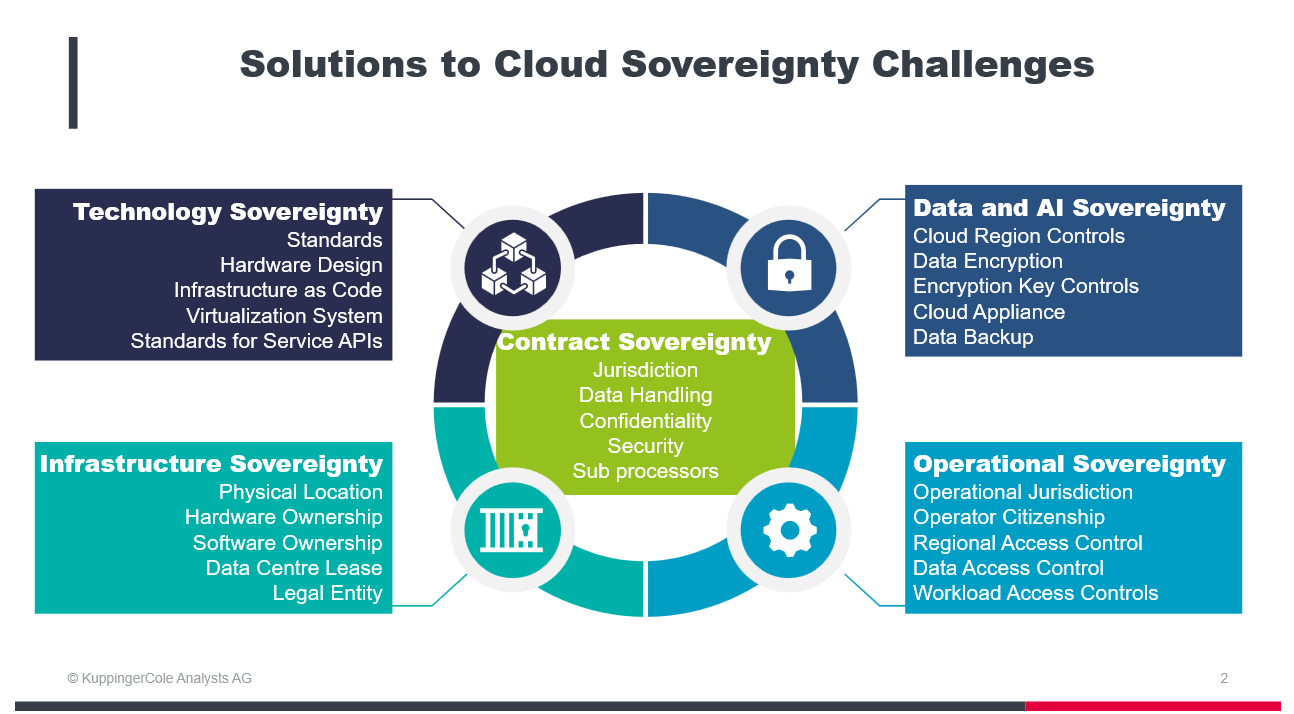
Figure 1: Cloud sovereignty dimensions
The following paragraphs describe how cloud services provide EU sovereignty.
Data sovereignty is addressed through the CSP offering services from data centers and network infrastructure within the EU and capabilities for the customer to ensure that their data is only stored and processed within that infrastructure. This is enhanced by support for data encryption to protect information at rest, in transit and during processing, where customers retain exclusive control of cryptographic keys within the EU to prevent unauthorized access by providers or external authorities. Additional capabilities may include an option to use of cloud appliances or dedicated environments to isolate sensitive workloads and retain them within the customers’ chosen location. For resilience against loss of access to the service, independent data backup capabilities allow organizations to retain copies of business-critical data outside the primary cloud environment.
The service addresses AI sovereignty by ensuring that AI models, training data, and inference workloads are developed, hosted, and processed within EU jurisdictions, governed by EU legal entities, operated by trusted personnel, and implemented with technical controls that prevent unauthorized access, data transfer, or external jurisdictional influence.
Operational sovereignty is achieved by the administration and operation of the cloud service being under EU jurisdictional and organizational control. The sovereign cloud services are not only delivered from EU data centers, but operational activities such as system administration, security, monitoring, and incident response are also conducted from within the EU. This may include guarantees over operator citizenship or residency, to ensure that personnel with privileged administrative access are subject to EU legal and regulatory frameworks.
Technical guardrails include regional access controls to restrict administrative access to management interfaces and control planes from outside the EU. This provides an administrative and operational boundary around the sovereign service. It supplements the normally expected controls that prevent access by the service administrators to customer data and workloads such as segmentation between the service control plane and the customers’ data plane. The service may also offer transparency over legal requests (such as subpoenas) for access to its customers services or data.
Infrastructure sovereignty begins with the physical location of the service infrastructure. The data centers hosting cloud services are physically located within the EU and are subject to EU legal and regulatory frameworks. Equally important is the legal entity that delivers the sovereign service this must be registered within the EU and its board members accountable under EU legislation. There should be an EU controlled oversight and governance framework.
Ownership is also a factor, and the legal entity should be majority EU owned to avoid undue influence from non-EU owners. The legal entity should also have full legal control over the infrastructure delivering the service. This includes considerations such as data center lease and property agreements as well as ownership of the servers, hardware, networking equipment and power supplies. It should also have full control over and access to the source code as well as the software images.
Technology sovereignty is achieved by the cloud service being built on widely adopted standards that promote interoperability and reduce vendor lock-in. This includes the use of open or standardized hardware components avoiding dependency on specialized or restricted platforms, allowing infrastructure to be sourced and maintained through multiple suppliers.
Support for widely adopted technical standards helps the customer to manage and secure their use of the service. These Infrastructure as Code (IaC) frameworks such as Terraform, for the customer to define, deploy, and replicate environments through portable rather than proprietary models. Integrations should be based on open API standards such as REST as well as identity and access controls based on standard protocols such as OIDC and SAML2.0. Workloads portability can be based on open standard virtual machine disk image formats such as OVA, VHD, and QCOW2.
An EU sovereign cloud service must include clear jurisdictional terms in its contracts, specifying that EU is the governing law under which disputes and enforcement are handled. There must also be transparency over legal jurisdiction where IP is created and developed as well as the details of and legal controls of critical suppliers or subcontractors involved in service delivery.
In addition, contractual security commitments should define the technical and organizational measures used to safeguard systems and data, including responsibilities under the shared responsibility model.
The contractual terms should include the EU Standard Contractual Clauses (SCCs) for cloud services that define obligations for data protection, security, and international data transfers, ensuring that personal data processed by cloud service providers receives a level of protection consistent with the requirements of the GDPR.
The top use cases for EU sovereign cloud services are in sectors where regulatory requirements, protection of sensitive data, and national or economic security concerns require strict control over data jurisdiction, operational governance, and infrastructure ownership.
Government and public sector organizations require the highest levels of sovereignty assurance because they manage sensitive citizen information, national administrative systems, and in classified data related to national security. This requires strict control over where data is stored and processed, clear jurisdictional authority over the cloud provider and its operators, and strong guarantees that non-EU governments or regimes cannot compel access to sensitive data. In addition, some use cases require operational and infrastructure sovereignty to ensure that critical public services remain available during geopolitical crises, wars, or supply chain disruptions.
Financial institutions require cloud services that support strict regulatory oversight and operational resilience obligations imposed by financial regulators. Banks, insurers, and market infrastructures must ensure that financial data, transaction records, and risk management systems meet these obligations and are protected from unauthorized access or legal exposure outside the applicable regulatory framework. Requirements in this sector include clear contractual obligations governing data processing, strong control over third-party service providers, and the ability for regulators to audit and supervise cloud operations. In addition, financial institutions must ensure that cloud services support operational continuity and resilience to meet regulatory expectations for financial stability.
Healthcare providers and life sciences organizations must ensure that patient information, clinical research data, and pharmaceutical intellectual property are protected under EU privacy and regulatory regimes. Requirements in this sector include strong guarantees regarding data jurisdiction, ensuring that personal health data is processed only within specified legal frameworks and protected from unauthorized access. Pharmaceutical companies and research institutions also require protection of proprietary research data, clinical trial information, and drug development intellectual property. In addition, healthcare organizations often require strong contractual and operational governance to ensure that service providers and their personnel handle sensitive health data in accordance with the relevant regulatory and ethical obligations.
Utilities and telecommunications providers operate critical national infrastructure and therefore require guarantees to ensure the security and resilience of operational systems and network data. These requirements focus on maintaining jurisdictional control over operational data, network management systems, and infrastructure monitoring platforms. Organizations in these sectors must ensure that cloud services supporting energy grids, water systems, and telecommunications networks remain protected from foreign legal influence and unauthorized access. They also require operational sovereignty to ensure that service management, maintenance, and incident response activities remain within jurisdictional control.
Manufacturing companies and commercial enterprises require protection of personal data, intellectual property, industrial data, and sensitive supply chain information. Product designs, manufacturing processes, trade data, and strategic business information represent significant competitive assets that must be protected from industrial espionage or unauthorized access. Sovereignty requirements for this sector therefore focus on ensuring that sensitive commercial data cannot be exposed through legal obligations. In some sectors such as defense manufacturing, sovereignty requirements may include strict location controls. These requirements are particularly important for multinational manufacturers operating across complex global supply chains.
Organizations selecting an EU sovereign cloud provider should evaluate offerings against the following key functional capabilities that determine whether the platform can meet both sovereignty requirements and the operational needs of their workloads.
An EU sovereign cloud must provide a broad set of core cloud platform services to support modern digital workloads. At a minimum for IaaS, the platform should deliver foundational compute, networking, storage, and serverless services, enabling organizations to build scalable applications and infrastructure. They should also offer managed database services, data lake platforms, and managed development environments such as Kubernetes to support cloud-native architectures. Organizations also expect AI capabilities, including managed Generative AI (GenAI) model training and deployment services, alongside a range of other managed services that reduce operational complexity.
The cloud platform must also provide depth in specialized technology domains that support advanced enterprise workloads and emerging digital capabilities. These include services optimized for data-intensive workloads, as well as high-performance compute capabilities required for scientific computing, simulation, and large-scale analytics. It should also be capable of supporting GenAI model training and inference. Additional areas may include IoT and edge computing platforms, which support industrial and connected-device environments.
It must demonstrate support for the specific regulatory and operational requirements of key industry sectors. This includes providing services tailored to the needs of these sectors and their compliance obligations. The services should align with relevant EU and sector-specific regulatory standards, offering pre-certified regulatory controls, reference architectures, and industry-specific compliance blueprints or landing zones that simplify deployment in regulated environments.
The platform should support their customers to meet their security and compliance responsibilities under the shared responsibility model. This includes providing CUECs that enable customers to implement their own security and governance measures. These include secure delegated administrative capabilities, allowing customers to manage privileged access. It should also support encryption of data at rest and in transit with customer-controlled encryption key management. Additional capabilities include secure network connectivity, detailed logging and monitoring, and the ability to integrate cloud telemetry with SIEM, security analytics, and threat detection tools.
For IaaS, the platform should support open standards include data formats such as OVA, VHD, and QCOW2; and IaC standards, such as Terraform, OpenTofu, and Pulumi. Integration capabilities should be based on open communication protocols and APIs, including REST, gRPC, AMQP, and other industry-standard interfaces. Similarly, identity and access management should support open federation standards such as OIDC, SAML 2.0, and SCIM.
The platform should provide support for customers to exit the service or migrate workloads to alternative environments without excessive technical or financial barriers. These include data export capabilities, enabling organizations to retrieve all stored data in non-proprietary formats. Workloads should be portable through support for standard virtual machine image formats, such as VHD, OVA, or QCOW2. In addition, migration tooling and documentation should assist organizations in transferring workloads, while pricing policies should ensure transparent and reasonable charges for exporting data, logs, backups, and metadata.
The service should be delivered by a legal entity established within the EU, operating under EU law and subject to European regulatory oversight. Contracts governing the service should specify EU jurisdiction and ensure that data processing obligations comply with relevant regulations such as GDPR and sector-specific regulatory frameworks. The service should also provide legal guarantees regarding data residency and administrative access. In addition, there should be mechanisms that protect customer data from exposure through extraterritorial legislation or foreign government access requests.
The platform should be delivered from data centers and infrastructure located within the EU by a legal entity registered and owned within the EU. Service management, security and administration should be conducted by EU-based personnel. Administrative access to the platform’s control plane should include regional access controls. In addition, operational governance structures should ensure that platform management, security operations, and service continuity processes remain independent from external jurisdictional influence.
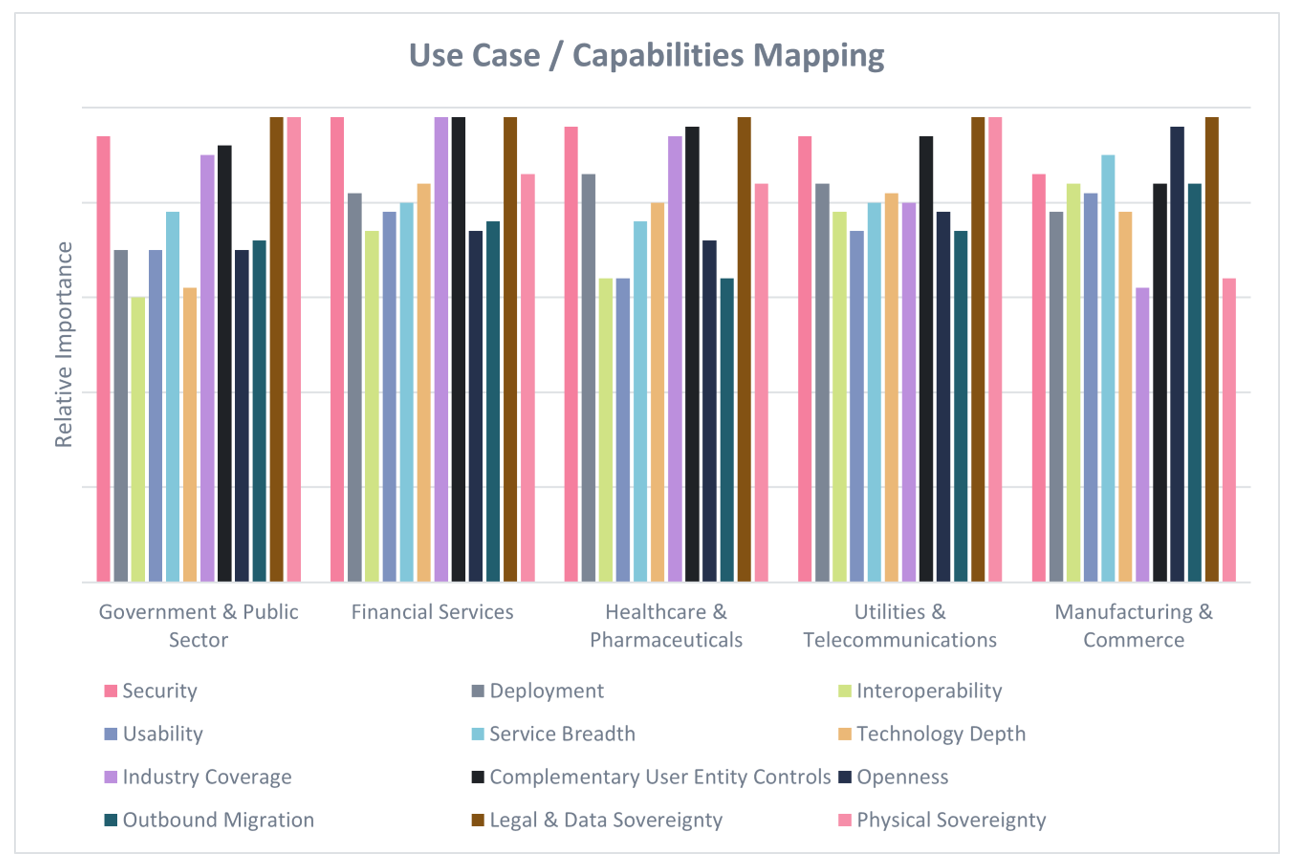
Figure 2: Use Case / Capability Mapping for EU Sovereign Cloud
In addition to evaluating key capabilities and sovereignty assurances, buyers should also consider a range of architectural, operational, and governance factors that may influence the long-term success and sustainability of their sovereign cloud adoption.
Architectural planning should address workload placement, data residency requirements, and the separation of regulated and non-regulated workloads. Organizations should also consider the operational complexity introduced by managing multiple environments and ensure that governance, monitoring, and security controls remain consistent across the overall architecture.
Most organizations have hybrid or multi-cloud architectures, where sensitive workloads and regulated data are deployed within sovereign environments while less sensitive services may continue to operate in other cloud platforms. Consider complexities of adding yet another cloud service against the sovereignty needs and benefits.
Buyers should evaluate how easily the sovereign cloud platform can integrate with existing IT environments without requiring extensive re-engineering. The ability to support common enterprise integration patterns, secure API connectivity, and hybrid networking architectures is essential to ensure that sovereign cloud services can be adopted without disrupting existing business processes.
Organizations should consider their long-term ability to exit or transition away from a sovereign cloud provider if business, regulatory, or strategic requirements change. Establishing a clear exit strategy at the outset helps organizations avoid unintended vendor lock-in and ensures that cloud adoption remains aligned with long-term digital strategy.
Buyers should evaluate whether the sovereign cloud provider offers sufficient visibility into operational processes, security controls, and administrative activities. This may include access to detailed audit logs, transparency reporting, independent certifications, and the ability to conduct regulatory or internal audits of the service.
Before migrating workloads to a sovereign cloud platform, organizations should classify their data and workloads to identify those that require sovereign hosting. Not all applications or data will require the same level of sovereignty assurance, and organizations should have a structured classification process for this.
Organizations must also have assessed the regulatory obligations that would apply to data and workloads being moved. As well as EU specific regulations such as GDPR, there may be other sector-specific or geographic ones that impose additional requirements on data handling, operational resilience, and third-party service providers.
Buyers should assess how the provider supports high availability, disaster recovery, and service continuity within the sovereign environment. This includes understanding geographic redundancy of data centers, backup strategies, failover capabilities, and the ability to maintain operations during infrastructure failures or geopolitical disruptions. For regulated sectors and critical infrastructure operators, resilience requirements may also include support for regulatory expectations around operational continuity and recovery time objectives.
Organizations should evaluate whether their internal teams possess the necessary skills to administer and exploit the sovereign cloud environments and whether they will require support from managed service providers or integration partners. Training, operational processes, and governance frameworks should be established before deployment to ensure that the cloud environment can be used and managed effectively.
Organizations should also consider the broader ecosystem of partners, managed service providers, and technology vendors that support the sovereign cloud platform. Buyers should assess the availability of implementation partners, security tools, compliance solutions, and industry-specific services that integrate with the platform.
This section contains a list of questions that buyers should ask vendors during the selection process.
Do you specialize in serving specific industries?
Large vendors will have customers across most industries. Some smaller vendors may focus on specific industry sectors, such as retail, media, health care, or finance. In some circumstances, vendors with experience and focus on the industry that is specific to your organization may provide more value.
What are your key differentiators?
Understanding the key differentiators between the vendors is essential. Ask the vendor what their unique capabilities are. For example, the depth of their technology offerings, industry specializations, data protection capabilities or their European heritage.
What certifications and attestations have you obtained for the solution?
Certification of the solution against security standards as well as industry regulations not only confirms compliance; it also demonstrates the vendor’s commitment and conveys trust. Security certifications such as ISO 27001 and attestations such as SOC2 as well as EU SecNumCloud, and German C5 are important. In addition, the relevant EU industry regulations and standards should be considered.
Does your solution help customers with regulatory or standards compliance?
Depending on geography and industry sector, organizations are often subject to a wide range of regulations. These regulations usually include obligations to protect financial data, such as PCI DSS, and personal data protection such as GDPR, Hébergeur de Données de Santé (HDS) for French healthcare providers. There are also EU regulations for cyber resilience such as the EU NIS2 and DORA. How does the solution help your organization meet to meet its obligations under the relevant laws and regulations?
How does your solution achieve scalability and high availability?
Does the solution scale sufficiently to meet the needs of your deployment? What are the limits that you need to consider? How can the solution be configured to meet the levels of availability that your organization requires? How does the service help to manage incidents that are detected?
How does your solution support a hybrid multi-cloud strategy?
Organizations are exploiting multiple clouds as well as on-premises and edge computing. How does the solution help to support the mixture of environments in your organization, as well as your prospects for cloud migration?
What emerging trends do you see in sovereign cloud adoption in Europe, and how are these influencing your platform roadmap?
This should help you to understand how well the provider understands regulatory and market direction, how the vendor plans to evolve their platform and whether the provider is investing in future capabilities.
What is on your short-term and long-term roadmap?
The list of features on a vendor's roadmap is a good indicator of their innovativeness and the vendor's ability to support emerging use cases. Also ask whether the vendor is planning to expand the EU locations from which their service is delivered. What features are expected in the near or long term (e.g., 3, 6, or 12 months out)?
Can I speak to some reference customers?
Finally, it is usually enlightening to speak to one or more reference customers. It is most helpful when the reference customer is in a similar industry and region.
Not all organizations have the same sovereignty needs, and not all EU sovereign cloud services provide the same breadth and depth of functionality. Organizations evaluating EU sovereign cloud services should use this buyer’s compass to take a structured and risk-based approach to provider selection. When assessing providers, organizations should evaluate not only sovereignty assurances but also the platform’s functional capabilities, openness, portability, and the security controls available to customers. They should also consider architectural planning, integration with existing systems, and long-term exit strategies in the process to avoid unintended dependencies.
Advisory Note: Digital Sovereignty and the Emerging European Defense Sector
Will the EU’s Cloud Sovereignty Framework Mitigate Geopolitical Cloud Risks?
Data Backup and Cloud Sovereignty
Confidential Computing and Data Sovereignty in Non-Sovereign Clouds
Sovereign Cloud Geopolitical Risks
© 2026 KuppingerCole Analysts AG. All rights reserved. Reproducing or distributing this publication in any form is prohibited without prior written permission. The conclusions, recommendations, and predictions in this document reflect KuppingerCole Analysts' initial views. As we gather more information and conduct deeper analysis, the positions presented here may undergo refinements or significant changes. KuppingerCole Analysts disclaims all warranties regarding the completeness, accuracy, and adequacy of this information. Although KuppingerCole Analysts' research documents may discuss legal issues related to information security and technology, we do not provide legal services or advice, and our publications should not be used as such. KuppingerCole Analysts assumes no liability for errors or inadequacies in the information contained in this document. Any expressed opinion may change without notice. All product and company names are trademarks™ or registered® trademarks of their respective holders. Their use does not imply any affiliation with or endorsement by them.
KuppingerCole Analysts supports IT professionals with exceptional expertise to define IT strategies and make relevant decisions. As a leading analyst firm, KuppingerCole Analysts offers firsthand, vendor-neutral information. Our services enable you to make decisions crucial to your business with confidence and security.
Founded in 2004, KuppingerCole Analysts is a global, independent analyst organization headquartered in Europe. We specialize in providing vendor-neutral advice, expertise, thought leadership, and practical relevance in Cybersecurity, Digital Identity & IAM (Identity and Access Management), Cloud Risk and Security, and Artificial Intelligence, as well as technologies enabling Digital Transformation. We assist companies, corporate users, integrators, and software manufacturers to address both tactical and strategic challenges by making better decisions for their business success. Balancing immediate implementation with long-term viability is central to our philosophy.
For further information, please contact clients@kuppingercole.com.