Why don't you like this?



Description
Short Summary
Interesting Facts
Notable Quotes
Recommendations
Takeaways


Introduction: The Agentic Shift
The evolution of Generative AI models has outpaced most security teams' expectations, from interactive assistants to autonomous agents that plan, act, delegate, and persist over time. In enterprise deployments, AI agents now write and execute code, call external APIs, manage files, orchestrate workflows, and, in some cases, invoke other AI agents to complete sub-tasks. The shift from generation to agency is not incremental. It is a qualitative change in the risk surface that enterprises must manage.
A note on terminology. This document uses four related but distinct terms.
- 'Generative AI' (GenAI) refers to the underlying model class: large language models and multimodal models that produce text, code, images, or structured output from a prompt.
- An 'AI agent' is a software entity that uses one or more such models to perceive, decide, and act, typically with access to tools.
- 'Agentic AI' describes the broader class of autonomous, goal-directed systems that chain multiple actions, delegate to sub-agents, and operate over time without continuous human prompting; agentic AI is powered by GenAI but is architecturally and operationally distinct from a single-turn chatbot.
- The generic word 'agent' without qualification is avoided here because, in identity, automation, and security contexts, it can mean a service account, a software agent (such as an endpoint agent), or a human user's representative. These meanings overlap with, but are not equivalent to, AI agents.
The security implications are that controls designed for GenAI inference (input filtering, output moderation, prompt-injection defense) remain necessary but are not sufficient. Agentic deployments add a second risk surface around action, identity, and delegation that must be governed alongside the model layer.
Traditional security frameworks were designed for human actors making discrete, identifiable requests. AI agents make cascading requests, often at machine speed, where a single high-level task spawns dozens of sub-actions across multiple systems. The policy question is no longer only 'is this request permitted?' but 'what is this agent permitted to do, with what identity, on what data, across what delegation chain, with what accountability trail?'
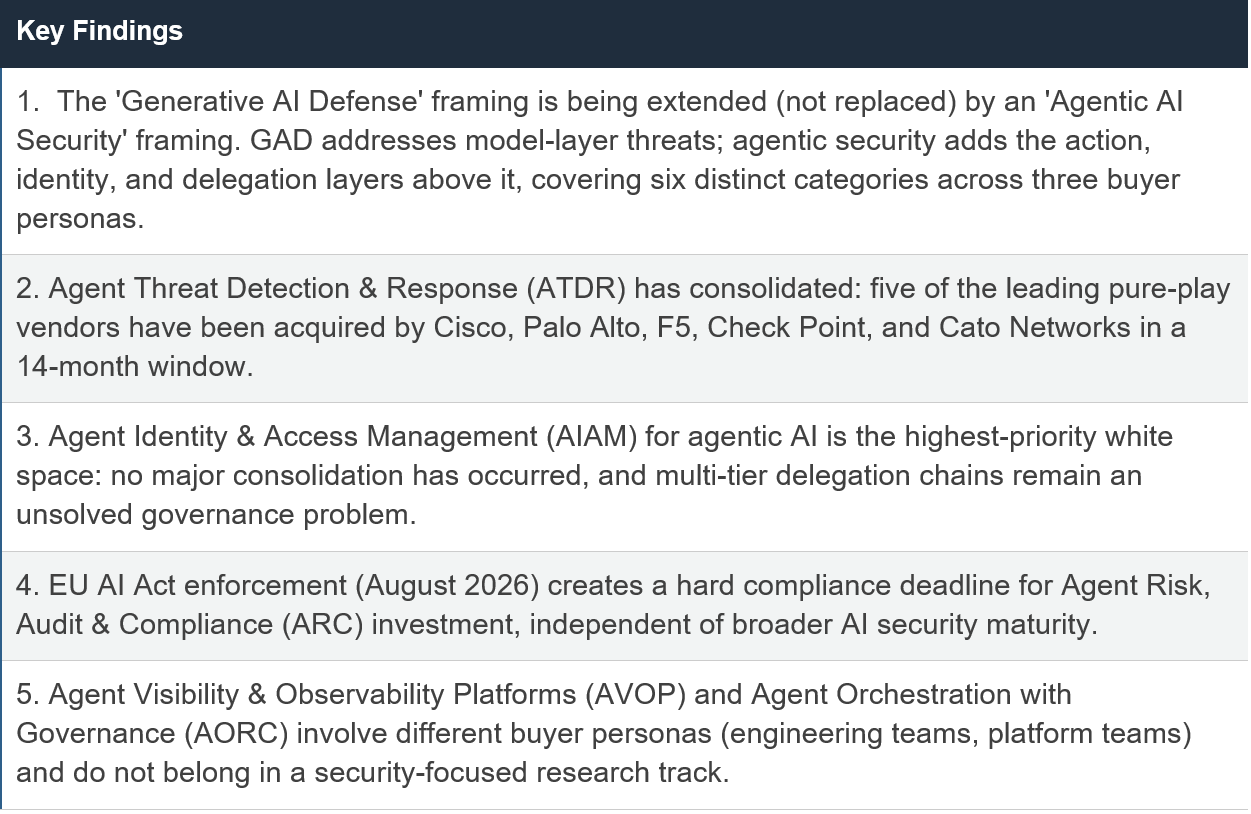
KuppingerCole's Generative AI Defense Leadership Compass (December 2025) provided the first structured evaluation of the vendor landscape for LLM and agent runtime protection. That compass addresses two of six meaningful categories in the agentic AI security and governance landscape. The remaining four represent real enterprise exposure and an evolving vendor market that warrants dedicated coverage.
The Six-Category Framework
In the full chapter: The Prevent / Observe / Detect/Respond / Govern ArchitectureCreate a free account
Three Research and Procurement Tracks
In the full chapter: Track 1: Agentic AI Defense (Extending GAD to the Agent Layer), Track 2: AI Agent Identity & Access Management, and Track 3: AI Governance, Risk & ComplianceCreate a free account
Market Dynamics: The ATDR Consolidation Wave
The full “Market Dynamics: The ATDR Consolidation Wave” chapterCreate a free account
Procurement Decision Tree
The full “Procurement Decision Tree” chapterCreate a free account
Recommendations
In the full chapter: For Enterprise Security and Risk Leaders and For Identity, IAM, and PAM LeadersCreate a free account
Related Research
The six-category framework described in this note maps to existing and forthcoming KuppingerCole research across the identity, security, and governance domains. Organizations building out their agentic AI security program should use the relevant compasses as vendor evaluation tools alongside the procurement decision tree in Section 5. KuppingerCole has expert analysts and advisors available to advise on vendor shortlisting and evaluation criteria for each track.
Leadership Compass: Generative AI Defense
Leadership Compass: AI SOC
Leadership Compass: Privileged Access Management
Leadership Compass: Identity Governance & Administration
Leadership Compass: Non-Human Identity Management
Copyright
© 2026 KuppingerCole Analysts AG. All rights reserved. Reproducing or distributing this publication in any form is prohibited without prior written permission. The conclusions, recommendations, and predictions in this document reflect KuppingerCole Analysts' initial views. As we gather more information and conduct deeper analysis, the positions presented here may undergo refinements or significant changes. KuppingerCole Analysts disclaims all warranties regarding the completeness, accuracy, and adequacy of this information. Although KuppingerCole Analysts' research documents may discuss legal issues related to information security and technology, we do not provide legal services or advice, and our publications should not be used as such. KuppingerCole Analysts assumes no liability for errors or inadequacies in the information contained in this document. Any expressed opinion may change without notice. All product and company names are trademarks™ or registered® trademarks of their respective holders. Their use does not imply any affiliation with or endorsement by them.
KuppingerCole Analysts supports IT professionals with exceptional expertise to define IT strategies and make relevant decisions. As a leading analyst firm, KuppingerCole Analysts offers firsthand, vendor-neutral information. Our services enable you to make decisions crucial to your business with confidence and security.
Founded in 2004, KuppingerCole Analysts is a global, independent analyst organization headquartered in Europe. We specialize in providing vendor-neutral advice, expertise, thought leadership, and practical relevance in Cybersecurity, Digital Identity & IAM (Identity and Access Management), Cloud Risk and Security, and Artificial Intelligence, as well as technologies enabling Digital Transformation. We assist companies, corporate users, integrators, and software manufacturers to address both tactical and strategic challenges by making better decisions for their business success. Balancing immediate implementation with long-term viability is central to our philosophy.
For further information, please contact clients@kuppingercole.com.
Introduction: The Agentic Shift
The Six-Category Framework


Three Research and Procurement Tracks
Track 1: Agentic AI Defense (Extending GAD to the Agent Layer)
Track 2: AI Agent Identity & Access Management
Track 3: AI Governance, Risk & Compliance
Market Dynamics: The ATDR Consolidation Wave
Procurement Decision Tree
Recommendations
Related Research
Copyright
Table of Contents


Table of contents
Close
Introduction: The Agentic Shift
The Six-Category Framework
Three Research and Procurement Tracks
Track 1: Agentic AI Defense (Extending GAD to the Agent Layer)
Track 2: AI Agent Identity & Access Management
Track 3: AI Governance, Risk & Compliance
Market Dynamics: The ATDR Consolidation Wave
Procurement Decision Tree
Recommendations
Related Research
Copyright









