Why don't you like this?



Description
Short Summary
Interesting Facts
Notable Quotes
Recommendations
Takeaways


Introduction
Digital transformation is no longer optional for businesses and organizations if they wish to stay competitive and deliver greater value to customers. But as they seek to embrace the advantages of Cloud, IoT, AI and Big Data projects across extended infrastructures, organizations need to be aware of the cyber security, compliance and identity risks that digital transformation also creates.
While these risks are serious, they can be significantly reduced through intelligent, fit for purpose and structured deployment of security solutions. As agile access and identity requests are a prime characteristic of a successful digital environment it follows that one of the most important tools to manage this securely is Privileged Access Management (PAM).
Privileged Access Management (PAM) solutions are critical cybersecurity controls that address the security risks associated with the use of privileged access in organizations and companies. Traditionally, there are primarily two types of privileged users:
- Privileged Business Users - those who need access to sensitive data and information assets such as HR records, payroll details, financial information or intellectual property, and social media accounts.
- Privileged IT Users – those who need access to the IT infrastructure supporting the business. Such permissions are usually granted to IT admins who need access to system accounts, software accounts or operational accounts.
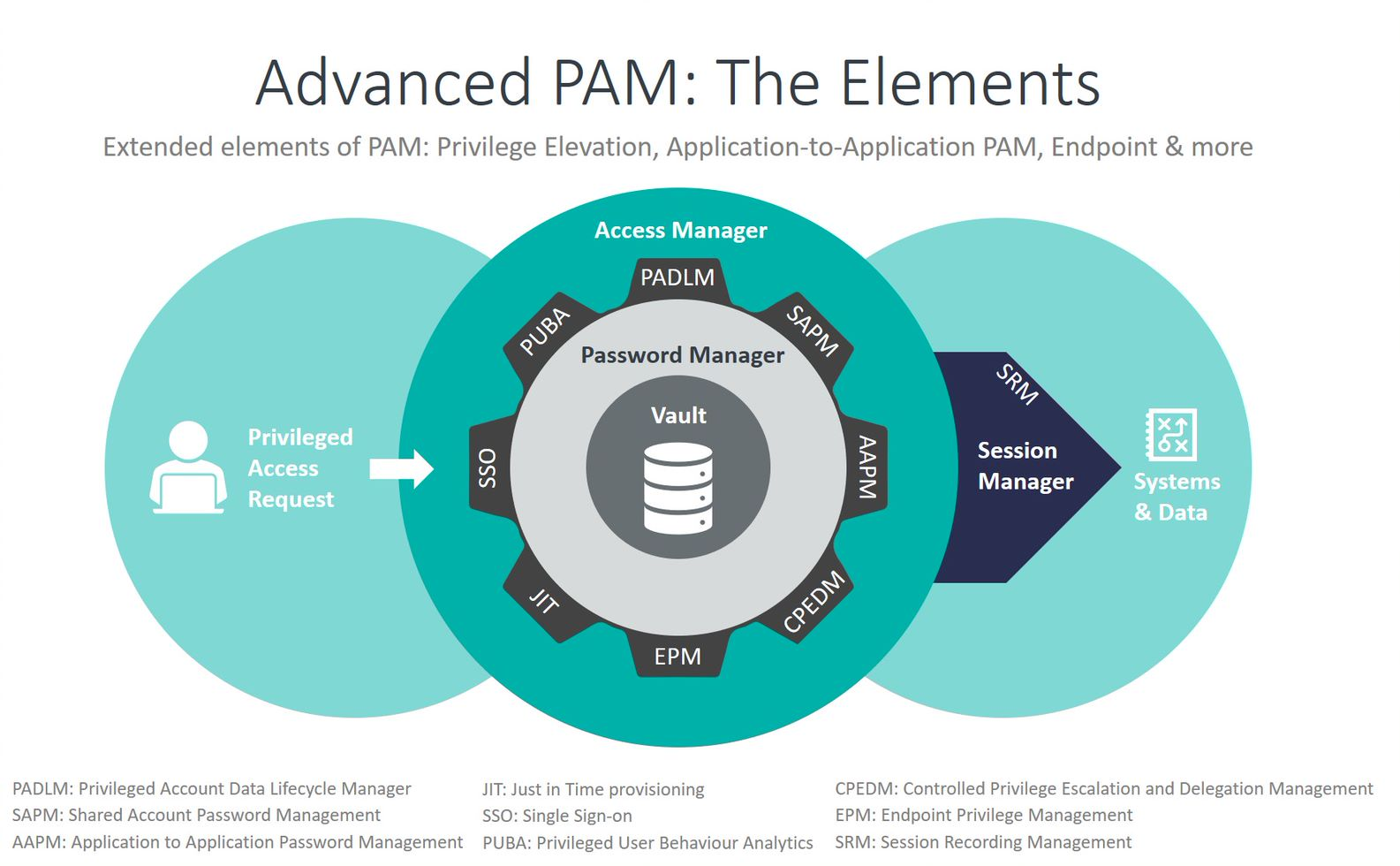
Among the key challenges that drive the need for privilege management are:
- Abuse of shared credentials
- Abuse of elevated privileges by unauthorized users
- Hijacking of privileged credentials by cyber-criminals
- Abuse of privileges on third-party systems
- Accidental misuse of elevated privileges by users
- The requirement to perform attestations on privileged users and admin accounts
Furthermore, there are several other operational, governance and regulatory requirements associated with privileged access:
- Discovery of shared accounts, software and service accounts across the IT infrastructure
- Identifying and tracking of ownership of privileged accounts throughout their lifecycle
- Establishing Single Sign-on sessions to target systems for better operational efficiency of administrators
- Auditing, recording and monitoring of privileged activities for regulatory compliance
- Managing, restricting, and monitoring administrative access of IT outsourcing vendors and MSPs to internal IT systems
- Managing, restricting, and monitoring administrative access of internal users to cloud services
In addition, organizations are now faced with tighter budget controls after the Covid-19 crisis which also highlighted the need for secure access to SaaS applications and databases from home offices or other remote locations. They need to balance cost, time to value and security for any new IT investment. Users also need fast and easy access to applications, files, databases and servers which calls for greater attention paid to the design of the security and productivity balance within PAM tools.
In recent years, PAM solutions have become more sophisticated making them robust security management tools. While credential vaulting, password rotation, privilege delegation and activity monitoring are now more common, more advanced capabilities such as privileged user analytics, risk-based session monitoring, advanced threat protection, and the ability to embrace PAM into an enterprise governance program are the new standard to protect against today’s threats in complex environments.
Product Description
The full “Product Description” chapterCreate a free account
Related Research
Advisory Note: Trends in Privileged Access Management for the Digital Enterprise –71273
Architecture Blueprint: Access Governance and Privilege Management – 79045
Blog: PAM Can Reduce Risk of Compliance Failure but is Part of a Bigger Picture
Blog: Privileged Access Management Can Take on AI-Powered Malware to Protect
Blog: Taking One Step Back: The Road to Real IDaaS and What IAM is Really About
Leadership Brief: Privileged Account Management Considerations – 72016
Leadership Compass: Identity Provisioning – 70949
Leadership Compass: Identity Governance & Administration – 71135
Leadership Compass: Privilege Access Management - 80088
Copyright
© 2026 KuppingerCole Analysts AG. All rights reserved. Reproducing or distributing this publication in any form is prohibited without prior written permission. The conclusions, recommendations, and predictions in this document reflect KuppingerCole Analysts' initial views. As we gather more information and conduct deeper analysis, the positions presented here may undergo refinements or significant changes. KuppingerCole Analysts disclaims all warranties regarding the completeness, accuracy, and adequacy of this information. Although KuppingerCole Analysts' research documents may discuss legal issues related to information security and technology, we do not provide legal services or advice, and our publications should not be used as such. KuppingerCole Analysts assumes no liability for errors or inadequacies in the information contained in this document. Any expressed opinion may change without notice. All product and company names are trademarks™ or registered® trademarks of their respective holders. Their use does not imply any affiliation with or endorsement by them.
KuppingerCole Analysts supports IT professionals with exceptional expertise to define IT strategies and make relevant decisions. As a leading analyst firm, KuppingerCole Analysts offers firsthand, vendor-neutral information. Our services enable you to make decisions crucial to your business with confidence and security.
Founded in 2004, KuppingerCole Analysts is a global, independent analyst organization headquartered in Europe. We specialize in providing vendor-neutral advice, expertise, thought leadership, and practical relevance in Cybersecurity, Digital Identity & IAM (Identity and Access Management), Cloud Risk and Security, and Artificial Intelligence, as well as technologies enabling Digital Transformation. We assist companies, corporate users, integrators, and software manufacturers to address both tactical and strategic challenges by making better decisions for their business success. Balancing immediate implementation with long-term viability is central to our philosophy.
For further information, please contact clients@kuppingercole.com.

Table of Contents


Table of contents
Close










