Why don't you like this?



Description
Short Summary
Interesting Facts
Notable Quotes
Recommendations
Takeaways


Introduction
Privileged Access Management (PAM), over the past few years, has become one of the most relevant areas of Cyber Security associated with IAM (Identity and Access Management) that deals with identifying, securing and managing privileged credentials and the resulting access across an Organization’s IT environment. Once considered a technology option for optimizing administrative efficiency by managing passwords and other secrets, PAM has evolved into a set of crucial technologies for preventing security breaches and credential thefts. PAM today concerns Security and Risk Management leaders as well as Infrastructure and Operation (I&O) leaders across the industries for several security and operational benefits.
Privileged Access Management represents the set of critical cybersecurity controls that address the security risks associated with privileged users and privileged access in an organization. There are primarily two types of privileged users:
- Privileged Business Users - those who have access to sensitive data and information assets such as HR records, payroll details, financial information, company’s intellectual property, etc. This type of access is typically assigned to the application users through business roles using the application accounts.
- Privileged IT Users – those who have access to IT infrastructure supporting the business. Such access is generally granted to IT administrators through administrative roles using system accounts, software accounts or operational accounts.
The privileged nature of these accounts provides their users with an unrestricted and often unmonitored access across the organization’s IT assets, which not only violates basic security principles such as least privilege but also severely limits the ability to establish individual accountability for privileged activities. Privileged accounts pose significant threat to the overall security posture of an organization because of their heightened level of access to sensitive data and critical operations. Security leaders therefore need stronger emphasis on identifying and managing these accounts to prevent the security risks emanating from their misuse.
Among the key challenges that drive the need for managing privileged access are:
- Abuse of shared credentials
- Abuse of elevated privileges by authorized users
- Hijacking of privileged credentials by cyber-criminals
- Abuse of privileges on third-party systems, and
- Accidental misuse of elevated privileges by users
Furthermore, there are several other operational, governance and regulatory requirements associated with privileged access:
- Discovery of shared accounts, software and service accounts across the IT infrastructure
- Identification and continuous tracking of ownership of privileged accounts throughout their life-cycle
- Establishing and managing privileged session to target systems for enhanced operational efficiency of administrators
- Auditing, recording and monitoring of privileged activities for regulatory compliance
- Managing and monitoring administrative access of IT outsourcing vendors and MSPs to internal IT systems, and
- Managing and monitoring privileged access of business users and IT administrators to cloud infrastructure and applications
Consequently, multiple technologies and solutions have been developed to address these risks, as well as provide better activity monitoring and threat detection.
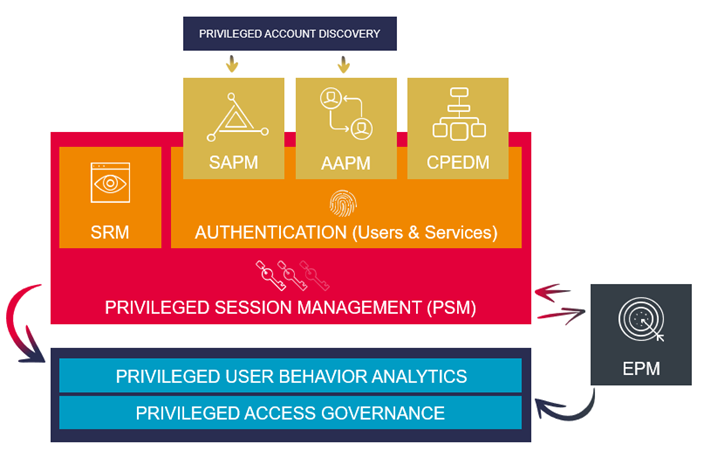
PAM is essential to all types of companies, well-beyond the large businesses. On the other hand, the broad and complex spectrum of technologies within the PAM market segment and the sometimes complex deployment are not always well-suited specifically for SMBs (small/medium businesses). While they need PAM, their focus (unless being high-risk businesses, e.g. in a critical infrastructure industry) must be on some essential capabilities, which specifically include
- Managing credentials securely, specifically for shared passwords (Shared Account Password Management)
- Providing secure remote access whenever required, as a baseline Privileged Session Management
- Account Discovery to move this into protection
Devolutions focuses on specific PAM solutions for the SMB market, covering remote access, shared account password management for various types of accounts, and is about to add account discovery.
Product Description
The full “Product Description” chapterCreate a free account
Strengths and Challenges
The full “Strengths and Challenges” chapterCreate a free account
Related Research
Architecture Blueprint: Access Governance and Privilege Management - 79045
Advisory Note: Privilege Management - 70736
Leadership Compass: Privileged Access Management
Buyer’s Guide: Consumer Identity and Access Management Solution – 80111
Architecture Blueprint: Hybrid Cloud Security – 72552
Advisory Note: Cloud Services and Security - 72561
Copyright
© 2026 KuppingerCole Analysts AG. All rights reserved. Reproducing or distributing this publication in any form is prohibited without prior written permission. The conclusions, recommendations, and predictions in this document reflect KuppingerCole Analysts' initial views. As we gather more information and conduct deeper analysis, the positions presented here may undergo refinements or significant changes. KuppingerCole Analysts disclaims all warranties regarding the completeness, accuracy, and adequacy of this information. Although KuppingerCole Analysts' research documents may discuss legal issues related to information security and technology, we do not provide legal services or advice, and our publications should not be used as such. KuppingerCole Analysts assumes no liability for errors or inadequacies in the information contained in this document. Any expressed opinion may change without notice. All product and company names are trademarks™ or registered® trademarks of their respective holders. Their use does not imply any affiliation with or endorsement by them.
KuppingerCole Analysts supports IT professionals with exceptional expertise to define IT strategies and make relevant decisions. As a leading analyst firm, KuppingerCole Analysts offers firsthand, vendor-neutral information. Our services enable you to make decisions crucial to your business with confidence and security.
Founded in 2004, KuppingerCole Analysts is a global, independent analyst organization headquartered in Europe. We specialize in providing vendor-neutral advice, expertise, thought leadership, and practical relevance in Cybersecurity, Digital Identity & IAM (Identity and Access Management), Cloud Risk and Security, and Artificial Intelligence, as well as technologies enabling Digital Transformation. We assist companies, corporate users, integrators, and software manufacturers to address both tactical and strategic challenges by making better decisions for their business success. Balancing immediate implementation with long-term viability is central to our philosophy.
For further information, please contact clients@kuppingercole.com.

Table of Contents


Table of contents
Close










