Why don't you like this?



Description
Short Summary
Interesting Facts
Notable Quotes
Recommendations
Takeaways


Summary
Databases are still the most widespread technology for storing and managing business-critical digital information. Growing amounts of the most valuable and sensitive corporate data must be protected against compromises of their integrity and confidentiality without affecting their availability for business processes. The number of security risks databases are open to is substantial, covering the information itself stored and processed in databases, underlying computing and network infrastructures, as well as applications accessing the data.
Databases have long been a prime target for cybercriminals of all sorts: from nation-state actors to business competitors or even malicious insiders. And as compliance regulations, such as the European Union’s GDPR, are getting stricter, a successful data breach can destroy both CIOs and the companies they work for. Unfortunately, recent breach statistics indicate that the number of attacks on critical verticals like healthcare, financial or government organizations continues to grow, with millions of records stolen daily.
Over 90% of breaches involved highly regulated personal and financial data, and less than 5% of breach victims reported that their current data protection measures were instrumental in preventing the breach. Attack scale is getting larger as well: the Equifax breach alone has affected half of the US population. Without a doubt, security has become the most important database capability, more than performance, manageability, availability, or anything else. Database security is becoming the new cybersecurity frontier.
In March 2017, KuppingerCole published the Leadership Compass on Database Security – a multivendor report covering multiple functional areas of database security. Although our analysis covered a mixture of both large veteran vendors and smaller, but innovative players, the results clearly indicate that only the largest companies that offer a wide range of products addressing different database security risks can be identified as leaders – see below.

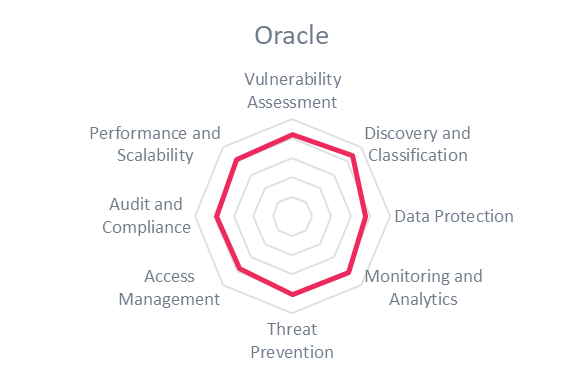
KuppingerCole has recognized Oracle among the distant overall leaders in database security, thanks to the combination of the company’s global market presence, broad range of database security products and services in all eight functional areas covered in the analysis, as well as its impressive financial strength.
Perhaps the only reason that has prevented Oracle from claiming the overall leader title in our last year’s report was its somewhat less than stellar score in the Innovation Leadership rating – at the time, we have recognized other vendor’s contributions higher. Since then, however, the company has more than made up for this shortcoming by announcing the Oracle Autonomous Database – a truly disruptive innovation comparable to the recent developments in other fields of information technology like machine learning or serverless computing.
Oracle Autonomous Data Warehouse Cloud (ADWC) was released in March 2018, and KuppingerCole reviewed the solution soon afterwards, concluding that Oracle Autonomous Database is the world’s first fully automated cloud database platform powered by machine learning. By eliminating human factor from database management, ADWC provides unprecedented security, reliability and performance for enterprise data management in the cloud.
The key findings of the report are summarized below:
- Human error is a major factor in security breaches. By introducing intelligent automation for all aspects of database management, Oracle ADWC not only reduces labor and costs for customers, but completely eliminates the human factor as a threat vector.
- Since ADWC completely eliminates administrative user controls, this dramatically increases its resiliency against malicious insiders, advanced hacking attacks as well as misconfigurations and other honest mistakes.
- Initial provisioning is the only step requiring human interaction: after defining the intended workload type, geographic location and resource policies, everything else is configured automatically according to the best practices in availability, security and performance.
- Since data encryption, access control and auditing are always enabled by default, sensitive data remains secure and compliant throughout its full lifecycle.
- Autonomous database instances support regular patching and upgrades with no downtime, as well as automated backup and disaster recovery functions. For demanding customers, a mission-critical SLA is offered with an impressive 99.995% availability level without any exceptions.
- Thanks to flexibility of the Oracle Exadata database machines running in the Oracle Cloud, ADWC instances support automated performance optimization and elastic resource usage, which ultimately leads to substantial cost reduction compared to traditional database servers.
On the whole, with the Autonomous Data Warehouse Cloud, Oracle has created a unique offering for the most demanding database customers that combines enterprise-grade performance and scalability with the highest level of security and compliance for sensitive corporate data by eliminating human factor and replacing it with industry best practices powered by the company’s decade-long expertise and machine learning.
The breadth of Oracle’s database security portfolio is impressive: with a number of protective and detective products and a number of managed services covering all aspects of database assessment, protection, monitoring and compliance, Oracle Database Security can address the most complex customer requirements, both on premises and in the cloud.
It’s worth noting that some of these products are specifically designed for Oracle Databases, which makes Oracle’s data protection solutions less suitable for companies using other types of databases. Other products, such as auditing, monitoring and test data management solutions, support multiple database types.
Key components of the Database Security suite are:
- Oracle Key Vault for centralized management of encryption keys
- Oracle Audit Vault and Database Firewall for controlling SQL Injection, detecting anomalies, and supporting forensic analysis
- Oracle Database Vault for enforcing trusted path access to data and controlling privileged users
- Oracle Advanced Security for encryption and redaction of sensitive data
- Oracle Data Masking and Subsetting for targeted archiving and static masking of sensitive data for nonproduction purposes
- Oracle Label Security to enable multi-tenant usage of data tables at the data row level
- Oracle Database Security Assessment Tool for configuration analysis and sensitive data discovery

| Ratings | Security |  |
| Functionality | |
|
| Integration | |
|
| Interoperability | |
|
| Usability | |
| Strengths |
|
| Challenges |
|
Oracle Autonomous Database Cloud
The full “Oracle Autonomous Database Cloud” chapterCreate a free account
Related Research
Leadership Compass: Database Security – 70970
Executive View: Oracle Autonomous Database – 70964
Copyright
© 2026 KuppingerCole Analysts AG. All rights reserved. Reproducing or distributing this publication in any form is prohibited without prior written permission. The conclusions, recommendations, and predictions in this document reflect KuppingerCole Analysts' initial views. As we gather more information and conduct deeper analysis, the positions presented here may undergo refinements or significant changes. KuppingerCole Analysts disclaims all warranties regarding the completeness, accuracy, and adequacy of this information. Although KuppingerCole Analysts' research documents may discuss legal issues related to information security and technology, we do not provide legal services or advice, and our publications should not be used as such. KuppingerCole Analysts assumes no liability for errors or inadequacies in the information contained in this document. Any expressed opinion may change without notice. All product and company names are trademarks™ or registered® trademarks of their respective holders. Their use does not imply any affiliation with or endorsement by them.
KuppingerCole Analysts supports IT professionals with exceptional expertise to define IT strategies and make relevant decisions. As a leading analyst firm, KuppingerCole Analysts offers firsthand, vendor-neutral information. Our services enable you to make decisions crucial to your business with confidence and security.
Founded in 2004, KuppingerCole Analysts is a global, independent analyst organization headquartered in Europe. We specialize in providing vendor-neutral advice, expertise, thought leadership, and practical relevance in Cybersecurity, Digital Identity & IAM (Identity and Access Management), Cloud Risk and Security, and Artificial Intelligence, as well as technologies enabling Digital Transformation. We assist companies, corporate users, integrators, and software manufacturers to address both tactical and strategic challenges by making better decisions for their business success. Balancing immediate implementation with long-term viability is central to our philosophy.
For further information, please contact clients@kuppingercole.com.

Table of Contents


Table of contents
Close









