
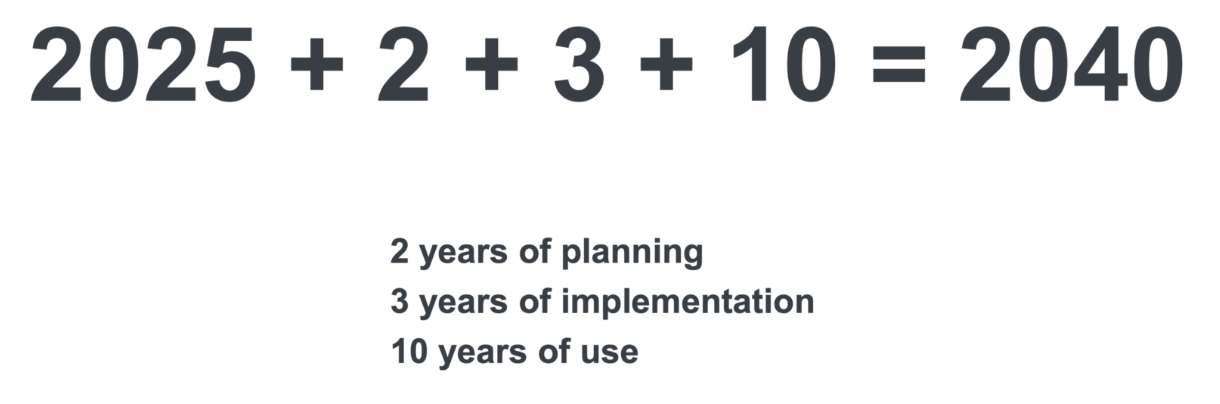
Identity systems implemented in 2025 will remain operational well into the 2030s and beyond. Establishing 2040 as a design horizon is not an exercise in speculation, but a practical planning necessity. Long implementation and lifecycle durations in identity management demand architectural decisions that remain adaptable over time.
Identity Fabric as Infrastructure and Integration
The concept of the Identity Fabric continues to serve as a reference model for delivering identity services across diverse domains. It represents both the infrastructure for producing such services and the mesh that integrates them. As environments become more heterogeneous - supporting humans, devices, AI agents, and service identities - this dual perspective is essential.
Despite observable progress, most implementations remain fragmented. Access management, identity governance, and privileged access management are still operated as siloed toolsets, not to speak of emerging technologies such as NHI (Non-Human Identity Management here). Many deployments rely on custom-built integration layers, creating complexity and limiting scalability. Moving toward orchestrated, API-driven service models is necessary to support dynamic identity environments.
Strategic Trends Reshaping Identity Architectures
Seven trends indicate the direction identity architectures must take to remain sustainable through 2040:
- Policy-Based Access Control (PBAC): Although introduced nearly five decades ago, PBAC remains underutilized. It enables dynamic, context-aware decisions based on attributes and policies and provides a structured alternative to static entitlements.
- Modular Architectures: IAM platforms are increasingly composed of loosely coupled components, often delivered via orchestration layers and reusable connectors. These facilitate rapid onboarding and reduce architectural duplication.
- Orchestration as a Core Capability: Orchestration platforms are essential for separating logic, data, and experience layers. This separation increases flexibility and supports continuous evolution of services without disrupting foundational infrastructure.
- Decentralized Identity (DCI): DCI supports portable, verifiable credentials, reducing reliance on central directories and enabling identity reuse across organizational boundaries. This model offers significant potential in enterprise, consumer, and machine identity use cases.
- Signal Sharing and Enrichment: Standards such as the Continuous Access Evaluation Protocol (CAEP) and the Shared Signals Framework (SSF) support real-time risk and behavior signal exchange, enabling adaptive access decisions.
- Autonomous Identity: AI-driven models are beginning to supplement or replace static policies, particularly in high-volume or rapidly changing contexts. This is relevant in environments involving IoT, OT, or AI-based entities.
- AI Identity: This encompasses both the use of AI in identity systems (e.g., for fraud detection or behavioral authentication) and the lifecycle governance of AI agents themselves as digital service actors.
Authentication Beyond Passwords and Usernames
Identity verification mechanisms must evolve. Passwords - and increasingly usernames - introduce friction without offering sufficient security. Passive authentication based on biometric and contextual signals provides a path forward. This approach strengthens assurance while improving usability. Eliminating not just passwords but moving from active to passive authentication, backed by large amounts of contextual signals, rather than attempting to improve authentication, is the more strategic objective.
Toward Context-Aware, AI-Augmented Access Control
PBAC provides a foundation for dynamic access decisions but is not sufficient for all scenarios. Real-world access decisions often occur in conditions where deterministic rules are too limited. AI can augment policy enforcement by analyzing signals, assigning confidence levels, and adapting to new behaviors. This supports granular decision-making at scale, particularly in environments with fluctuating trust levels. AI can help in moving beyond PBAC, either with AI-generated dynamic policies or AI-based decision-making instead of policy-based decisions.
The Enterprise Value of Decentralized Identity
Decentralized identity has applications beyond public sector use cases. In enterprise IAM, DCI can address the recurring challenge of establishing a single source of truth. By issuing and verifying credentials in real time, organizations reduce the need for synchronization and gain higher data quality. DCI is especially relevant in IGA, federation, and dynamic access control scenarios. DCI also provides an opportunity for getting rid of identity silos in CIAM (Consumer IAM) use cases. With decentralized identity, there is no single silo containing millions of credentials anymore. There are millions of segregated decentralized identities. That massively reduces attack surfaces.
A Conceptual Architecture for the 2040 Identity Fabric
The 2040 Identity Fabric is defined by several characteristics:
- A service mesh of identity capabilities, coordinated through orchestration
- Policy-based and AI-augmented access decisions
- Real-time signal aggregation and exchange to inform risk-aware responses
- Support for a broad spectrum of identity types, including non-human and autonomous entities
- A modular structure allowing flexible deployment and integration across domains
Many elements of this model are already emerging in product strategies and reference architectures. Orchestration has become a key evaluation criterion, and most modern platforms expose modular APIs and components. These are necessary adaptations to manage complexity in increasingly dynamic environments. 
This is not a replacement for existing IAM. Rather, it is a functional expansion - one that repositions identity as a dynamic, composable infrastructure layer capable of adapting to the requirements of hybrid, real-time, and autonomous ecosystems.
Governance as the Constant
As identity architectures shift toward autonomy, modularity, and signal-based decision-making, governance remains essential. Whether applied to AI-driven entitlements, decentralized credentials, or passive authentication flows, strong governance frameworks are required to ensure transparency, accountability, and policy compliance.
The long-term viability of identity systems will depend not only on technical evolution but also on the strength of the governance structures embedded within them.
